
Automatically apply for jobs with Zippia
Upload your resume to get started.
Vocational nursing instructor skills for your resume and career
15 vocational nursing instructor skills for your resume and career
1. Patients
- Educate allergy patients on medications, signs and symptoms of systemic and localized allergic reactions, and immunology administration schedules.
- Prepared medications and gave injections including the observation patients for response and/or reaction after medication ingestion/injection.
2. Direct Patient Care
- Administer direct Patient Care, Administer medication, Acute Check.
- Provided direct patient care and assistance to cognitively impaired adults 60 years and older; including medication administration.
3. Course Objectives
A course objective allows students to know all that a course is about, why it is taught, where it is going, and what is required of them to be successful in the course. It forms the basis of the class and establishes a behavior, skill, or action that a student can demonstrate if they have achieved mastery of the objective. The objectives must be observable, measurable, valid, and also aligned with the expectations of the course.
- instruct students to course objectives and motivate students to actively participate in the learning process; conduct timely student evaluations.
- Created patient assignments that achieved course objectives and promoted the individual growth and competency achievement of students.
4. Vital Signs
Vital signs are a set of values indicating different body systems' performance. They are measurements of the body's most basic functions. The four major vital signs used in medicine to assess a patient are body temperature, pulse rate, respiration rate, and blood pressure.
- Perform injections, vital signs, catheter insertions/care, and documentation.
- Obtained, recorded, and reported vital signs.
5. Clinical Facilities
- Planed for, schedule and develop contracts with clinical facilities for the implementation of the curriculum.
- Act as liaison between clinical facilities, community partners and the college.
6. Clinical Rotations
- Perform in a professional capacity with outside institutions for coordination of clinical rotation sites for senior nursing students and instructors.
- Instructed Associate of Science in Nursing candidates in their first hospital based clinical rotation on a medical/surgical/orthopedic unit.
Choose from 10+ customizable vocational nursing instructor resume templates
Build a professional vocational nursing instructor resume in minutes. Our AI resume writing assistant will guide you through every step of the process, and you can choose from 10+ resume templates to create your vocational nursing instructor resume.7. CPR
Cardiopulmonary resuscitation or CPR is a medical procedure that involves chest compression to help a patient breathe. This artificial ventilation helps in keeping the brain function in place and regulates blood throughout the body. CPR is a lifesaving procedure that is used in emergencies.
- Planned and conducted CPR certification for fundamental level nursing students.
- Conducted CPR instruction for hospital staff requiring certification.
8. Direct Supervision
Direct supervision is a term used to indicate that a person is supervising a certain task or a certain person while being physically present or in close proximity. It refers to the presence of a person and the availability of their supervision in something if it is needed.
- Operated as GVN under the direct supervision of a RN.
- Worked under indirect supervision of Oral Radiologist and assisted in classroom and laboratory setting.
9. NCLEX
- Developed nursing division first proctored online unit and comprehensive test in preparation for the computer-based NCLEX.
- Lead for development of an online pharmacology module for remediation, retention and NCLEX Review for Associate Nursing Degree program.
10. Rehabilitation
- Dedicated and patient-focused: seven years of nursing experience as a Vocational Nurse in rehabilitation and long-term care.
- Work directly with the Physical Medicine and Rehabilitation (PMR) Physician/Medical Director conducting patient assessments.
11. Registered Nursing
- Provided clinical instruction and supervision to Registered Nursing students in various acute care facilities and multiple department specialties.
- Lecture instructor for registered nursing students completing their Leadership (National University), Nursing
12. Blood Pressure
- Obtained blood pressure, temperatures, blood or urine samples if requested by the physician.
13. Syllabus
- Train and supervise LVN students on campus and clinical settings based on institution s course syllabus.
- Composed women's health and OB/GYN portions of the syllabus, lesson and instructional plans.
14. Acute Care
The branch of secondary healthcare which is responsible for giving short-term care to patients recovering from severe injuries or urgent medical problems is known as acute care. Acute care comprises multiple domains like; emergency care, urgent care, short-term stabilization, pre-hospital care, critical care, and trauma care.
- Developed and implemented Physical Diagnosis Skills laboratory for First Year Acute Care Nurse Practitioner students.
- Assisted in developing simulation laboratory for clinical instruction hours in lieu of acute care settings.
15. IV
- Performed IV insertions and removal Checked blood sugar levels Gathered and prepared medications Helped with the CPAP machine Administered insulin injections
- Supervised the management of anti-arrhythmic, antibiotics, and analgesic IV infusions.
5 Vocational Nursing Instructor resume examples
Build a professional vocational nursing instructor resume in minutes. Browse through our resume examples to identify the best way to word your resume. Then choose from 5+ resume templates to create your vocational nursing instructor resume.

What skills help Vocational Nursing Instructors find jobs?
Tell us what job you are looking for, we’ll show you what skills employers want.
What type of skills will young vocational nursing instructors need?
Dr. Rodney Rohde Ph.D.
Professor and Chair, Texas State University
Here are some broad strokes for what new graduates will need in the coming years - 1. Communication skills; 2. Problem-solving and troubleshooting; 3. Use their math and science skills, especially the core foundations of medical laboratory science - hematology, immunohematology (blood bank), clinical chemistry, and microbiology; 4. Professionalism (manage yourself, others, time, and things); 5. Self-starter with the ability to work alone and in groups across healthcare and with the public; 6. Empathy and sympathy for colleagues as well as the patients we serve.
What soft skills should all vocational nursing instructors possess?
Dr. Raquel Engolio
Assistant Professor, Department Head for Nursing, Nicholls State University
List of vocational nursing instructor skills to add to your resume
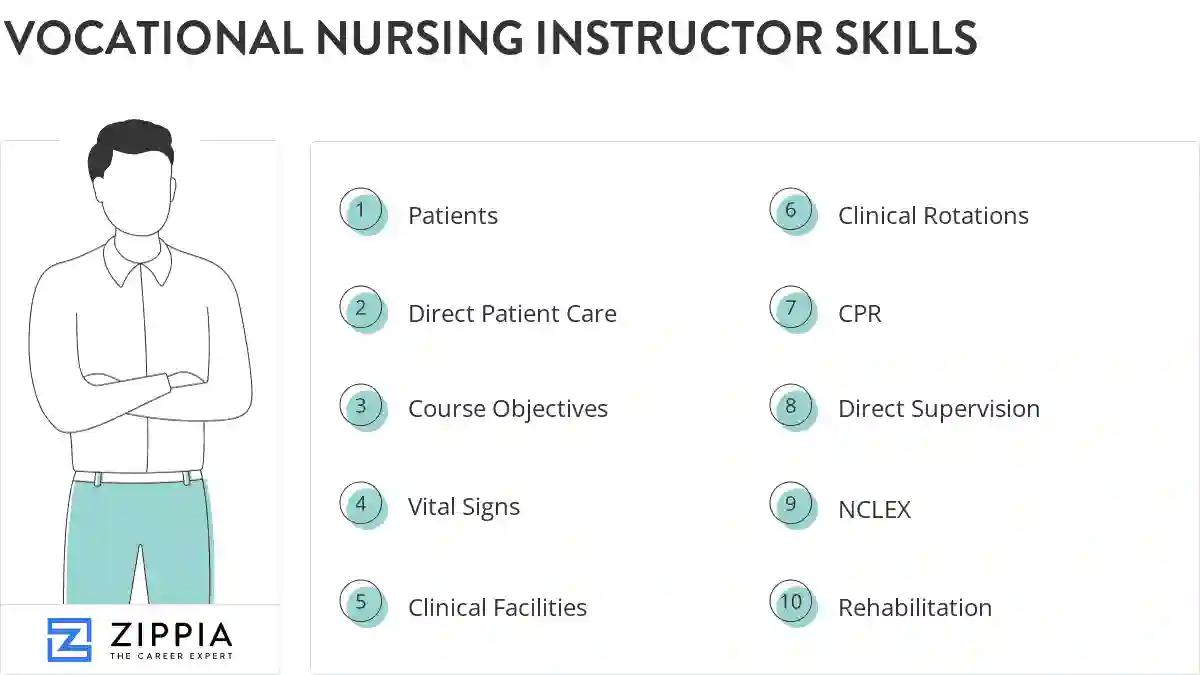
The most important skills for a vocational nursing instructor resume and required skills for a vocational nursing instructor to have include:
- Patients
- Direct Patient Care
- Course Objectives
- Vital Signs
- Clinical Facilities
- Clinical Rotations
- CPR
- Direct Supervision
- NCLEX
- Rehabilitation
- Registered Nursing
- Blood Pressure
- Syllabus
- Acute Care
- IV
- Pediatrics
- Infection Control
- Catheter
- Administer Medications
- Medical Surgical
- Physical Assessments
- Physician Orders
- G-Tube
- Medical-Surgical Nursing
- Curriculum Development
- Tracheostomy
- EKG
- Disease Process
- Clinical Sites
- Patient Care
- ROM
- Patient Teaching
- Medical Terminology
- Physiology
- ADL
- Pharmacology
- Tracheotomy
- Physical Therapy
- Clinical Supervision
Updated January 8, 2025
