
Automatically apply for jobs with Zippia
Upload your resume to get started.
Waste treatment operator skills for your resume and career
15 waste treatment operator skills for your resume and career
1. OSHA
- Promoted to Safety Coordinator responsible for tracking and implementing OSHA procedures.
- Trained in OSHA Electrical generation and management procedures.
2. Water Samples
- Led Safety inspections and delivered water samples for the borough, DER, and EPA.
- Collected various wastewater samples and conducted sample tests.
3. Hazardous Materials
Any substance or good that is harmful to human health as well as the environment are called hazardous materials. Such materials must be handled carefully to avoid any mishaps. Harmful gases. chemicals, strong medicines or drugs, radioactive elements required for radiation purposes, a human blood sample that carries germs, all of these are considered hazardous materials.
- Job responsibilities include, heavy equipment operator for transportation of hazardous materials and job site remediation projects.
- Inspected hazardous materials for proper packaging and labeling; reported deficiencies.
4. Test Water
- Collect and test water and sewage samples, using test equipment and color analysis standards.
- Collect and test water and sewage samples, using test equipment and color analysis standards.
5. Plumbing
- Utilize a variety of piping plumbing equipment, maintain and operate electrical distribution systems and generator distribution stations.
- Service and repair plumbing equipment associated with domestic water pumping systems.
6. Safety Procedures
Safety procedures are a set of standardized procedures, that ensures minimal to no risk to people, resources, and the work environment. A company follows the step-by-step safety procedures as it they not only keep the customers and the employees safe, but also help in avoiding legal claims.
- Ensured equipment lockout and safety procedures were followed by all employees.
- Assisted superintendent with preparation, implementation and updating SOP's, safety procedures and emergency procedures.
Choose from 10+ customizable waste treatment operator resume templates
Build a professional waste treatment operator resume in minutes. Our AI resume writing assistant will guide you through every step of the process, and you can choose from 10+ resume templates to create your waste treatment operator resume.7. Hazardous Chemicals
- Water treatment with hazardous chemicals as well as water testing and tracking data results.
- Scheduled periodic cleaning and refilling of solution tanks including the handling of hazardous chemicals.
8. EPA
The Environmental Protection Agency (EPA) is a US-based organization established to sustain and improve the environmental and human health standards across the United States. EPA was established by US President Richard Nixon by executive order in December 1970. The EPA formulates laws and releases guidelines to promote the health of individuals and the ecosystem.
- Position required license issued by Illinois EPA.
- Assumed supervisory responsibility and signature authority for EPA and State DEP reporting.
9. Water Quality
- Maintain and troubleshoot water quality issues such as PH, copper and turbidity.
- Assisted in maintaining RO/DI water quality.
10. Non-Hazardous Waste
- Perform daily operations of batch treatment and continuous treatment of waste from production operations including processing chromic acid and non-hazardous wastes.
- Managed the handling, discharge, reduction and transportation of haz-mat and non-hazardous wastes and steam generated within the operations facilities.
11. PH Meter
- Performed field-testing of waste streams as necessary for characterization using pH meters and hydrometers.
- Measured acidity and alkalinity of clarifier overflow to determine efficiency of impurity recovery, using pH meter.
12. Test Results
- Monitored the flocculation process, tested samples for chemical pollutants, maintained daily records of chart readings and sample test results.
- Recorded test results using a variety of chemistry-specific software programs.
13. Waste Treatment Plant
- Worked as a waste treatment plant operator/maintainer at the General Motors waste treatment plant in Fort Wayne, Indiana.
- Maintained waste treatment plant at tier 1 automotive plant.
14. Waste Streams
- Processed incoming Hazardous and Non-Hazardous waste streams.
- Placed hazardous waste in to a proper waste stream for disposal.
15. Chemical Additions
- Provided service to production areas in the form of chemical additions, chemical bath changes, filter changes, and housekeeping.
5 Waste Treatment Operator resume examples
Build a professional waste treatment operator resume in minutes. Browse through our resume examples to identify the best way to word your resume. Then choose from 5+ resume templates to create your waste treatment operator resume.

What skills help Waste Treatment Operators find jobs?
Tell us what job you are looking for, we’ll show you what skills employers want.
List of waste treatment operator skills to add to your resume
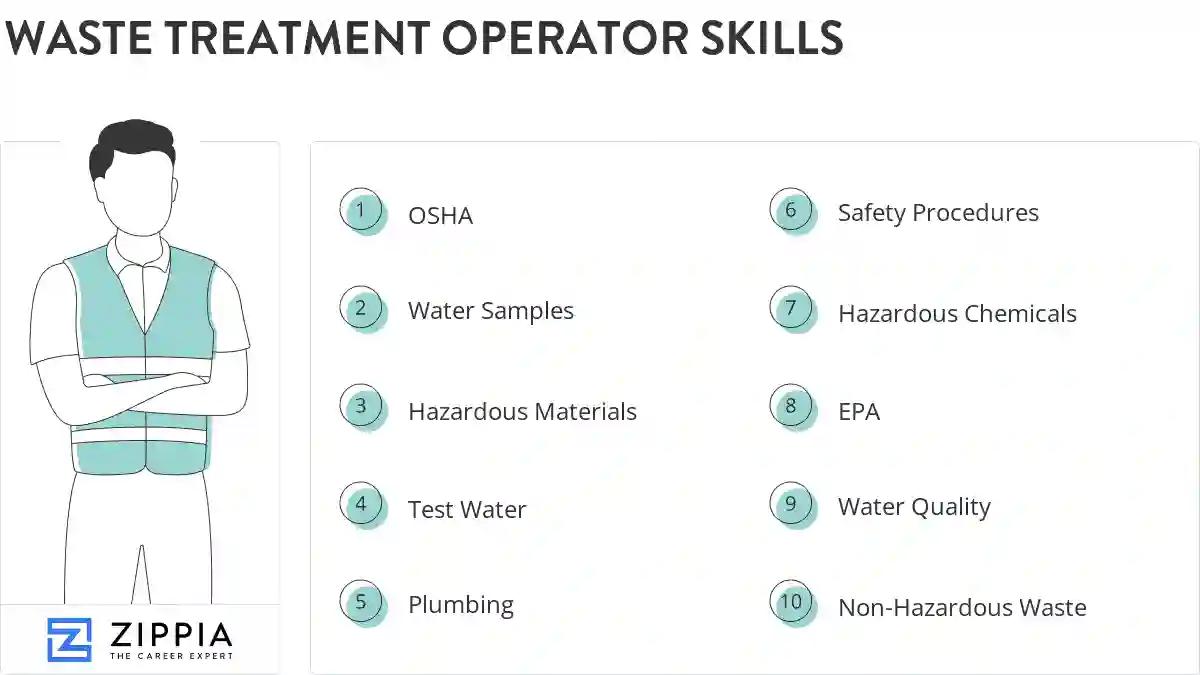
The most important skills for a waste treatment operator resume and required skills for a waste treatment operator to have include:
- OSHA
- Water Samples
- Hazardous Materials
- Test Water
- Plumbing
- Safety Procedures
- Hazardous Chemicals
- EPA
- Water Quality
- Non-Hazardous Waste
- PH Meter
- Test Results
- Waste Treatment Plant
- Waste Streams
- Chemical Additions
- Filter Press
- Clarifiers
- Chemical Waste
- Treatment Process
- Lab Analysis
- General Maintenance
- Plant Equipment
- ORP
- Test Equipment
- Routine Operations
- Chemical Inventory
- Operational Data
- RAN
- Federal Regulations
- Waste Treatment Facility
- HVAC
- PLC
- Control Room
- Centrifuges
- Electric Motors
- Aerators
- Blowers
Updated January 8, 2025
