
Automatically apply for jobs with Zippia
Upload your resume to get started.
Water plant operator skills for your resume and career
15 water plant operator skills for your resume and career
1. Water Treatment Plant
Water treatment refers to the process of improving water quality in a way that it becomes appropriate for a specific use. The uses maybe industrial water supply, irrigation, drinking, water recreation or river flow maintenance. The water treatment process usually removes contamination from an undesirable component, if not completely then at least partially.
- Performed routine operational and general maintenance tasks associated with the operation of water treatment plant equipment and facilities.
- Operated 75 MGD surface water treatment plant and associated distribution system -utilizing state-of-the-art SCADA system.
2. Plant Equipment
The equipment that has a capital nature and can be easily moved from personal property is called plant equipment. Unlike fixed equipment, plant equipment is temporarily added to the structure of a building. These can be appliances, power tools, forklifts, vehicles, etc. Plant equipment plays a vital role in plant maintenance and ensures that the area has minimum breakdowns and the plant is fully functional at the lowest possible cost
- Performed and maintained preventative maintenance on all plant equipment.
- Monitor and maintain plant equipment, pumps, motors and SCADA system, as necessary.
3. Water Samples
- Monitored and regulated controls for local water plant operations, including testing water samples and monitoring water distribution.
- Collected water samples, operated chemical-feeding devices, and performed laboratory tests.
4. Lab Tests
A laboratory test is a practice in which a health care provider uses a sample of urine, blood, and other bodily fluid/tissue to get information about an individual's health. Lab tests lay a solid foundation for the diagnostics, screening, or monitoring specific diseases or conditions. Tests can help determine a treatment plan, access if a designated treatment is working, or monitor the situation of acute diseases.
- Recorded information observed and obtained from computers, lab tests, meters, gauges and other instruments.
- Mixed chemicals and performed lab tests on water for state and federal regulations.
5. SCADA
- Keep records and prepare reports as needed within SCADA, Delta V and Microsoft Office Systems
- Monitored SCADA system with special attention to flow and tank levels and adjusted plant accordingly.
6. Water Quality
- Record water quality and plant operating information on standard reports, capturing significant water quality information for the decision-making process.
- Monitor water quality by performing laboratory tests, observing continuous monitoring equipment and the computer system.
Choose from 10+ customizable water plant operator resume templates
Build a professional water plant operator resume in minutes. Our AI resume writing assistant will guide you through every step of the process, and you can choose from 10+ resume templates to create your water plant operator resume.7. Plant Operations
- Monitor and adjust plant operations based on microscopic analysis and laboratory results.
- Maintained plant operations and water production.
8. Mechanical Equipment
Mechanical equipment is a term referring to the machinery which have been created and gathered for the purpose of fulfilling one or more functions and consisting of, most often, multiple components.
- Apprentice operator Maintenance and repair on a variety of mechanical equipment
- Examine machinery or mechanical equipment; identified reasons for malfunction and complete repairs /maintenance.
9. Process Control
Process control is a method pertaining to continuous production processes that uses the aid of ICS (Industrial Control Systems) for production. This method enables production to be done with a level of consistency and safety in an economically friendly manner that is impossible to achieve solely through manual control.
- Performed process control samples in various labs, coordinated data quality assurance and performed equipment maintenance.
- Interpret computerized information and relate it in decision making of plant operational process control.
10. Chlorine Residual
- Monitored chlorine residuals within the distribution system.
- Monitor system chlorine residuals and ammonia residuals
11. Water Treatment
- Performed laboratory analysis* Collected distribution samples* Maintained water storage levels* Operated and monitored all phases of water treatment
- Communicate any operational issues to the superintendent of water treatment and maintenance department.
12. Minor Maintenance
- Performed minor maintenance on chemical feeders, valves, pumps, and other associated equipment.
- Performed minor maintenance and repairs on plumbing systems.
13. Water Flow
- Monitor and adjust water flow from outside sources.
- Maintained pumps, helped monitor water flow by reading charts, meters and guages.
14. Water Treatment Facility
- Coordinated start up, expansion and operation of water treatment facility for Honda Manufacturing Of Alabama.
- Assist to install water treatment facility and analyze equipment requirements for chemical and biology laboratory.
15. TCEQ
- Completed TEEX water courses to obtain Class D water license issued by TCEQ.
- Prepared daily reports and MOR reports for TCEQ.
5 Water Plant Operator resume examples
Build a professional water plant operator resume in minutes. Browse through our resume examples to identify the best way to word your resume. Then choose from 5+ resume templates to create your water plant operator resume.

What skills help Water Plant Operators find jobs?
Tell us what job you are looking for, we’ll show you what skills employers want.
List of water plant operator skills to add to your resume
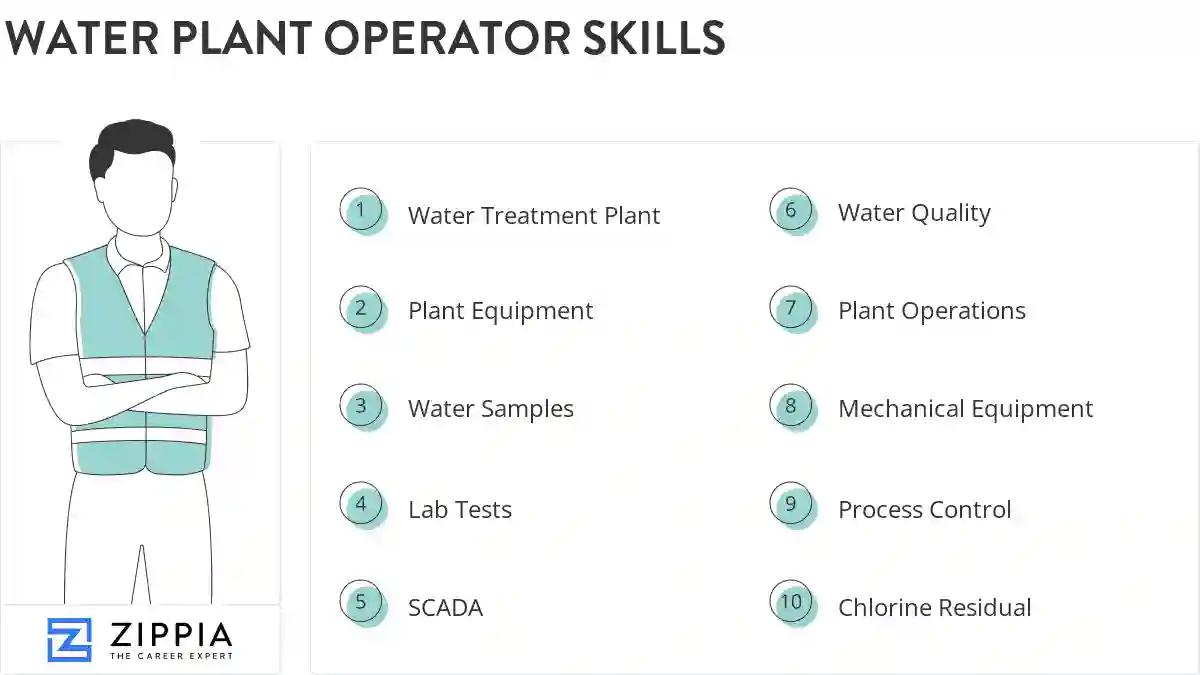
The most important skills for a water plant operator resume and required skills for a water plant operator to have include:
- Water Treatment Plant
- Plant Equipment
- Water Samples
- Lab Tests
- SCADA
- Water Quality
- Plant Operations
- Mechanical Equipment
- Process Control
- Chlorine Residual
- Water Treatment
- Minor Maintenance
- Water Flow
- Water Treatment Facility
- TCEQ
- Plant Processes
- Routine Maintenance
- General Maintenance
- Distribution Systems
- Treatment Plant Systems
- Hazardous Chemicals
- Electric Motors
- Potable Water
- Water Production
- Blowers
- Pump Stations
- Federal Regulations
- Chemical Feeders
- Gauge Readings
- Water Systems
- Control Panels
- Test Results
- Chemical Usage
- Preventative Maintenance
- Mowing
- Water Lines
- Respirators
- Clean Water
- Chemical Analysis
- Lab Analysis
- Storage Tanks
- Odor Control
- UV
- Reverse Osmosis
- Backwash Filters
- Rakes
- Water Meters
Updated January 8, 2025
