
Automatically apply for jobs with Zippia
Upload your resume to get started.
Weather observer skills for your resume and career
15 weather observer skills for your resume and career
1. DOD
Definition of Done (DoD) is a set of deliverables that are needed to devise software. These deliverables are valuable to the system and can be exemplified by writing code, coding comments, unit testing, integration testing, design documents, release notes, and so on.
- Provide customer service to DoD and Allied Force pilots; process weather briefs, in-flight and ATC weather requests.
- Executed detailed daily briefings communicating to senior leadership the tropical cyclone conditions and potential impacts to DoD resources.
2. Federal Aviation Administration
- Certified Weather Observer, National Weather Service / Federal Aviation Administration.
3. Radar
Radar is a system designed for detecting the presence, distance, direction, and speed of objects, by sending out pulses of radio waves that get reflected off the object back to the source. This technology is used by meteorologists, weather department, the marine and armed forces of a country.
- Analyzed satellite and radar imagery, computer generated graphics and charts to forecast atmospheric conditions.
- Integrate weather analyses and reports with radar and satellite imagery interpretations.
4. Air Traffic Control
- Reported weather parameters to various government agencies including Air Traffic Control, National Weather Service and law enforcement.
- Provide tactical meteorological support and safety of flight briefings to Department of Defense aviators, Air Traffic Control and Allied Forces.
5. Data Quality Control
- Provided operational briefing, manually edited automated data, and performed data quality control.
6. Weather Station
- Observed weather phenomena, encoded and recorded the observation following established instructions and guides using computer-based systems in the weather station.
- Monitored part-time contract weather stations in Missouri and
7. Weather Warnings
- Disseminated weather warnings using SR611 Automated Voice Messaging.
- Encoded and disseminated weather warnings and information.
8. Aviation Safety
- Provided real time data for aviation safety and flight operations to the 7th Air wing in Atsugi, Japan.
9. Flight Operations
Flight operations refer to the activities within an airport that entails dispatching, flight planning, flight watch, weather data provision, and facilitating ground-to-air communication. They ensure proper integration of the airport crew, making appropriate schedules, and planning maintenance activities.
- Identify, evaluate, and monitor significant weather developments, especially as they present potential impacts on critical flight operations.
- Supported flight operations by providing forecasts and upper-air analysis of local and regional weather phenomenon.
10. Meteorological Data
- Collected, calculated and analyzed meteorological data for use in weather forecasting while systematically monitoring changing atmospheric conditions.
- Record and analyze visibility, wind speed/direction and other meteorological data.
11. Computer System
- Tested and evaluated computer hardware and software to establish efficiency, reliability, and compatibility with the existing computer systems.
- Maintained various records and documentation for department computer systems.
12. Metar
- Observed, recorded and encoded surface weather in METAR and synoptic WMO coded format on an hourly basis.
- Disseminated METAR observations for 24/7 operations both locally and long-line through various weather sites and equipment.
13. Asos
- Use Automated Surface Observation System (ASOS) to retrieve and disseminate weather data.
- Operate data collection systems through Automated Surface Observation Systems (ASOS).
14. Weather Reports
- Prepared current condition weather reports for the FAA.
- Weather Observer sending coded weather reports hourly to forecasters and planners Briefed decision makers current and future weather and their limiting factors
15. PowerPoint
- Produced up-to-date training seminars in PowerPoint.
- Conducted training for personnel on safety procedures and forecasting procedures using Excel and PowerPoint.

What skills help Weather Observers find jobs?
Tell us what job you are looking for, we’ll show you what skills employers want.
List of weather observer skills to add to your resume
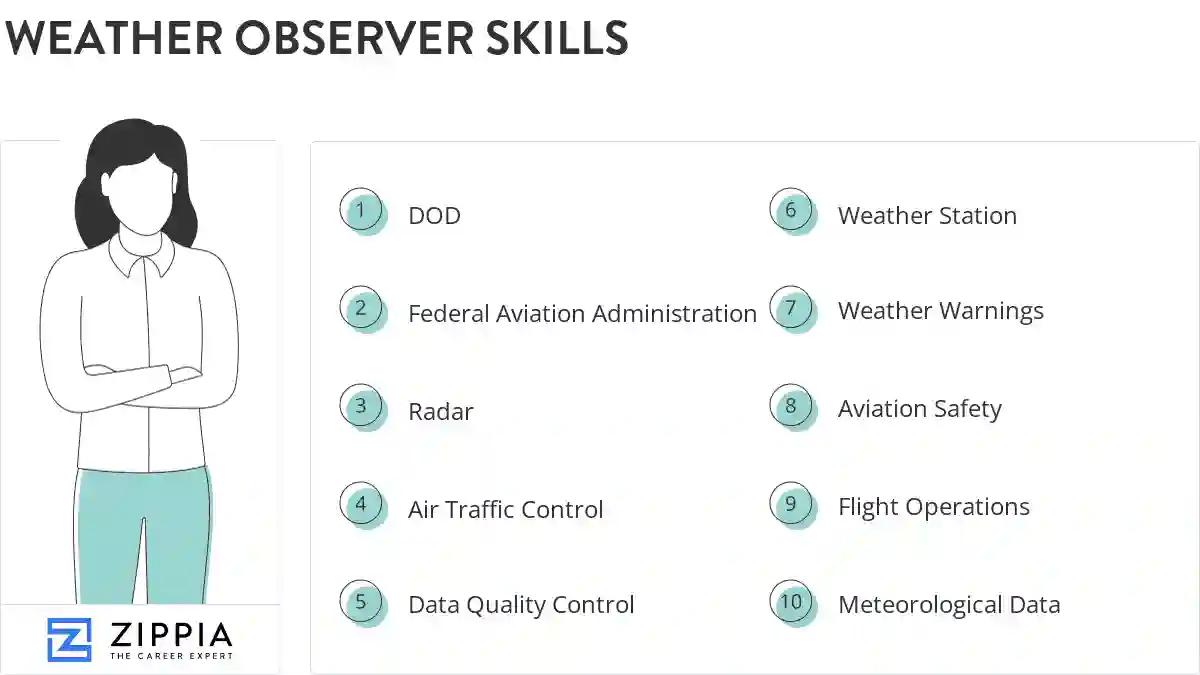
The most important skills for a weather observer resume and required skills for a weather observer to have include:
- DOD
- Federal Aviation Administration
- Radar
- Air Traffic Control
- Data Quality Control
- Weather Station
- Weather Warnings
- Aviation Safety
- Flight Operations
- Meteorological Data
- Computer System
- Metar
- Asos
- Weather Reports
- PowerPoint
- NOAA
- Usable Data
- Operator Maintenance
Updated January 8, 2025
