Explore jobs
Find specific jobs
Explore careers
Explore professions
Best companies
Explore companies
Job outlook for web content managers in the United States
Web content manager job growth summary. After extensive research, interviews, and analysis, Zippia's data science team found that:
The projected web content manager job growth rate is 10% from 2018-2028.
About 33,700 new jobs for web content managers are projected over the next decade.
Web content manager salaries have increased 8% for web content managers in the last 5 years.
There are over 5,775 web content managers currently employed in the United States.
There are 61,192 active web content manager job openings in the US.
The average web content manager salary is $74,186.
Are web content manager jobs in demand?
Web content manager job and salary trends over time
Web content manager jobs over time
Web content manager job growth rate over time
| Year | # of jobs | % of population |
|---|---|---|
| 2021 | 5,775 | 0.00% |
| 2020 | 5,924 | 0.00% |
| 2019 | 6,765 | 0.00% |
| 2018 | 5,550 | 0.00% |
| 2017 | 5,223 | 0.00% |
Average web content manager salary over time
Web content manager salary by year
| Year | Avg. salary | Hourly rate | % Change |
|---|---|---|---|
| 2026 | $74,186 | $35.67 | +3.9% |
| 2025 | $71,410 | $34.33 | +1.9% |
| 2024 | $70,074 | $33.69 | +1.6% |
| 2023 | $68,999 | $33.17 | +0.8% |
| 2022 | $68,451 | $32.91 | +1.9% |
Web content manager jobs by state
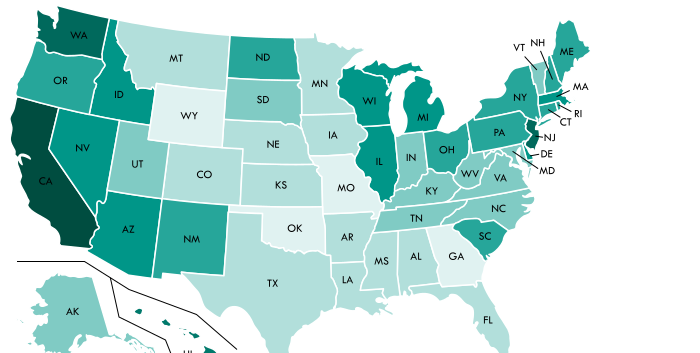
Most common states for web content managers
| Rank | State | Population | # of jobs | Employment/ 1000ppl |
|---|---|---|---|---|
| 1 | District of Columbia | 693,972 | 291 | 42% |
| 2 | Massachusetts | 6,859,819 | 1,086 | 16% |
| 3 | Rhode Island | 1,059,639 | 151 | 14% |
| 4 | Oregon | 4,142,776 | 527 | 13% |
| 5 | Utah | 3,101,833 | 401 | 13% |
| 6 | Vermont | 623,657 | 75 | 12% |
| 7 | Virginia | 8,470,020 | 947 | 11% |
| 8 | Washington | 7,405,743 | 787 | 11% |
| 9 | California | 39,536,653 | 3,909 | 10% |
| 10 | Illinois | 12,802,023 | 1,262 | 10% |
| 11 | New Jersey | 9,005,644 | 877 | 10% |
| 12 | New York | 19,849,399 | 1,747 | 9% |
| 13 | Maryland | 6,052,177 | 548 | 9% |
| 14 | Minnesota | 5,576,606 | 520 | 9% |
| 15 | Pennsylvania | 12,805,537 | 961 | 8% |
| 16 | Colorado | 5,607,154 | 438 | 8% |
| 17 | Connecticut | 3,588,184 | 272 | 8% |
| 18 | New Hampshire | 1,342,795 | 110 | 8% |
| 19 | Montana | 1,050,493 | 81 | 8% |
| 20 | Delaware | 961,939 | 65 | 7% |
Most common cities for web content managers
| Rank | City | # of jobs | Employment/ 1000ppl | Avg. salary |
|---|---|---|---|---|
| 1 | Englewood | 1 | 3% | $62,777 |
| 2 | Doral | 1 | 2% | $64,835 |
| 3 | Fort Collins | 1 | 1% | $63,098 |
| 4 | Knoxville | 1 | 1% | $71,713 |
| 5 | Wilmington | 1 | 1% | $83,173 |
| 6 | Chicago | 3 | 0% | $83,221 |
| 7 | Austin | 1 | 0% | $63,992 |
| 8 | Baltimore | 1 | 0% | $69,790 |
| 9 | Cleveland | 1 | 0% | $77,547 |
| 10 | Des Moines | 1 | 0% | $61,093 |
| 11 | Houston | 1 | 0% | $63,449 |
| 12 | Indianapolis | 1 | 0% | $69,581 |
| 13 | Washington | 1 | 0% | $69,431 |
Web Content Manager job outlook: Expert opinions
Our panel of web content manager experts
Cabrini University
Maryville University of Saint Louis
University of Cincinnati
Huntington University
North Dakota State University
Siena College

University of Kentucky

University of Scranton

University of Houston - Downtown

West Los Angeles College
Berea College

Campbellsville University
Prairie View A&M University

The City College of New York
National Institute for Metalworking Skills (NIMS)

Dragonfly Editorial

Association for Talent Development

University of Oregon
What will help Web Content Managers increase their earning potential?
Rich Johnson: Digital media covers a lot of mediums and requires many skill sets (print, static online, animation, interactive). The print arm is a lesser component although still valuable in the scope of marketing. Smartphones, tablets and gaming have moved a lot of digital into a customer expectation of interactive and customizable content. The present model of career specialization in a certain aspect of this spectrum of skills is changing. The age of the generalist is becoming more of a reality as design tools are becoming more accessible and A.I. is assisting in the more complex tasks. I would say that someone working in digital media will need to focus more on the big picture of design, predicting trends and developing solutions from a point of view with perspective. It will be even more important to understand the needs of a system from the top down and provide solutions that enhance that system. This might be through partnering with marketing and sales to conceptualize solutions, pitching product ideas and other functions related to creative and art direction. And be curious, all of the time. Keep up to date with everything that is happening. Take classes, watch tutorials, read articles and be obsessed with the breakneck rate of change. Digital media is constantly changing and possibilities are always expanding. It can be near impossible to be a master of all of these trajectories, but you can understand them well enough to bring in a specialist when the challenge requires it. This is where I predict that A.I. will be a major paradigm shift. There will be a time when you will ask the system to solve a problem, and you can choose what parts of the process that you want to control. So to boil it down... Develop a well rounded set of skills Further develop specialist level skills where you excel Keep on top of change and keep a thirst for learning Strengthen your connection to problem solving and creative innovation Keep an eye on the future predicting what might be around the bend
Professor Cheryl Pilchik
Marketing at Cabrini U.Cabrini University
Business Administration, Management And Operations
What Web Content Manager skills would you recommend for someone trying to advance their career?
Professor Cheryl Pilchik: Look at all the benefits offered by the company, such as medical, holidays, 401K, etc. Also, consider using the position as a steppingstone in your field to a second job in the near future.
What general advice would you give to a Web Content Manager?
Kara Alaimo PhD: The communication landscape is always changing. The social media platforms that are popular right now may not even exist by the time my students graduate, and of course they're always changing their algorithms and the kinds of content they prioritize, so professional communicators can never get too comfortable in their work. Therefore, one of the most important skills to acquire is how to stay on top of all these changes, keep learning how different platforms work, and come up with creative ideas to use on them.
What Web Content Manager skills would you recommend for someone trying to advance their career?
Kara Alaimo PhD: A lot of my former communication students who are commanding the highest salaries are working in social media management. This is because often senior communication executives who have been working in the field for decades feel like they don't know how TikTok and emerging platforms work and think people who grew up as digital natives hold the secrets of the universe, so they empower them at earlier stages in their careers to run organizations' social channels. It's not uncommon for me to see a former student who manages social media accounts on behalf of an organization get multiple promotions and raises within their first few years of graduation.
What will help Web Content Managers increase their earning potential?
Kara Alaimo PhD: I strongly recommend that students consider jobs managing social media accounts on behalf of people and organizations. There's a lot of demand among employers to hire people for these positions right now, and a lot of my students are thrilled to discover that they can make a good living creating social media content - which many of them consider to be more like fun than work. This is why at Fairleigh Dickinson University we just created new academic programs in social media to give students the skills and credentials to go after these kinds of exciting jobs with significant labor market demand that often have particularly attractive starting salaries.
Dr. Leilani Carver-Madalon Ph.D.
Director of Graduate and Undergraduate Communication and Associate Professor of Strategic Communication and LeadershipMaryville University of Saint Louis
Public Relations, Advertising, And Applied Communication
What general advice would you give to a Web Content Manager?
Dr. Leilani Carver-Madalon Ph.D.: People hire people who they know, like, and are competent. So, how do you become known, liked, and competent? Beyond college, some unexpected ways to a successful career are 1) Internships 2) Informational Interviews, and 3) earning certifications.
Internships: Getting an internship is not a new idea but it is a very important one. Some organizations now only hire people who intern for them first. The internship now becomes a trial before hire. For example, Fleishman Hillard, ranked the fourth best PR agency in the World, offers many full-time Internships, 40 hours a week. Recent grads who want to work for Fleishman Hillard should see getting an Internship as the best avenue towards getting a job at Fleishman Hillard. Many organizations use their internship pools as potential hiring pools so do not be afraid to do a paid internship after graduation for a premier organization.
Informational Interviews: This is a wonderful way for people within an organization to get to know you and for you to learn from others with experience. Informational interviews are short interviews where you connect with someone in our field, research them, and their company and prepare questions to ask for advice. These interviews expand your network and also help you learn. These are a wonder source of networking.
Earn Certifications: Besides going to class and doing well, it is also important to be able to show what you know through certifications. For example, Hubspot has free certifications that you can take and link to your LinkedIn account. One I recommend is their Social Media Marketing Certification at https://academy.hubspot.com/courses/social-media?library=true&= This is yet another way to show your knowledge and expertise in our field. Showing through certifications is always preferable to telling someone you have the skillset.
What Web Content Manager skills would you recommend for someone trying to advance their career?
Dr. Leilani Carver-Madalon Ph.D.: Many of my students get hired to do social media for organizations because organizations need help in this area. Knowing how to create engaging and creative content, produce quality videos, manage and understand data analytics, and respond to crises are some of the most important skills. Additionally, utilizing AI to do more with less will also become more and more important.
What will help Web Content Managers increase their earning potential?
Dr. Leilani Carver-Madalon Ph.D.: The first thing is to do your research so that you know the market and what the salary range is for your job in your city. This article has a list of free salary calculators.
Then, you wait until an offer is made. Once an offer is made you can negotiate (but never before).
Then, you ask politely. The amount is usually around 5- 10% of the salary. I encourage you to ask for 10% because they will likely try to meet you in the middle.
For a script, you could say something like...
Thank you so much for this offer. I am very excited to work at Company X. I know my internship experiences and degree from X University will help me be able to bring value to this organization.
Regarding salary, I was looking for something closer to $_________. Is this possible?
(Then be quiet).
It is beneficial to ask. The worst thing they can say is no. Also realize that you can negotiate vacation days, working from home, a 4-day work week, and other benefits that may be important to you if they cannot offer you more money. Once when I worked for a non-profit, I maxed out their salary but I negotiated another week of paid vacation because I asked. Asking after research and with respect is always a win.
What general advice would you give to a Web Content Manager?
Chris Carter: I would recommend playing up their value as critical analysts and researchers who can synthesize information in accessible ways. I would tell them to be open to all kinds of writing opportunities, whether technical, journalistic, or editorial, watching for possibilities in online and print venues alike. English majors' detective skills suit them well to museums and libraries, but also to private and governmental organizations that need shrewd investigators. Turning interpretive savvy into pithy prose and presentations can be great for public relations, and a penchant for lucid communication can set graduates up for podcasting and social media management. Some people might turn those talents toward careers in law or marketing. Others might continue their paths as creative writers and cultural critics, though it's worth noting that full-time, tenure-track jobs in English Departments are hard to come by.
What Web Content Manager skills would you recommend for someone trying to advance their career?
Chris Carter: With the rise of ChatGPT and large language models, English majors will need to clarify how human writers, editors, and analysts can enrich machine-generated content. They do well to practice prompt engineering and gradual conditioning of machine responses, but they also need to be diligent readers who can spot bad AI syntheses. This means correcting faulty information stemming from data aggregation, for sure, but also spotting cultural biases that machines replicate when drawing on preexisting texts. Those texts carry with them the values and assumptions of the people who initially produced them, with ChatGPT reflecting and potentially amplifying the inequities that plague human cultures. The need for ethical intervention is quite urgent, then, and that's where English majors tend to excel. Such intervention will concern not only the accuracy and political tilt of information, but the question of whose language and style count as standard. Writing technologies have always been bound up with power relations. DEI-oriented humanists and English majors will have plenty of opportunities to address those problems as AI becomes more embedded in workplaces and public institutions.
Brock Zehr
Associate Professor of Business & Economics and MBA DirectorHuntington University
Religion/Religious Studies
What general advice would you give to a Web Content Manager?
Brock Zehr: Social media content development, data analytics, and quality video content generation will all be in greater demand. Employers tell me that the "soft skills" of being a team player, excellent communication skills, integrity, and a strong work ethic are still valued skills.
Ahmad Asady
Assistant Professor of Management Faculty Scholar, Challey Institute for Global Innovation and GrowthNorth Dakota State University
Marketing
What general advice would you give to a Web Content Manager?
Ahmad Asady: The role of a Marketing professional is as rewarding as it is demanding. On one hand, it offers the chance to unleash creativity, see the direct impact of your work, and enjoy a variety of experiences across different projects and industries. On the other hand, it comes with its fair share of challenges, such as the pressure to perform under tight deadlines and budgets, the constant need to stay ahead in a fast-evolving field, and the stress of quantifying the effectiveness of marketing campaigns. Despite these challenges, the role remains appealing for those drawn to a career that demands both strategic thinking and creative innovation, underscored by the powerful tool of persuasion to shape consumer behavior and drive business success.
Soyoung Joo
Assistant Professor of MarketingSiena College
Marketing Department
What skills stand out on Web Content Manager resumes?
Soyoung Joo: Communication and time management skills are valuable skills for marketing managers.
What skills will help Web Content Managers earn the most?
Soyoung Joo: Being able to work well with people from diverse backgrounds can be added to the above skills.
Joshua Abboud Ph.D.
Associate Professor, Director of Bachelor of Liberal StudiesUniversity of Kentucky
Writing, Rhetoric, and Digital Studies
What skills will help Web Content Managers earn the most?
Joshua Abboud Ph.D.: This is a difficult question to answer in terms of writing, and specifically content writing. More than skills, the amount of money you make will be determined by the projects you are offered. And the projects you are offered will be determined by the kind of writing ethos you develop. You have some control over that with your own approaches to the craft of writing: what kinds of hardened soft skills can you acquire and make your own? For example, can you learn how to use Adobe Indesign? You may not use it for every job, but it might come in handy to create something that other writers may not have thought of just using Microsoft Word. This can give you a creative and innovative way to complete a job that helps form your unique style as a writer. How can you use your understanding of Search engine optimization to help you do research in a way that leads you to sources that are little used or even forgotten, perhaps? The more you can demonstrate that unique approach and show it off on social media and even underscore it in your past projects, the more likely you will build a reputation in demand. And you will definitely meet other writers along the way who could help you in the future. Don't underestimate the power of networking, in-person and online.
Abhijit Roy
Professor of MarketingUniversity of Scranton
School of Management
What soft skills should all Web Content Managers possess?
Abhijit Roy: These are very important, yet harder to quantify skills, not only for marketing professionals but for business graduates in general. They include the ability to make sound decisions under pressure, having a high emotional intelligence quotient (EQ) as embodied by having empathy towards coworkers and subordinates, delegating appropriately, mentoring, communicating, time management, maintaining positivity despite setbacks and adapting to unforeseen challenges, being flexible, being persuasive and assertive at appropriate moments, yet being collaborative, seeking feedback, and the ability to negotiate and resolve conflicts when needed, amongst others.
Soft skills are typically more instrumental in enabling candidates to fit into an organization's culture and be strong candidates for promotion. Most marketing jobs involve candidates representing their brand initiatives and building strong client relationships, so interpersonal, and other soft skills are often valued more than hard skills. The strongest case for having excellent soft skills is that they are more easily transferable across various jobs and industries.
Dr. Richard Conde Ph.D.
Assistant ProfessorUniversity of Houston - Downtown
Marilyn Davies College of Business
What soft skills should all Web Content Managers possess?
Dr. Richard Conde Ph.D.: The need for soft skills are consistent through time. With our societal focus on social media, texting, emojis, etc. It appears to me companies are looking for the following:
- Active listening skills
- Willingness to be self-reflective and accept feedback
- Accept different perspectives. The collision of ideas creates knowledge
- Communicate to the listener (at their level). Flex communicators
- Cultural intelligence. Demographics changes will require better understanding of team member's, boss', customer's, etc. cultural context
Will there be an enduring impact of the coronavirus pandemic on Web Content Managers?
Anthony Cuomo: We have changed the ways in which we communicate with each other. Now, more than ever, we know that technology is pervasive and has revolutionized the way we communicate personally and professionally. Virtual interviews, online group meetings and presentations are the new norm. Job seekers who are able to communicate effectively online will have an advantage in our new context. I don't think Zoom meetings or Skype are going away any time soon. So, practicing how to sustain eye contact with a camera, being personable and communicating enthusiasm virtually will set you apart from other applicants.
J. Ian Norris Ph.D.
Professor of Marketing and Fellow, American Council on EducationBerea College
Economics and Business Department
What certifications/licenses/courses can have the biggest impact for Web Content Managers?
J. Ian Norris Ph.D.: Digital marketing skills are essential for any area of marketing. Luckily there are many online certifications available for this purpose. On the research side, Google Analytics offers a certification. It will also be valuable to know the analytics platforms on social media sites such as facebook, Instagram, and TikTok. Conversely, all of these sites also offer training on digital advertising and promotion, such as Google AdWords. Any coursework in digital marketing that provides instruction in Search Engine Marketing (SEM) will also be highly valuable. Finally, digital video and editing skills are also quite valuable, as all kinds of companies and organizations are using the short video format for storytelling and brand advertising.
What will help Web Content Managers increase their earning potential?
J. Ian Norris Ph.D.: No matter what area of marketing you are working in--in fact, no matter what job you are working in at all, statistical literacy is essential. There is so much data out there that data literacy will confer significant competitive advantage to those who can leverage it. This doesn't mean everyone has to be able to do regression modeling, but being able to interpret correlational patterns and draw actionable meaning from it will be a foundational skill. A big bonus would be some basic coding skills. Finally, it is worth mentioning that while most social media marketing still happens on Facebook, it will be essential to know platforms such as Instagram and TikTok for any products or services targeted to younger consumers.
Jeannie Clark
General Manager, WLCU-TV/FM, Assistant Professor of Broadcasting & Director of Broadcast ServicesCampbellsville University
What skills stand out on Web Content Manager resumes?
Jeannie Clark: Experience is the thing that most employers I have worked with are looking for. An applicant that has worked with specific types of equipment and software used in the industry is also more desirable since the learning curve for training is quicker.
Dr Rick Baldwin
Associate Professor of PracticePrairie View A&M University
Management and Marketing Department
What general advice would you give to a Web Content Manager?
Dr Rick Baldwin: To begin their career, I suggest that the graduate pursue their career as an entrepreneur. Based on the career interest, actually develop a business plan to launch this career as a business. I would use this as a platform in beginning the career as entrepreneur, consultant, or as an employee of a marketing organization.
What Web Content Manager skills would you recommend for someone trying to advance their career?
Nancy Tag: Not sure what you mean by this. Do you mean a gap year following undergraduate before applying to grad school? Or taking time off during their program of study? In some ways, the tight job market might make it advisable for unemployed students to consider staying in school or applying for a master's degree earlier than planned. If they can afford it, this is a better use of time for advanced learning, networking, and career support than simply being unemployed or underemployed.
What general advice would you give to a Web Content Manager?
Nancy Tag: Keep learning. Add certificates to your resume. Go to as many industry conferences as you can for advanced learning and networking. Right now, more conferences and panels are online and free than ever before. Watch them - and take notes! As we say in the BIC program: stay curious. The communications industry evolves so rapidly that the ability to absorb and apply new information is critical to being successful and making an impact.
Will there be an enduring impact of the coronavirus pandemic on Web Content Managers?
Montez King: There will definitely be an enduring impact on graduates. As the leader of an organization, I have been challenged with overhauling our products and services to be scalable and sustainable in a coronavirus and post-coronavirus economy. We have had to figure out quickly how we need to pivot in the delivery of our services to operate successfully in a contactless marketplace.
These solutions can be in favor of our future workforce, as this generation is comfortable with using technology. However, contactless environments can also have an extremely negative impact on individuals that rely on a face-to-face work environment and work-place socialization for stability. This is not necessarily realized until one is faced with contactless interaction for extended time. Young graduates must find ways to maintain stability, engage with their colleagues, network with peers, and learn to be productive regardless of their environment, as confidence in face-to-face work environments will take years to fully recover.
What type of skills will young Web Content Managers need?
Montez King: Young graduates must first realize the new economy and distinguish between the old. This is key for recognizing needed skills beyond what counselors or parents may suggest.
The new economy reveals that more than 50 percent of the jobs in the US workforce will require performance validating credentials, something less than a four-year degree but more than a high school diploma. These needed credentials are skill-related rather than typical learning degrees (four-year degrees). This is due to an economy that relies heavily on practical and technical skills to remain or become competitive.
Despite an overwhelming demand for a skilled workforce, young graduates are choosing a path of learning credentials due to pressures from peers, family, and career counselors. The perception in the majority of our communities that a four-year degree holds an upper class distinction pushes our future workforce against the real needs of the new economy. In this new economy, "Cs" get degrees, but they do not necessarily get jobs.
Another existing challenge that must be explored to better understand the true skills needed to enter the workforce is tunnel learning. This is when someone focuses too heavily on a traditional occupation and does not acquire related skills. The new economy has shown that occupations are meshing together. This creates gray lines between occupations. Consequently, young graduates must be able to identify and understand the connectivity between occupations within their industry. Successful companies thrive by having a workforce that operates with seamless connectivity between needed skill sets.
In regard to actual skills needed, young graduates should attain skills (at some level) in technology, regardless of their occupation. This is because technology is or is becoming the cornerstone of everything. See below for technology duties associated with most occupations:
-Writing scripts to add additional functionality to most technology devices that support a business's operations
-Programming devices such as robots, machine tools, etc.
-Programming PLCs
-Networking devices
-Creating visual tools
-Data collection
-Contextualizing data
-Analyzing
-Writing queries
-Reporting
What experience really stands out on Web Content Manager resumes?
Montez King: A resume stands out to an employer when a candidate is able to show that they can create an experience when they do not have actual experience on-the-job. This is when someone reverse engineers a product for better understanding and is able to gain practical experience and clearly explain that on their resume. Young graduates will not likely have enough real world experience, if any, so they need to create their own and highlight it on their resumes. This reveals true potential to their prospective employers.
What type of skills will young Web Content Managers need?
Samantha Enslen: The biggest talent gap I see in my industry (B2B communications) is good writing skills. We can find good copy editors. But it's very difficult to find talented writers who have the brainpower to understand a complex IT, finance, or healthcare solution -- and then explain it clearly and succinctly. And explain it in a way that resonates with a sophisticated B2B customer. In the future, people who can do this will be worth their weight in gold.
Are there any particularly good places in the United States for Web Content Managers to find work opportunities?
Samantha Enslen: I'm not sure that writing and editing skills are limited to geography anymore. For example, all our B2B copywriting and editing work is done remotely. All our staff works remotely, from home offices in 8 different states. And most of our customers work from home, too. Moving forward, I think where editors and writers live will matter less and less.
How do you envision technology impacting Web Content Managers in the next 5 years?
Samantha Enslen: Several technologies are making editing work more efficient. For example, some of our customers work in Google Docs rather than Microsoft Word. Docs have a "track changes" feature similar to Word's; it maintains multiple versions of a document, and it allows multiple people to review a document at the same time. We've also started using Adobe InCopy to proofread designed files, rather than marking up a PDF using Adobe Acrobat sticky notes. InCopy gives editors access to the text portions of a document while locking down the design elements. The increase in efficiency InCopy generates is astounding. Then there are consistency checkers like PerfectIt and Lingofy. They automate a lot of the mundane work involved in editing -- like checking for consistent hyphenation -- so editors can focus on higher-value tasks like increasing clarity and flow. I don't think technology will ever take the place of editors, but we can use it to make our work more efficient and more reliable.
What type of skills will young Web Content Managers need?
Paula Ketter: According to the Association for Talent Development whitepaper, Bridging the Skills Gap: Workforce Development, the biggest current and future workplace skills gaps noted are in communication, critical thinking, and managerial and supervisory skills. Employees also must be able to understand and work with different technologies and have skills in problem solving, critical thinking, interpreting data, and strategically using digital information.
What technology do you think will become more important and prevalent for Web Content Managers in the next 3-5 years?
Paula Ketter: According to ATD's Future of Work: Technology, Predictions, and Preparing the Workforce research report, the adoption of new technologies such as automation, artificial intelligence (AI), and the Internet of Things will affect how employees perform their jobs. Technologies such as these may take over a few tasks employees perform as part of their jobs-and, in some cases, jobs may be replaced entirely.
E-learning's use in organizations is on the rise. It currently makes up between 21 and 40 percent of the median organization's learning portfolio, compared to between 1 and 20 percent five years ago, according to Association for Talent Development research. The COVID-19 pandemic is driving organizations to rethink how they provide learning to their employees.
And with that rise in e-learning comes the increase in use of podcasts, video, simulations, games, and virtual platforms.
Are there any particularly good places in the United States for Web Content Managers to find work opportunities?
Paula Ketter: Given that many organizations are re-evaluating whether employees will return to full-time office work, it is difficult to answer where in the United States graduates would find work in TD. From that lens, developing expertise in delivering virtual or hybrid learning solutions will be a critical component for future success in the field.
How do you envision technology impacting Web Content Managers in the next 5 years?
T. Bettina Cornwell: While everyone "kinda sorta" had an online presence, our experiences have elevated the importance of a meaningful online face. Technology providers, already advancing at a breakneck pace with AR, VR, IoT, AI, and streaming solutions, will up their game. Some people, brands, and companies in marketing were literally left in the dark, and most have learned from their experience. Thus, we can expect both supply-side and demand-side interest and investment in technology.