
Automatically apply for jobs with Zippia
Upload your resume to get started.
Winder operator skills for your resume and career
15 winder operator skills for your resume and career
1. Quality Checks
Quality checks are a component of quality control aimed at ensuring that quality requirements are met. Internally, quality checks provide assurance to managers, and externally, it provides assurance to clients, federal departments, authorities, and certifiers.
- Performed hourly quality checks to ensure production of quality product.
- operate a winder and preform quality checks on parts throughout the work day.
2. Safety Procedures
Safety procedures are a set of standardized procedures, that ensures minimal to no risk to people, resources, and the work environment. A company follows the step-by-step safety procedures as it they not only keep the customers and the employees safe, but also help in avoiding legal claims.
- Trained others in safety procedures, and job requirements.
- Adhered to safety procedures and policies.
3. Safety Rules
Principles or regulations that ensure the protection of people, objects, or the environment are called safety rules. These rules can be governing actions, devices, or procedures that help in minimizing the risks of loss, injury, or damage.
- Operate Crown forklifts, reach trucks, winders and stock pickers* Follow safety rules and regulations
- Followed all safety rules required by OSHA while operating in twelve hour shifts.
4. Extrusion
- Performed specialized production line and quality control duties in a professional production environment specializing in plastic extrusion.
- Operated extrusion equipment keeping all settings in spec for quality production keep production moving using forklifts
5. Production Schedules
The project plan of a film or a documentary that highlights how a production budget will be spent over a given period until its completion is called a production schedule. The scheduling process starts with writing and analyzing the script, which is then broken down to determine and allocate the budget for each scene. The production schedule also includes several elements of the film including; cast actors, special effects, wardrobe, special equipment, stunts, extras, silent bits, production equipment, and many others.
- Monitor the production process and adjust production schedules accordingly.
- Follow production schedule according to customer request.
6. Production Data
Production data is the data stored and used by business owners to conduct business. Production data must be accurate, well documented, and readily available as it is essential to completing day-to-day business tasks and processes.
- Record production data such as numbers and types of bobbins wound.
- Assign employees to equipment Enter production data.
Choose from 10+ customizable winder operator resume templates
Build a professional winder operator resume in minutes. Our AI resume writing assistant will guide you through every step of the process, and you can choose from 10+ resume templates to create your winder operator resume.7. Doff
- Filled bobbins into pockets of machine then doff when package become a full ball of yarn.
- Operated skein winder machine, doff twisted yarn packages, quality control and housekeeping
8. Safety Policies
Safety policies are the rules and codes of conduct developed by an organization to ensure workplace safety.
- Controlled temperature environment with extreme heat exposure, experienced in practicing all safety policies during operation.
- Follow all safety policies and wear proper PPE within the required areas of the Fiber Department.
9. Quality Products
A quality product satisfies the client's intended need and matches the cost the consumer paid for it.
- Operate and perform routine maintenance on manufacturing machinery used for production of quality products.
- Exceeded customer product expectations by maintaining equipment to product quality products.
10. Machine Operators
Machine operators, also known as machinists, refer to workers responsible for various machines with specific functions. Their duties include setting up equipment, loading materials, and operating machinery. The machine operators also monitor and optimize their operations for efficiency.
- Operate machinery used in the production process, or assist machine operators.
- Deliver and set up machine operators with raw materials.
11. Customer Specifications
A Customer Specification is a document that describes the general requirement of an expected service from a contractor. It outlines the key requirements of the customer. Customer specifications should be written in simple and general language so that the contractor clearly understands the expectations of the customer. It is also known as a User Specification.
- Examined completed work to detect defects and verify conformance to customer specifications
- Repacked boxes of nylon in packing line as required meeting quality and customer specifications.
12. Production Reports
- Maintained daily production reports and promptly completed all necessary paperwork.
- Prepared and maintained production reports and personnel records.
13. Product Specifications
A product specification is a document detailing all the requirements and key features of a product that's about to be built. It's mostly called a blueprint because it's the product in its theoretical form which is also the preliminary stage of product design.
- Read work orders and communicate with co-workers in order to determine equipment settings, adjustments, supply and product specifications.
- Followed product specifications, to select materials, determine work methods, and setup machines.
14. Paper Machine
- Supervised paper machine crew and delegated daily product orders.
- Maintained and controlled quality paper production on paper machine.
15. Spindles
- Cleaned and dechoke spindles to maintain machine efficiency to meet production requirements.
- Mounted rolls of base material on machine spindles for automatic feed through machines.
5 Winder Operator resume examples
Build a professional winder operator resume in minutes. Browse through our resume examples to identify the best way to word your resume. Then choose from 5+ resume templates to create your winder operator resume.

What skills help Winder Operators find jobs?
Tell us what job you are looking for, we’ll show you what skills employers want.
List of winder operator skills to add to your resume
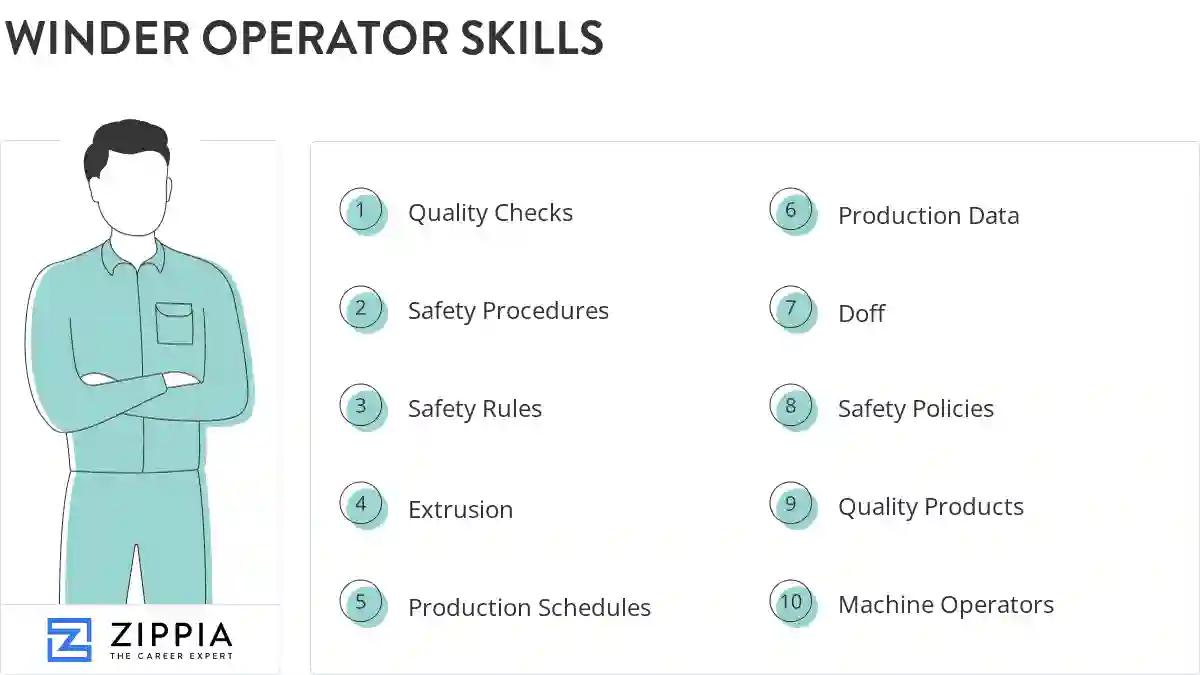
The most important skills for a winder operator resume and required skills for a winder operator to have include:
- Quality Checks
- Safety Procedures
- Safety Rules
- Extrusion
- Production Schedules
- Production Data
- Doff
- Safety Policies
- Quality Products
- Machine Operators
- Customer Specifications
- Production Reports
- Product Specifications
- Paper Machine
- Spindles
- ISO
- Fiber Glass
- Computer System
- Detect Defects
- Clamp Truck
- Electrical Components
- Hoists
- Plastic Film
- Quality Standards
- Electrical Equipment
- Assembly Line
- Machine Adjustments
- Dry End
- Customer Orders
- Brazing
- Safety Standards
- Slitters
- Safety Guidelines
Updated January 8, 2025
