
Automatically apply for jobs with Zippia
Upload your resume to get started.
Workforce staffing advisor skills for your resume and career
15 workforce staffing advisor skills for your resume and career
1. HR
HR stands for human resources and is used to describe the set of people who work for a company or an organization. HR responsibilities revolve around updating employee records and carrying out management processes like planning, recruitment, evaluation, and selection processes. HR is a key contributor to any company or organization's growth as they are in charge of hiring the right employees, processing payrolls, conducting disciplinary actions, etc.
- Worked with executive management and HR business partner to implement division wide employee referral bonus program.
- Partnered across HR for end-to-end client satisfaction in the recruiting process.
2. Troubleshoot
Troubleshooting is the process of analyzing and fixing any kind of problem in a system or a machine. Troubleshooting is the detailed yet quick search in the system for the main source of an issue and solving it.
- Answer telephone to provide desired information or troubleshoot to resolve the problems or complaints of customers and associates.
- Coach, counsel and troubleshoot with associates and customers to resolve problems and complaints.
3. Unemployment Insurance
- Perform essential unemployment insurance activities and services with Workforce members.
- Conducted fact-finding with unemployment insurance claimants to determine eligibility.
4. Community Organizations
Community organizations refers to a form of social or volunteer work that focuses on bettering a community. This may be a community defined by geographic boundaries or by a person's racial or sexual identity. These organizations are often nonprofits that help groups of people affected by natural disasters or hate crimes.
- Assist community organizations, businesses and other agencies with labor market and legal information.
- Provided presentations and training opportunities for clients, community organizations, and employers.
5. Local Employers
- Developed relationships with local employers and secured commitments to hire qualified welfare-to-work participants.
- Provide job developments by contacting local employers to establish employment opportunities for job seekers.
6. Linkedin
- Collaborate with Social Media Outreach Recruiter for effective dissemination of information through LinkedIn, Facebook, and Twitter, etc.
- Conducted Boolean logic searches on LinkedIn and job boards (Clearedjobs.net, Indeed.com, etc.)
7. Employee Engagement
- Consult with Fortune 500 companies on human capital initiaitves such as talent management, employee engagement, and organizational effectiveness.
8. Customer Service
Customer service is the process of offering assistance to all the current and potential customers -- answering questions, fixing problems, and providing excellent service. The main goal of customer service is to build a strong relationship with the customers so that they keep coming back for more business.
- Deliver excellent customer service to participants and employers.
- Provided excellent, prompt, and staff assisted customer service to customers referred to and served by their program.
9. Unemployment Claims
- Provided assistance in determining eligibility benefits for unemployment claims.
- Answer telephone inquiries in a call center environment from claimants and employers regarding unemployment claims.
10. Community Resources
Community resources are a set of resources that are used in the day to day life of people which improves their lifestyle in some way. People, sites or houses, and population assistance can come under the services offered by community resources.
- Researched and retained knowledge of community resources which exist to provide related services.
- Implemented various ideas using labor market information to lead clients toward employment objective utilizing community resources when necessary.
11. Career Fairs
- Travel (10%) to various local, state and national job/career fairs.
- Utilized various sourcing activities to recruit information technology consultants including career fairs, networking events, internet and employee referral programs.
12. State Agencies
State Agencies, also called government agencies, are organizations associated with the government that oversee various aspects of society. These handles often handle administrative paperwork to ensure all laws, rules, and regulations are followed. State agencies include the Tennessee Valley Authority, Washington State Department of Labor, and Texas Health and Human Services Commission.
- Handle inquiries from claimants, employers, and other state agencies regarding the unemployment program.
13. In-Depth Interviews
- Conducted in-depth interviews to determine eligibility for unemployment benefits and liability of employers.
14. Strategic Objectives
- Represent the University and identify business opportunities that will meet UOPX strategic objectives.
15. TANF
- Maintained a working knowledge of TANF and the PA department of Human Services regulations.
- Worked cooperatively with community organizations to provide support and resources to TANF clients.

What skills help Workforce Staffing Advisors find jobs?
Tell us what job you are looking for, we’ll show you what skills employers want.
List of workforce staffing advisor skills to add to your resume
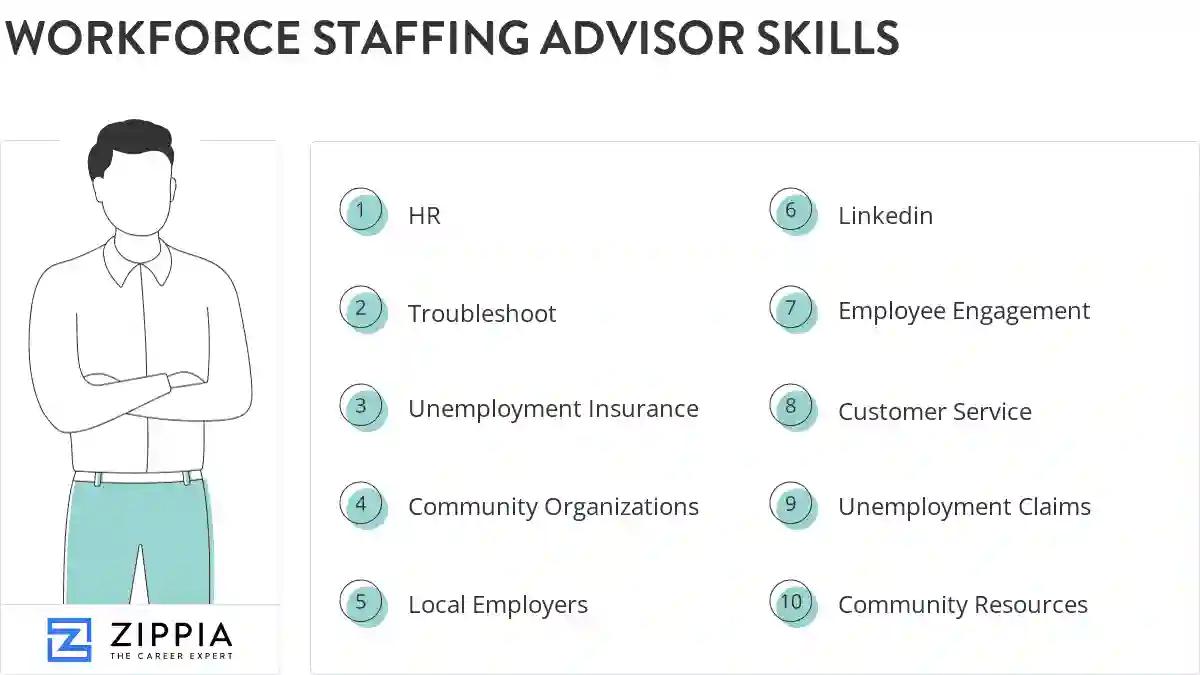
The most important skills for a workforce staffing advisor resume and required skills for a workforce staffing advisor to have include:
- HR
- Troubleshoot
- Unemployment Insurance
- Community Organizations
- Local Employers
- Employee Engagement
- Customer Service
- Unemployment Claims
- Community Resources
- Career Fairs
- State Agencies
- In-Depth Interviews
- Strategic Objectives
- TANF
- Support Services
Updated January 8, 2025
