
Automatically apply for jobs with Zippia
Upload your resume to get started.
Adjunct psychology professor skills for your resume and career
15 adjunct psychology professor skills for your resume and career
1. Semester
A semester is a calendar that divides an academic year into sections of fifteen to eighteen weeks. The time system adopted by schools and countries differ. While the half system divides the academic year into two sessions, the quarter system divides the academic year into four sessions.
- Instructed a 3-hour semester course entitled Introduction to Psychology
- Collaborated with Campus Librarian each semester to teach students principles and research tools to conduct and submit APA Group Research Project.
2. Syllabus
- Developed syllabus and overall course structure and provided classroom instruction.
- Facilitate class Instruction and develop and manage syllabus materials.
3. Developmental Psychology
Developmental psychology is the study concerning the changes and growth of a person throughout their life, usually from infancy to adolescence.
- Facilitate courses in Abnormal, General, and Developmental Psychology.
- course teachings of "Child Psychology" and "Developmental Psychology".
4. Course Content
- Tapped into a Variety of Teaching Methods to Deliver Course Content to Students of Diverse Learning Preferences and Cultural Backgrounds.
- Created, developed, and implemented all course content from the original research using cutting edge research methodologies and practices
6. Research Methods
Research methods are tools, strategies, processes, or techniques that are used to collect and analyze data to discover new information or better understand a topic. Developing a research method is an integral part of research design. There are different types of research methods that use different data collection tools. These can be qualitative, quantitative, or mixed.
- Teach Research Methods and Statistics (II & III) Lab
- Teach Research Methods, Statistics, Social Psychology, Introductory Psychology
Choose from 10+ customizable adjunct psychology professor resume templates
Build a professional adjunct psychology professor resume in minutes. Our AI resume writing assistant will guide you through every step of the process, and you can choose from 10+ resume templates to create your adjunct psychology professor resume.7. Student Learning
- Prepared and utilized lesson plans and implemented evaluation devices for student learning.
- Collaborate with appropriate faculty to oversee student learning activities and progress.
8. Student Performance
- Collaborated with discipline faculty to assess and revise measurable student performance indicators.
- Develop curriculum and assessments to measure student performance and progress.
9. Ethics
Ethics is a branch of knowledge that involves recommending, defending, and systemizing aspects of right and wrong behavior.
- Developed and prepared class syllabus and teaching materials for strategic management, business and government ethics, and organizational behavior classes.
- Teach Freshman Orientation, Human Resource Management, Personal Values and Organizational Ethics and Organizational Communication.
10. Sociology
Sociology is the study of human behavior through societies, groups, and larger developments. Sociology encompasses virtually every aspect of human interaction, from crime to religion to marriage rituals. This study also looks at how humans divide one another, including race, political, and wealth classes.
- Facilitated lectures and discussions in various psychology and sociology classes.
- Teach the assigned psychology and sociology classes in accordance with learning objectives and session plan outlines specified by the College.
11. Course Materials
- Course material focused on cognition, emotions, social behavior, personality, psychological disorders, and psychotherapy.
- Develop teaching strategies and curriculum on term basis in order to organize, prepare, and deliver course materials.
12. Course Syllabus
- Developed course syllabus, curriculum, lecture material and multimedia presentations for an introductory hospitality class offered at a local University.
- Designed and facilitated course syllabus and lesson plans, while regularly evaluating students' progress and maintaining accurate attendance records.
13. Course Objectives
A course objective allows students to know all that a course is about, why it is taught, where it is going, and what is required of them to be successful in the course. It forms the basis of the class and establishes a behavior, skill, or action that a student can demonstrate if they have achieved mastery of the objective. The objectives must be observable, measurable, valid, and also aligned with the expectations of the course.
- Provide quality instruction and meet course objectives.
- Coordinated with students about assignments, exercises and lectures, effectively communicating course objectives and supporting students' academic success.
14. Cognitive Psychology
- Designed and implemented a rigorous curriculum in cognitive psychology for a group of fifteen academically gifted high school students.
- Created curriculum and taught General Psychology, Industrial/Organizational Psychology, Psychological Testing, Cognitive Psychology and Group Processes courses.
15. Mental Health
Mental health is the state of wellbeing in which an individual can cope with the regular stresses and tensions of life, and can work productively without having any emotional or psychological breakdown. Mental health is essential for a person of any age and helps them make the right decisions in their life.
- Provided individual and group therapy to patients hospitalized in state mental health institutions.
- Provided in-services, lectures, presentations and instruction on various social work and mental health topics.
5 Adjunct Psychology Professor resume examples
Build a professional adjunct psychology professor resume in minutes. Browse through our resume examples to identify the best way to word your resume. Then choose from 5+ resume templates to create your adjunct psychology professor resume.

What skills help Adjunct Psychology Professors find jobs?
Tell us what job you are looking for, we’ll show you what skills employers want.
What adjunct psychology professor skills would you recommend for someone trying to advance their career?
Suzanne Kemp Ph.D.
Director of Dance, Associate Professor of College of Fine Arts and Production, University of Nebraska-Lincoln
What type of skills will young adjunct psychology professors need?
Dr. Lori Gray
Associate Professor: Director of Music Education, Boise State University
I would add that graduates need a strong work ethic, an understanding of professionalism and respect in the workplace, and self-awareness and an understanding of personal needs and limitations both at work and in their personal lives. In these current living conditions during a global pandemic (COVID-19), graduates also need resilience, perseverance, adaptability, and flexibility. These are all skills I would want for our Music Education majors to cultivate, as the climate in K-12 Education is ever-changing. However, I believe these are all skills that would be useful in any new career path.
List of adjunct psychology professor skills to add to your resume
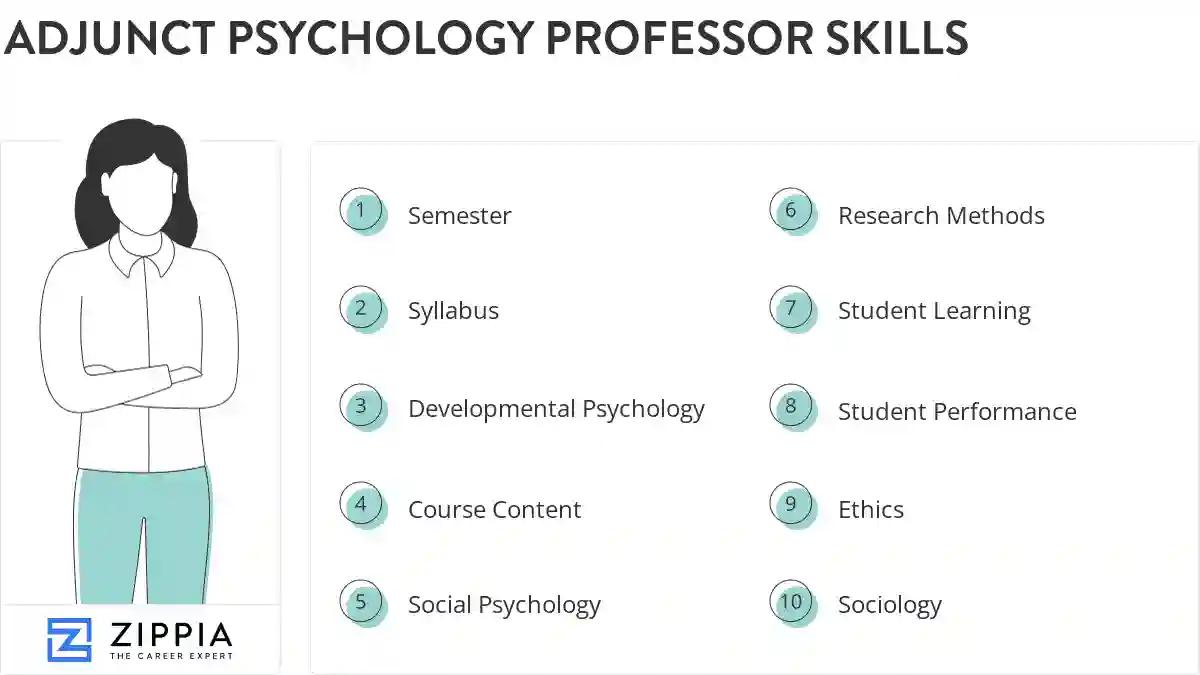
The most important skills for an adjunct psychology professor resume and required skills for an adjunct psychology professor to have include:
- Semester
- Syllabus
- Developmental Psychology
- Course Content
- Social Psychology
- Research Methods
- Student Learning
- Student Performance
- Ethics
- Sociology
- Course Materials
- Course Syllabus
- Course Objectives
- Cognitive Psychology
- Mental Health
- General Psychology
- Abnormal Psychology
- Learning Environment
- Discussion Boards
- Human Development
- PSY
- Child Psychology
- Instructional Materials
- Teaching Methodologies
- Educational Psychology
- PowerPoint
- Learning Objectives
- Course Outlines
- Courses Taught
- Lifespan Development
- Course Curriculum
- Moodle
- Research Projects
- Undergraduate Psychology Courses
- Curriculum Development
- APA
- Human Growth
- Psychopharmacology
- Current Literature
- Cognitive Processes
- Class Material
Updated January 8, 2025

5. Social Psychology