Find a Job You Really Want In
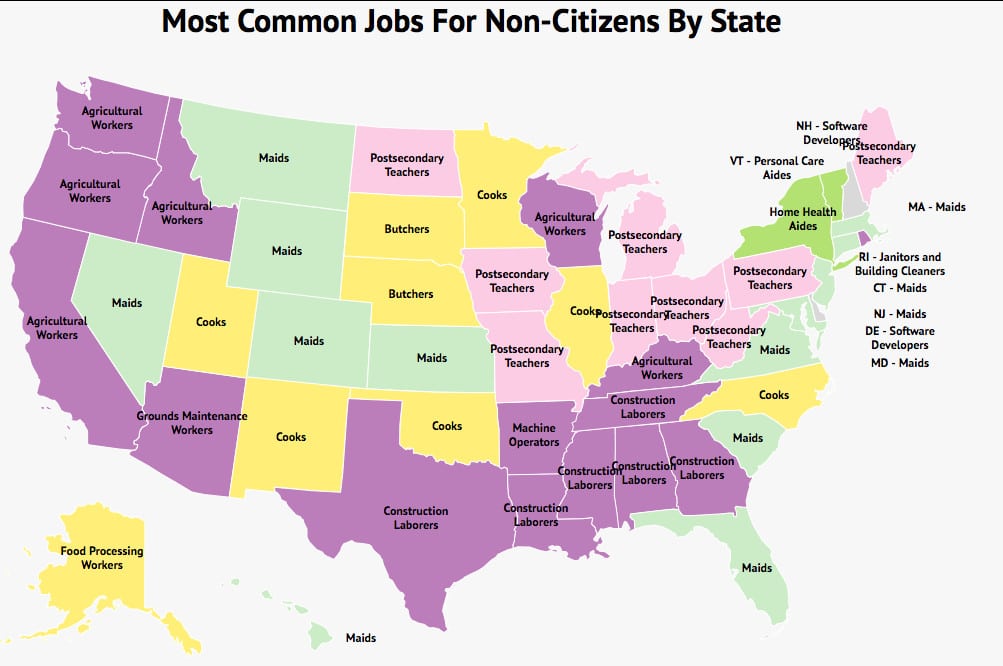
As of 2026, the U.S. Census Bureau continues to provide valuable insights into the demographics of non-citizen residents through its annual American Community Survey (ACS). This survey includes data on the educational and professional contributions of non-citizens, particularly in the realm of academia. Given our focus on job trends and career paths, we delved into the employment statistics of non-citizens in the educational sector.
While non-citizens are commonly associated with service and agricultural roles, a notable trend has emerged in recent years: a significant number of non-citizen professionals are occupying positions as postsecondary educators, particularly in the Midwest.
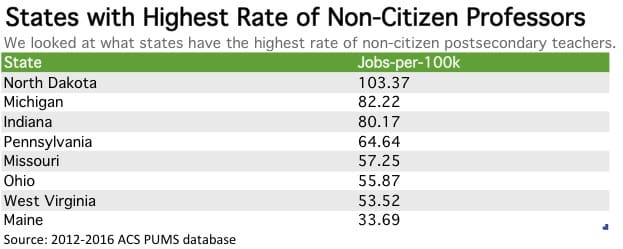
The following states have reported postsecondary school teachers as the most prevalent job for non-citizens, measured by the rate per 100,000 population.
The jobs-per-100k metric is crucial for this analysis. For instance, in North Dakota, there are 103 non-citizen postsecondary school teachers for every 100,000 residents.
Summary of Findings
- North Dakota leads the nation in the concentration of non-citizen postsecondary teachers, boasting a rate of 103.37 jobs per 100,000 residents.
- From 2007 to 2021, the United States Citizenship and Immigration Services (USCIS) approved over 2.6 million H-1B visa petitions, with colleges, universities, and professional schools filing 229,053 of these petitions.
- Currently, there are nearly 190,000 non-citizen college professors in the U.S., with individuals of Chinese ancestry representing 22.31% and those of Asian Indian ancestry accounting for 12.03% of the total.
Methodology
Using the latest American Community Survey data, we analyzed the most common job titles held by non-citizens across different states, identifying postsecondary teaching as a prominent occupation among foreign-born residents.
North Dakota
According to the 2021 ACS, North Dakota’s foreign-born population is approaching 25,000. Notably, 28.6% of the over 9,000 non-citizens over the age of 16 are employed in the educational services sector, the highest proportion among all job sectors.
In 2021, 15.6% of foreign-born non-U.S. citizens in North Dakota held a graduate or professional degree, compared to only 7.3% of the native North Dakota population.
Michigan
In Michigan, 20% of the foreign-born population aged 25 and older held a graduate degree in 2021, significantly higher than the 10% of the native population with the same level of education. Additionally, there were 8,181 participants in the J-1 Visa program in Michigan, with professors and research scholars constituting 23% of the program participants.
Indiana
In Indiana, foreign-born residents are 74.5% more likely to possess a graduate degree compared to their native counterparts. Furthermore, in 2021, 15% of working-age (25 and older) foreign-born individuals held a graduate degree, compared to just 9% of the native population.
Additional Insights
Similar to native-born individuals, the income of foreign-born citizens increases with educational attainment. In 2021, foreign-born individuals with some college education or an associate degree earned a median weekly income of $699, while those with a bachelor’s degree or higher made $1,259.
As of 2021, nearly 954,000 foreign-born individuals were employed in education, training, or library occupations across the United States.

Author

McLeod Brown is a former writer and researcher for the Zippia Career Advice blog. His work at Zippia focused on understanding the relationship between colleges, debt, and jobs. A graduate of the University of North Carolina at Wilmington with a BA in Business Administrator, he is now pursuing a masters of science in analytics from the Institute of Advanced Analytics.