- Income Statistics
- Average PTO Days
- What Percentage of Americans Live Paycheck to Paycheck?
- Average American Income
- Millionaire Statistics
- Average Salary out of College
- Average Bonus Statistics
- Minimum Wage Statistics
- Union Benefits Statistics
- Savings Statistics
- Average Annual Raise
- Income Inequality Statistics
- How Many People Make Over 100k?
- Average 401(k) Sstatistics
- Average Net Worth Statistics
- $100k After-Tax Income By State
- Average Global Income
33 Incredible Millionaire Statistics [2026]: 8.8% Of US Adults Are Millionaires
Research Summary. There are more millionaires in the U.S. than you might realize, and you may know a few personally. Here are some enlightening statistics about millionaires:
-
Approximately 22 million millionaires reside in the U.S.
-
8.8% of U.S. adults are millionaires.
-
33% of U.S. millionaires are women.
-
76% of millionaires in the U.S. are white, while white individuals represent 60% of the total U.S. population.
-
Globally, there are about 62.5 million millionaires, marking an 11.4% increase since 2020.
For further insights, we have categorized the data in various ways:
Age | Gender | Industry | Location | Trends and Projections

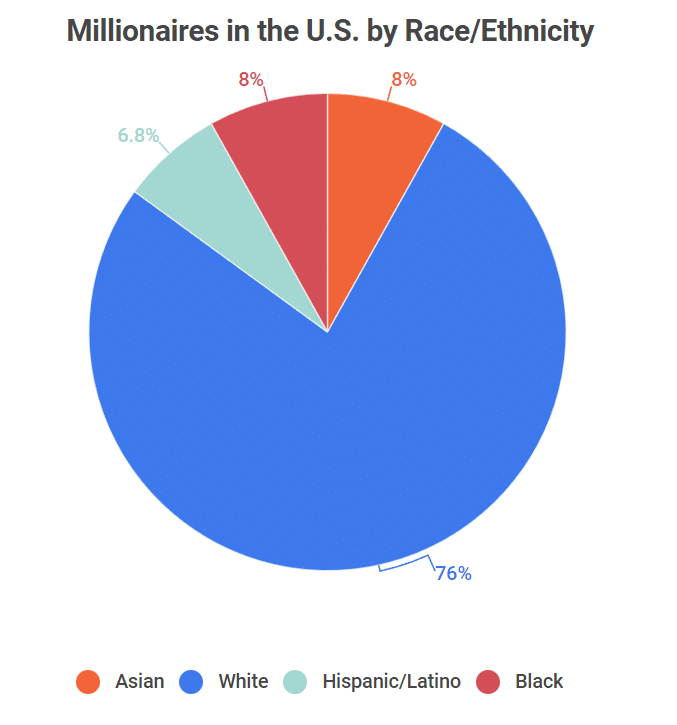
Millionaires by Race and Ethnicity
-
76% of millionaires in the U.S. are White. White, non-Hispanic individuals constitute about 60% of the U.S. population.
-
8% of millionaires in the U.S. are Black. Black individuals represent approximately 14% of the U.S. population.
-
8% of millionaires in the U.S. identify as Asian. Asians account for 6% of the U.S. population.
-
7% of millionaires in the U.S. identify as Hispanic or Latino. Hispanic and Latino individuals make up around 19% of the U.S. population.
-
Asian individuals who are middle-aged and college-educated have the highest likelihood of becoming millionaires in the U.S.
It’s estimated that 22.3% of Asian individuals with bachelor’s degrees are or will become millionaires, which is notable given that the Asian demographic comprises about 6% of the U.S. population.
-
Approximately 21.5% of middle-aged, college-educated white individuals are or will become millionaires.
This ranks as the second-highest among racial demographics, with white individuals (not Hispanic or Latino) making up approximately 60% of the U.S. population.
-
About 6.8% of middle-aged, college-educated Hispanic or Latino individuals are estimated to become millionaires.
This demographic represents approximately 19% of the U.S. population.
-
Approximately 6.4% of middle-aged, college-educated Black individuals are estimated to be or become millionaires.
Black or African American individuals constitute about 14% of the U.S. population.
Millionaire Statistics by Age
-
The world’s 100 richest individuals earned their first $1 million at an average age of 37.
-
The average millionaire is 57 years old.
-
As of 2023, 42% of millionaires are baby boomers (ages 58 to 76), the largest age group.
-
As of 2023, 19% of millionaires are millennials (ages 19 to 34).
Millionaire Education Statistics
-
88% of surveyed millionaires graduated from college.
In comparison, only 33% of the general U.S. adult population has completed college.
-
62% of surveyed millionaires graduated from public or state universities.
Only 8% reported attending “prestigious” private institutions.
-
52% of surveyed millionaires earned a master’s degree or higher.
This significantly exceeds the 12% of the general U.S. adult population that has achieved advanced degrees.
Millionaire Statistics by Gender
-
33%, or one-third, of the U.S.’s millionaires are women.
-
Women comprise approximately 20% of Fidelity 401(k) account holders who have at least $1 million saved.
-
The average age for women to have $1 million set aside for retirement is 58.5.
-
The average age for men to have $1 million saved for retirement is 59.3.
Millionaire Statistics by Industry
-
Only 15% of surveyed millionaires hold senior leadership positions.
These roles include C-suite executives (like CEOs and CFOs) and vice presidents. Additionally, one-third of these millionaires have never earned six figures, and less than one-third reported an average career income of $100,000.
-
The five most common careers among millionaires, according to surveys, include engineering, accounting (CPA), and law.
Managers and educators also rank prominently within this demographic.
-
The finance and investments sector yields the highest number of millionaires.
This industry is home to 371 billionaires, along with a notable number of millionaires.
The top five sectors generating millionaires are:
-
Finance and Investments
-
Technology
-
Manufacturing
-
Fashion and Retail
-
Healthcare
The food and beverage and real estate sectors follow as the sixth and seventh highest contributors, respectively.
-
Location Statistics of Millionaires
-
There are 21,951,000 millionaires in the U.S.
This represents 39.1% of the global total of millionaires.
-
New Jersey boasts the highest percentage of millionaire households in any state.
The five states with the highest ratios of millionaire households per capita are:
-
New Jersey: 9.76%
-
Maryland: 9.72%
-
Connecticut: 9.44%
-
Massachusetts: 9.38%
-
Hawaii: 9.2%
-
-
The U.S., China, Japan, Germany, and the United Kingdom are the five countries with the largest number of millionaires.
Here’s the breakdown:
-
U.S.: 21.951 million
-
China: 5.28 million
-
Japan: 3.66 million
-
Germany: 2.95 million
-
United Kingdom: 2.49 million
France follows closely with 2.47 million individuals valued at $1 million or more.
-
-
Globally, there are approximately 56.1 million millionaires.
This indicates a 5.2 million increase from the 50.9 million millionaires recorded in 2019.
-
Millionaires collectively control nearly 46% of the world’s wealth.
Their total worth is about $191.6 trillion, representing 45.8% of the world’s total wealth.
Millionaire Trends and Projections
-
In 2020, the U.S. saw an influx of 1.7 million new millionaires.
This figure represents one-third of the total global count of new millionaires in that year.
-
From 2016 to 2020, an estimated average of 1,700 individuals became millionaires daily.
This was in addition to the 2.4 million new millionaires added to the U.S. total from 2010 to 2015.
-
79% of surveyed millionaires did not inherit their wealth.
This indicates that they built their fortunes independently rather than relying on wealthy relatives. Furthermore, 80% of these millionaires grew up in families with incomes at or below the middle-income level, while just 2% came from high-income families.
-
By 2025, the global count of millionaires is projected to reach 84 million.
This signifies an increase of nearly 50%. The number of ultra-high net worth individuals (those with at least $30 million) is anticipated to grow by about 60% during the same period.
-
From 2000 to 2020, the collective wealth of millionaires worldwide has nearly quadrupled.
In 2000, their net worth was $41.5 trillion, and by 2020, it had surged to $191.6 trillion. Over this 20-year span, the share of global wealth held by millionaires increased from 35% to 46%.
Millionaire FAQ
-
How many millionaires are there in the U.S.?
There are 21,951,000 millionaires in the U.S. This accounts for 39.1% of the world’s total of 56.1 million millionaires.
-
Is a millionaire in the top 1% of wealth in the U.S.?
No, a millionaire isn’t in the top 1% of wealth in the U.S. To qualify for the top 1%, your net worth must exceed $11 million. To be in the top 10%, you need a net worth of $1.22 million, indicating that most millionaires fall within this range rather than the top 1%.
-
What percentage of the world’s adult population are millionaires?
1.1% of the world’s adult population are millionaires. This translates to about 56 million individuals. Collectively, this group holds approximately $191.6 trillion, controlling around 46% of global wealth.
-
Which profession has the most millionaires?
The finance and investment sector has the highest number of millionaires. Additionally, it also accounts for the majority of billionaires: 371, to be exact. While not everyone in finance and investment will become a millionaire, this industry offers the greatest potential for wealth accumulation.
-
How old is the average millionaire?
The average millionaire is 57 years old. This age reflects the time required for prudent financial choices, diligent work, and wise investments to yield significant returns, typically around the ages of 50 or 60.
Conclusion
As of 2026, the 56 million millionaires worldwide represent just 1.1% of the global adult population while controlling 46% of the planet’s wealth. In the U.S., nearly 22 million millionaires account for 8.8% of the adult population and over 39% of the world’s millionaires.
While many millionaires are found in finance, engineering, accounting, and law, numerous others thrive in education or management roles, which may come as a surprise. The industries most responsible for creating millionaires (and billionaires) in the U.S. are finance and investments, technology, manufacturing, fashion and retail, and healthcare.
Approximately 33% of the nation’s millionaires are women, with the average millionaire being 57 years old. Notably, Asian and white individuals currently have the highest likelihood of achieving millionaire status. However, nearly everyone can enhance their chances by pursuing higher education, as 88% of existing millionaires hold college degrees, and 52% possess advanced degrees.
Common misconceptions suggest that wealth comes solely from family fortune or prestigious private education. In reality, 79% of surveyed millionaires have not received inheritances, and only 8% attended elite private universities, with 62% graduating from public or state institutions.
References
-
Financial Samurai. “Your Chances of Becoming a Millionaire by Race, Age, and Education.” Accessed on December 22, 2021.
-
United States Census Bureau. “QuickFacts: United States.” Accessed on December 22, 2021.
-
Betway Insider. “From Millionaire to Billionaire: Forbes Rich List Journeys.” Accessed on December 22, 2021.
-
Rutgers. “Become a Millionaire One Small Step at a Time.” Accessed on December 22, 2021.
-
Statista. “Distribution of U.S. Millionaires by Generation, as of 2013.” Accessed on December 22, 2021.
-
Ramsey. “The National Study of Millionaires.” Accessed on December 22, 2021.
-
CNBC. “How Many Women Millionaires? Depends on the Study.” Accessed on December 22, 2021.
-
Business Insider. “This is the Age When Most People Become Millionaires.” Accessed on December 22, 2021.
-
Forbes. “How Billionaires Got So Rich in 2021.” Accessed on December 22, 2021.
-
Credit Suisse. “The Global Wealth Report 2021.” Accessed on December 22, 2021.
-
Statista. “American States with Highest Ratio of Millionaire Households Per Capita in 2020.” Accessed on December 22, 2021.
-
Fortune. “1,700 People in America Are Becoming Millionaires Every Day.” Accessed on December 22, 2021.
-
The Guardian. “World Gained 5.2m Millionaires Last Year in COVID Crisis – Report.” Accessed on December 22, 2021.
-
Financial Gym. “Who Is in the ‘Top 1% and 10%’?” Accessed on December 22, 2021.
-
Forbes. “Millionaire Status Is On The Rise With 5.2 Million People Joining The Club.” Accessed on December 22, 2021.
- Income Statistics
- Average PTO Days
- What Percentage of Americans Live Paycheck to Paycheck?
- Average American Income
- Millionaire Statistics
- Average Salary out of College
- Average Bonus Statistics
- Minimum Wage Statistics
- Union Benefits Statistics
- Savings Statistics
- Average Annual Raise
- Income Inequality Statistics
- How Many People Make Over 100k?
- Average 401(k) Sstatistics
- Average Net Worth Statistics
- $100k After-Tax Income By State
- Average Global Income

Author

Abby is a writer who is passionate about the power of story. Whether it’s communicating complicated topics in a clear way or helping readers connect with another person or place from the comfort of their couch. Abby attended Oral Roberts University in Tulsa, Oklahoma, where she earned a degree in writing with concentrations in journalism and business.