- Facts and Figures
- Social Security Statistics
- Social Media Statistics
- Cell Phone Usage Statistics
- Cryptocurrency Statistics
- White Collar Crime Statistics
- Crowdfunding Statistics
- Branding Statistics
- How Many Emails Are Sent Per Day
- Money Laundering Statistics
- Childcare Availability Statistics
- Cold Calling Statistics
- Automation And Job Loss Statistics
- Student Loan Statistics
- Spam Statistics
- Password Statistics
- Ransomware Statistics
- Christmas Spending Statistics
- Average Grocery Cost By State
- Average Screen Time Statistics
- Average Monthly Expenses
- IoT Statistics
- Gen Z Statistics
Research Summary. In our hyper-connected world, spam—whether in the form of emails, calls, or texts—remains a persistent annoyance. As we strive to manage our digital lives, the influx of unsolicited messages can feel overwhelming, often interrupting our daily routines and productivity.
Despite advancements in technology and spam filters, the battle against unwanted communications continues. To shed light on the current landscape of spam, we’ve compiled key statistics and insights. Our research reveals:
-
Approximately 45% of all emails are classified as spam.
-
Daily, an estimated 145 billion spam emails are sent globally.
-
Advertisements make up 36% of all spam emails.
-
46% of Americans report receiving spam calls on their mobile phones.
General Spam Statistics
Spam is a daily disruption for individuals and businesses across the globe. Here are some noteworthy statistics that illustrate its widespread impact:
-
Spam costs businesses an estimated $70 billion annually.
This significant loss arises from decreased productivity, with email spam alone costing an estimated $20.5 billion each year.
-
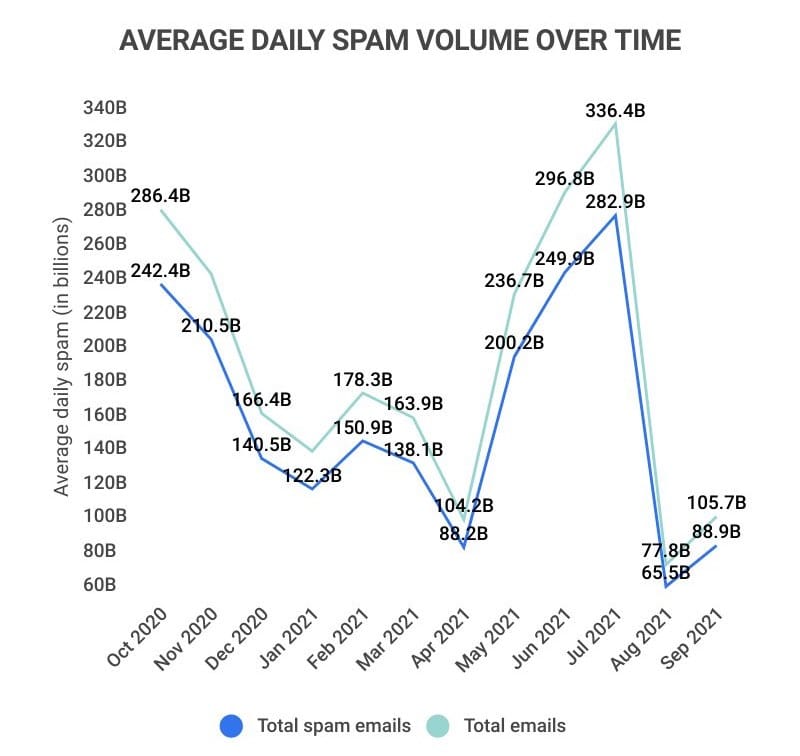
Between July 2021 and August 2021, there was a dramatic 76.8% decrease in the global daily volume of spam emails.
After peaking at 282.93 billion in July 2021, spam email volume dropped to 65.5 billion by August. However, by September 2021, the daily volume began to rise again, reaching 88.88 billion.
Month Daily volume of spam emails (in billions) Percent increase / decrease in spam emails Oct 2020 242.42B N/A Nov 2020 210.54B -13.15% Dec 2020 140.56B -33.24% Jan 2021 122.33B -12.97% Feb 2021 150.93B 23.38% Mar 2021 138.09B -8.51% Apr 2021 88.21B -36.12% May 2021 200.24B 127.00% Jun 2021 249.95B 24.82% Jul 2021 282.93B 13.20% Aug 2021 65.50B -76.85% Sep 2021 88.88B 35.69% -
The US remains the largest source of spam, accounting for 25.35% of global spam.
In addition to the US, other significant contributors include the Russian Federation (19.84%), Germany (7.36%), the Netherlands (4.53%), and France (4.00%). Together, the US and Russia are responsible for nearly half of all spam.
Country Traffic (Jan 2022 – Nov 2022) Share of spam United States 109.14M 25.35% Russian Federation 85.40M 19.84% Germany 31.70M 7.36% Netherlands 19.51M 4.53% France 17.20M 4.00% Canada 17.11M 3.97% China 16.47M 3.83% United Kingdom 11.69M 2.72% Singapore 8.38M 1.95% Ukraine 6.52M 1.52%
Scam Statistics
While some spam is merely unwanted advertising, other messages can have malicious intent. Scammers frequently use spam as a method to deceive unsuspecting victims. Here are the key facts:
-
The FTC reported that consumers lost $5.8 billion to fraud in 2021.
Email fraud and identity theft are particularly prevalent, with median losses averaging $500 per incident.
-
Scam texts surged by 146% between 2019 and 2020.
Digital scams have accelerated in recent years, with overall fraud increasing by 70% from 2020 to 2021.
-
Phone calls accounted for 18% of all scam losses in 2021.
A total of $546 million was lost to phone scam calls, making it the third largest source of losses. Social media and websites/apps accounted for $770 million (26%) and $554 million (19%) in losses, respectively.
-
59.49 million Americans reported losing money to phone scams in 2021.
Alarmingly, one in three Americans stated they had fallen victim to a phone scam in the past year, making it one of the most common scamming techniques.
Phone Spam and Scam Statistics
Phone spam and scams are prevalent in the US, and many can recall their last spam call. Here are some revealing trends:
-
60% of all US phone calls are robocalls or spam.
With an additional 40% of calls categorized as scams, engaging with these calls can lead to devastating consequences for many consumers.
-
As of 2021, the average loss per scam call was $567.41.
This marks a significant increase from 2020, when the average loss was $182, demonstrating a staggering 212% rise in per-scam losses.
-
70% of scam calls utilize neighborhood spoofing.
Scammers have become adept at disguising their identities and often mask their numbers to mimic local area codes, making the calls seem more legitimate and increasing the likelihood of being answered.
Text Spam and Scam Statistics
The rise of spam and scam texts has reached concerning levels in recent years. Here are some critical statistics to understand this issue:
-
West Virginia reports the highest number of spam texts per person, averaging 515 per year.
Other states with significant spam text volumes in 2021 included: Idaho (491), New York (483), Texas (422), and Nevada (420).
State Average spam texts per person (2021) West Virginia 515 Idaho 491 New York 483 Texas 422 Nevada 420 -
Delivery scams represent the most common type of text scams, comprising 26.3% of all text scams.
Other prevalent text scams include: COVID-19 (6.5%), banking (3.5%), Apple product and hardware sweepstakes (3%), and healthcare (1.2%).
Scam type Share of total text scams Deliveries 26.3% COVID-19 6.5% Banking 3.5% Apple products and hardware sweepstakes 3.0% Healthcare 1.2% -
Men aged 35-44 are the most targeted group for spam texts.
As of 2021, 59.4% of spam recipients were men, while only 38.3% were women, indicating that middle-aged men are more frequently targeted, although younger women (ages 18-34) are also at risk.
Spam Statistics FAQ
-
What percentage of email is spam?
As of December 2021, 45% of all emails were spam. This was a slight decrease from 47.3% in 2020, which was inflated due to the surge in digital spam during the pandemic.
However, accurately identifying spam email percentages across different countries and billions of users is challenging. While 45% is the most widely cited figure for 2021, estimates suggest that spam could account for as much as 73% of all emails.
Regardless of the exact percentage, it’s clear that a significant portion of global email traffic consists of unwanted spam.
-
Who sends the most spam?
Groupon is noted as the leading spam sender, averaging 388 emails per user annually. This equates to more than one email per day. Other notable spam offenders include:
-
LivingSocial – 363 emails per user
-
Facebook – 310 emails per user
-
Meetup – 199 emails per user
-
J. Crew – 175 emails per user
-
Twitter – 173 emails per user
-
Victoria’s Secret – 160 emails per user
-
LinkedIn – 157 emails per user
-
Gilt – 155 emails per user
-
Kohls – 154 emails per user
-
Banana Republic – 145 emails per user
-
Gap – 139 emails per user
-
Old Navy – 137 emails per user
-
Bed Bath & Beyond – 135 emails per user
-
Target – 120 emails per user
-
-
How much spam is sent per day?
Approximately 145 billion spam emails are sent daily. However, this number varies significantly with seasonal changes and other factors.
For instance, in July 2021, daily spam volume peaked at 282.93 billion before dropping to 65.5 billion in August (a 76.8% decrease). In the same year, April recorded 88.21 billion spam emails, while May saw a significant rise to 200.24 billion (a 127% increase).
Conclusion
Spam continues to be a growing concern both in the US and globally. With an average of 145 billion spam emails sent each day, it contributes to 45% of all emails and approximately 60% of all phone calls being spam-related.
As of 2022, American consumers are particularly affected, with one in three reporting they have fallen victim to a phone scam in the past year, incurring losses averaging over $500 per incident.
However, individuals can take proactive measures against spam. By refraining from sharing personal information over phone calls and ignoring unsolicited texts and emails, potential fraud can often be prevented. Additionally, opting out of email lists and disabling cookies on websites can further reduce exposure to spam.
These combined strategies can significantly help mitigate scams and decrease the overwhelming volume of spam affecting our daily lives.
References
-
Statista – Average daily spam volume worldwide from October 2020 to September 2021
-
PL – 46% of Americans now receive spam calls on their cell phone EVERY DAY. Here’s why
-
Baltimore Business Journal – Study: Spam costs companies $70B annually
-
Experian – Identity Theft Is on the Rise, Both in Incidents and Losses
-
CNBC – Consumers lost $5.8 billion to fraud last year — up 70% over 2020
-
TC – FTC: US consumers lost $770 million in social media scams in 2021, up 18x from 2017
-
CNBC – Americans lost $29.8 billion to phone scams alone over the past year
-
FCC – Caller ID Spoofing
- Facts and Figures
- Social Security Statistics
- Social Media Statistics
- Cell Phone Usage Statistics
- Cryptocurrency Statistics
- White Collar Crime Statistics
- Crowdfunding Statistics
- Branding Statistics
- How Many Emails Are Sent Per Day
- Money Laundering Statistics
- Childcare Availability Statistics
- Cold Calling Statistics
- Automation And Job Loss Statistics
- Student Loan Statistics
- Spam Statistics
- Password Statistics
- Ransomware Statistics
- Christmas Spending Statistics
- Average Grocery Cost By State
- Average Screen Time Statistics
- Average Monthly Expenses
- IoT Statistics
- Gen Z Statistics

Author

Jack Flynn is a writer for Zippia. In his professional career he’s written over 100 research papers, articles and blog posts. Some of his most popular published works include his writing about economic terms and research into job classifications. Jack received his BS from Hampshire College.