Find a Job You Really Want In
America’s Most (And Least) Stressed Cities in 2026
Are you feeling overwhelmed by stress? You’re not alone. Recent surveys indicate that a significant portion of Americans—over half—experience high levels of stress during their workdays. This stress can lead to health issues, increased absenteeism, and decreased productivity.
In today’s fast-paced environment, many factors contribute to anxiety, from rising living costs and stagnant wages to long work hours and extended commutes. Just as your career path influences your professional journey, where you choose to live and work can significantly affect your mental well-being.
To identify which cities in the U.S. are grappling with the most stress, Zippia analyzed nearly 200 cities across five key stress-inducing categories. The findings reveal a stark contrast in stress levels across different locations, with some cities feeling the heat and others maintaining a calmer atmosphere. Keep reading to discover where your city ranks.
Main Findings
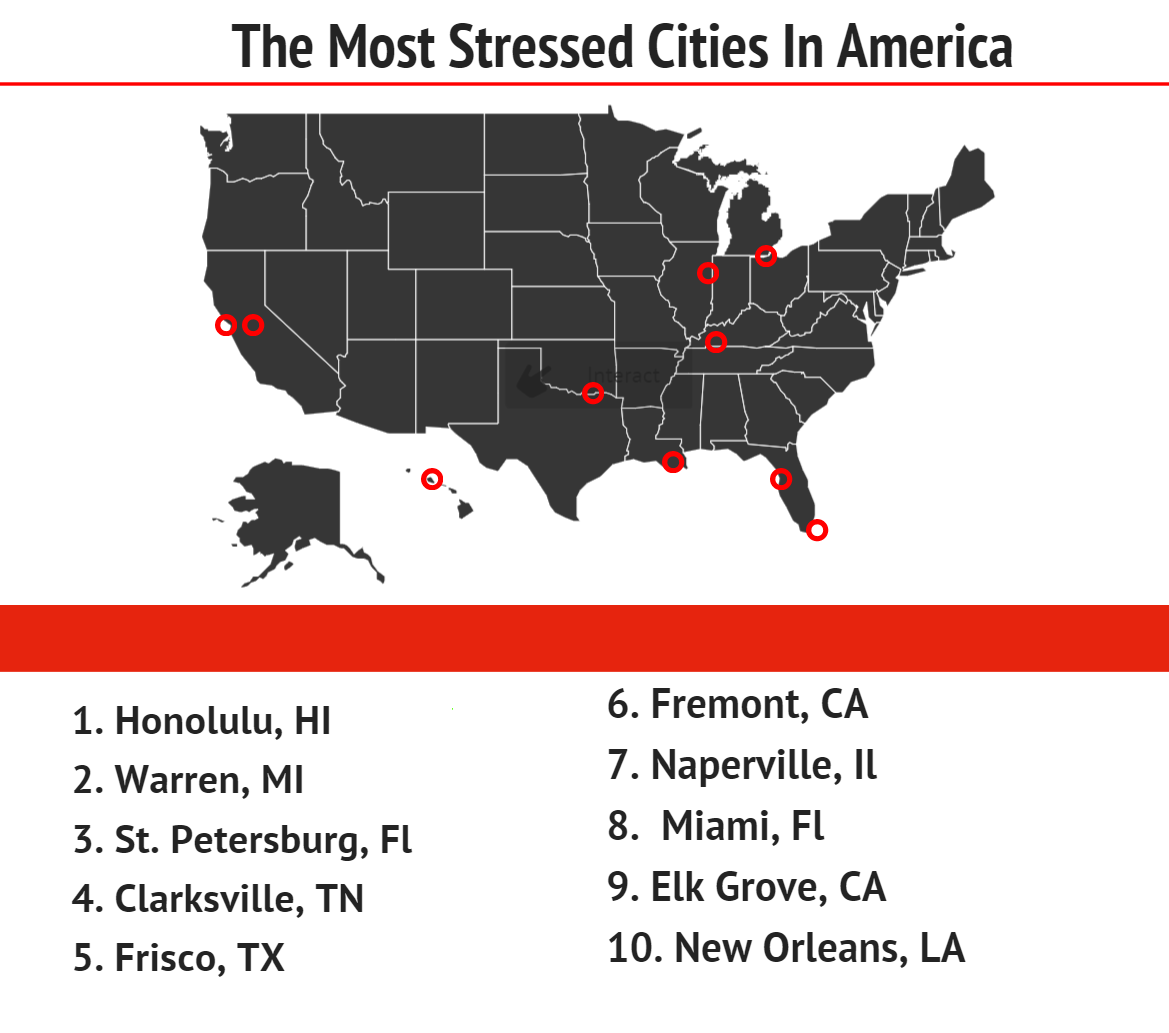
Most and Least Stressed Cities
| Rank | City | Commute Time (min) | Unemployment Rate (%) | Average Hours Worked | Uninsured Residents (%) | Income to Housing Costs Ratio (Lower is Worse) |
|---|---|---|---|---|---|---|
| 1 | Honolulu, HI | 29 | 4 | 39 | 29 | 12.51% |
| 2 | Warren, MI | 26 | 5 | 39 | 20 | 17.37% |
| 3 | St. Petersburg, FL | 35 | 7 | 37 | 28 | 15.20% |
| 4 | Clarksville, TN | 37 | 4 | 39 | 15 | 18.21% |
| 5 | Frisco, TX | 41 | 4 | 39 | 11 | 10.65% |
| 6 | Fremont, CA | 35 | 5 | 38 | 13 | 22.39% |
| 7 | Naperville, IL | 31 | 4 | 37 | 17 | 9.74% |
| 8 | Miami, FL | 29 | 4 | 38 | 23 | 21.96% |
| 9 | Elk Grove, CA | 30 | 5 | 40 | 4 | 14.53% |
| 10 | New Orleans, LA | 26 | 5 | 40 | 32 | 45.43% |
Methodology – How We Determined the Most (and Least) Stressful Cities
Each city was ranked from 1 to 197 across five categories:
- Commute Time
- Hours Worked
- Unemployment Rate
- Percentage of Uninsured Residents
- Income to Housing Costs Ratio
Data was sourced from the latest five-year Census American Community Survey. Understanding stress is complex, and we focused on factors that significantly impact quality of life.
The first two metrics—average commute time and average hours worked—are crucial for work-life balance. Longer work hours and commutes mean less time for personal life, which can escalate stress levels. Higher stress is correlated with longer commutes and more hours spent at work.
Next, we considered unemployment rates. A high unemployment rate can contribute significantly to stress, as financial insecurity weighs heavily on residents. The more people struggle to find jobs, the more stress the city experiences.
We also examined the percentage of uninsured residents. Access to healthcare reduces stress related to health concerns, so cities with a higher uninsured rate may face greater stress levels.
Lastly, we analyzed the income-to-housing-costs ratio. Financial stability is a major stress factor, and homes being unaffordable can exacerbate anxiety. This metric highlights the disparity between median salaries and housing costs, further illustrating stress levels across cities.
Conclusion: Insights on the Most (and Least) Stressful Cities
Stress is subjective and can vary widely from person to person. While we focused on key indicators of stress, individual experiences may differ significantly. If you find yourself in a city like Honolulu or Warren, Michigan, and feel content, it may be perplexing why others around you are stressed.
Conversely, if you live in a less stressed city and feel overwhelmed, remember that personal circumstances heavily influence your stress levels. The crucial takeaway from this analysis is that location can play a significant role in overall stress levels. Understanding your environment can help in managing stress more effectively. So, the next time you’re caught in traffic, take a moment to breathe and remember that your surroundings significantly impact your state of mind.
If you need specific data or statistics for your coverage, please email kmorris@zippia.com with your requests.

Author

Kathy is the head of content at Zippia with a knack for engaging audiences. Prior to joining Zippia, Kathy worked at Gateway Blend growing audiences across diverse brands. She graduated from Troy University with a degree in Social Science Education.