- Income Statistics
- Average PTO Days
- What Percentage of Americans Live Paycheck to Paycheck?
- Average American Income
- Millionaire Statistics
- Average Salary out of College
- Average Bonus Statistics
- Minimum Wage Statistics
- Union Benefits Statistics
- Savings Statistics
- Average Annual Raise
- Income Inequality Statistics
- How Many People Make Over 100k?
- Average 401(k) Sstatistics
- Average Net Worth Statistics
- $100k After-Tax Income By State
- Average Global Income
Research Summary: Bonuses are a significant part of compensation for many employees, often providing an incentive for enhanced performance and retention. As of 2026, companies are increasingly recognizing the importance of bonuses as part of their overall compensation strategy. Our data analysis team found the following key insights:
-
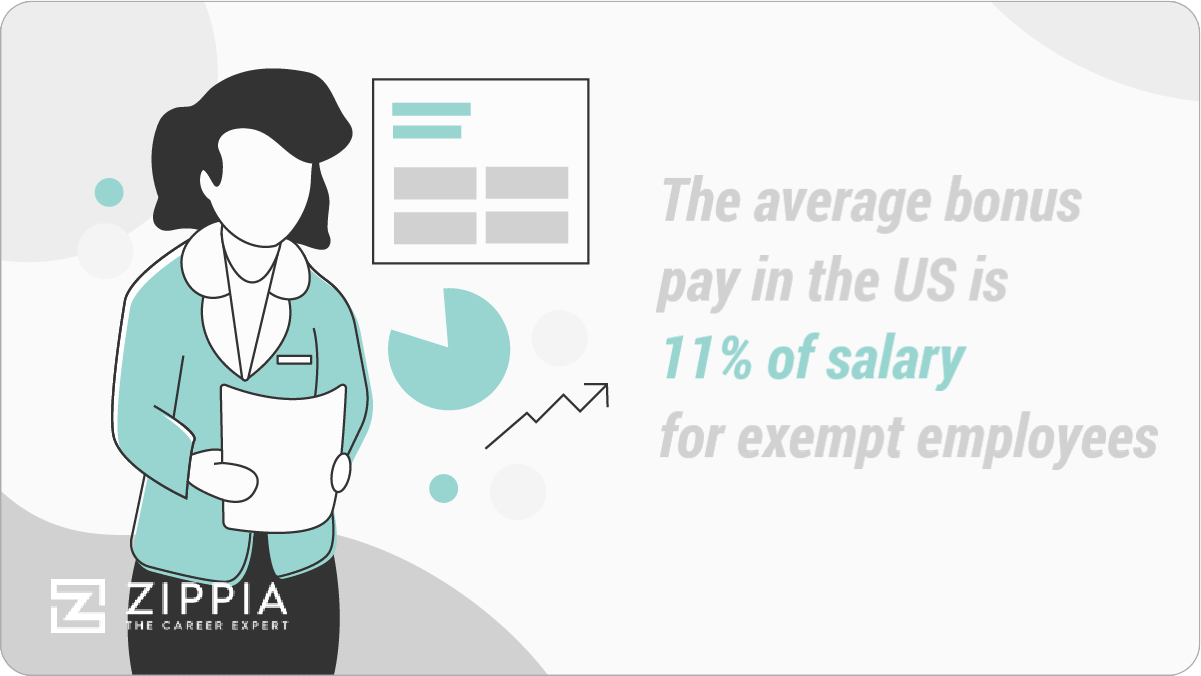
As of 2025, the average bonus pay in the U.S. is 11% of salary for exempt employees, 6.8% for nonexempt salaried employees, and 5.6% for hourly employees.
-
35% of companies in the U.S. now offer year-end bonuses, reflecting a growing trend.
-
42% of all U.S. workers have access to various nonproduction bonuses.
-
The most frequently awarded bonuses are year-end bonuses (11% of all employees), holiday bonuses (6% of all employees), and cash profit-sharing bonuses (7% of all employees).
-
The Information industry leads in bonus accessibility, with 72% of employees having access.
-
63% of companies report that the bonuses offered in 2025 were higher than those in 2024.
For more detailed findings, explore the following sections:
Bonuses | Industry | Trends and Predictions | Opinions on Bonuses
General Bonus Statistics
Although the Fair Labor Standards Act (FLSA) does not mandate bonuses, many companies voluntarily offer them as part of their compensation packages. Currently, 35% of companies provide year-end bonuses. Here are some notable statistics:
-
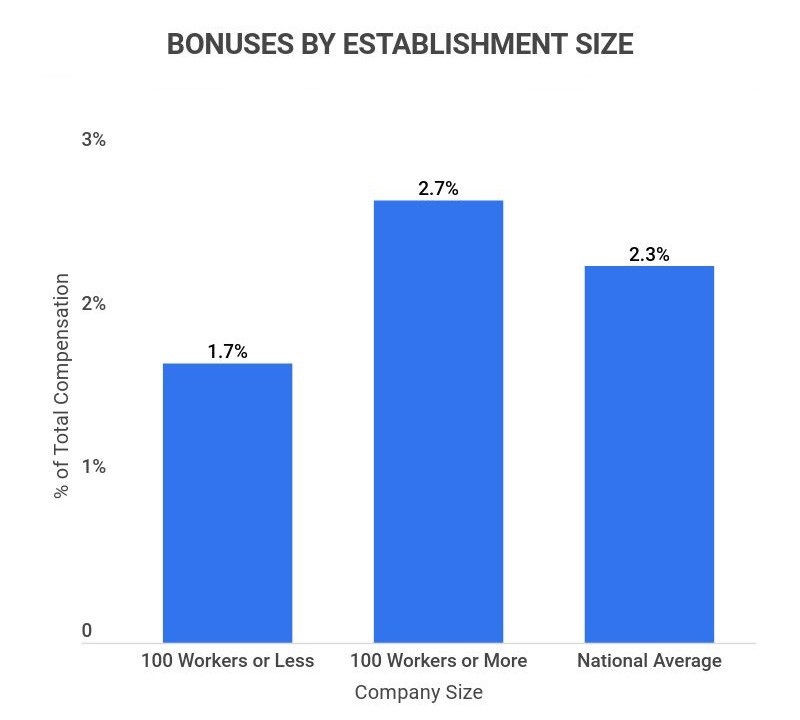
As of early 2025, the average nonproduction bonus constitutes 2.4% of total compensation costs.
Across all private industry workers, the average hourly cost for nonproductive bonuses is approximately $0.85, or 2.4% of total compensation.
There is a slight variation between establishments with 100 or more workers and those with fewer than 100, with the former averaging 2.8% and the latter 1.9%.
-
The information industry offers the highest bonus access, with 72% of employees eligible.
This sector also provides the most substantial year-end bonuses (27%), cash profit-sharing bonuses (17%), and referral bonuses (25%).
-
The leisure and hospitality industry has the lowest bonus accessibility at just 20%.
This represents a significant gap compared to the information industry, with only 5% of employees receiving year-end bonuses and a mere 3% eligible for holiday bonuses.
-
35% of U.S. companies provide year-end bonuses.
This figure has risen by 2% since 2024, indicating a broader trend towards incentivizing performance post-pandemic.
Types of Bonuses Statistics
Companies offer various types of bonuses, including year-end, cash profit-sharing, employee recognition, holiday, longevity, payment in lieu of benefits, and referral bonuses. Here are key insights from our research:
-
Year-end bonuses are most prevalent in companies with fewer than 100 employees.
In these smaller companies, year-end bonuses are given to 15% of workers, while only 8% of employees in larger firms receive them.
-
Cash profit-sharing bonuses are more common in larger firms.
In companies with over 100 employees, 12% of workers receive cash profit-sharing bonuses, compared to only 4% in smaller companies.
-
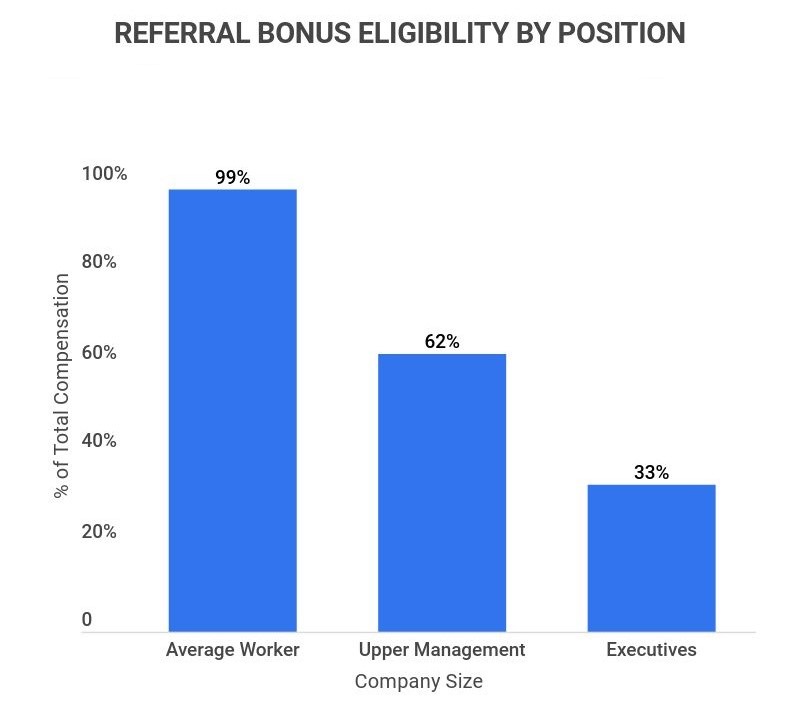
98% of professionals are eligible for referral bonuses.
Despite this high percentage, eligibility decreases significantly at higher levels, with only 35% of executives and 60% of upper management qualifying for referral bonuses.
-
Employee referrals account for 45% of all hires.
This statistic highlights the effectiveness of referral programs in recruitment, as referrals constitute only 8% of applicants but yield a significant portion of hires.
-
The average referral bonus ranges from $1,800 to $2,200.
Other popular rewards include additional PTO, gift cards, points for prizes, and public recognition.
Bonuses by Industry Statistics
The industry you work in significantly influences the bonuses available to you. For instance, only 14% of public sector jobs offer incentive bonus plans for non-executives, compared to 50% in the private sector. Here are some additional insights:
-
Private sector jobs are 40% more likely to provide incentive bonus plans for non-executives than public sector jobs.
Only 14% of public jobs offer these plans, compared to 50% in the private sector.
-
The construction industry offers the most holiday bonuses, at a rate of 12%.
Including related sectors such as extraction and farming, the rate rises to 14%.
-
Industries like information, financial services, and manufacturing provide over 55% of their employees with bonuses.
Specifically, 72% of employees in the information sector have access to bonuses, 68% in financial services, and 57% in manufacturing.
-
Management, business, and financial occupations offer the highest bonus access, with 62% of employees eligible.
The most common type of bonus in this sector is the year-end bonus, accessible to 20% of employees.
-
Service occupations provide the least bonus access, at only 25% of employees.
In these roles, only 3% of employees have access to cash profit-sharing bonuses, while year-end bonus access stands at just 6%.
-
Leading companies like Amazon and Walmart have increased their bonuses recently.
As of 2023, full-time employees at Amazon and Walmart receive a “special recognition” bonus of $300, while part-time employees earn $150.
-
Companies with 100 or more employees provide 8% more access to bonuses.
In larger companies, 46% of workers have access to bonuses, compared to 38% in smaller firms.
| Industry Type | % of Workers With Access to All Bonuses | Cash Profit-Sharing | Employee Recognition | End-Of-Year Bonuses | Holiday Bonuses | Longevity Bonuses | Referral Bonuses | Other Bonuses |
|---|---|---|---|---|---|---|---|---|
| Administrative & Support & Waste Management | 28 | 2 | 1 | 9 | 5 | 1 | 7 | 7 |
| Construction | 43 | 6 | 2 | 20 | 12 | 1 | 4 | 6 |
| Education & Health Services | 34 | 2 | 3 | 8 | 7 | 1 | 7 | 10 |
| Financial Activities | 68 | 12 | 10 | 20 | 6 | 2 | 10 | 22 |
| Information | 72 | 17 | 8 | 27 | 3 | 1 | 25 | 22 |
| Leisure & Hospitality | 20 | 3 | 1 | 5 | 3 | 1 | 3 | 1 |
| Manufacturing | 57 | 14 | 2 | 18 | 7 | 1 | 6 | 23 |
| Professional & Business Services | 45 | 6 | 7 | 15 | 5 | 1 | 11 | 13 |
| Trade, Transportation & Utilities | 40 | 12 | 2 | 8 | 6 | 1 | 5 | 8 |
| Other Services | 28 | 2 | 1 | 9 | 14 | 1 | 2 | 3 |
Bonuses Trends and Predictions
The evolving landscape of bonuses reflects broader economic trends and employee expectations. As of 2026, here are some insights:
-
Current bonuses, averaging 11% of salary, have stabilized since 2025.
In 2024, bonuses were approximately 10.9% of salary. The increase in 2025 has led to a steady average of 11% in 2026.
-
79% of companies planned to award bonuses in 2025.
Organizations are increasingly tying bonuses to performance metrics, with expectations for higher payouts as the economy improves.
-
Access to bonuses has risen by 4% since 2024.
The proportion of companies offering year-end bonuses has grown from 32% to 35% in this period.
Employee Opinions on Bonuses
What do employees think about bonuses? Engagement and satisfaction are high among those who receive bonuses. Our findings indicate:
-
47% of Americans expect higher bonuses this year.
While 42% anticipate their bonuses will remain the same, optimism for higher bonuses prevails as companies recover from economic challenges.
-
Employees receiving bonuses or regular rewards are 8 times more engaged.
These rewards can take many forms, including year-end, cash profit-sharing, or recognition bonuses, contributing significantly to employee morale.
-
70% of employees prefer cash incentives over gift cards.
While the preference for cash is slight, it highlights employees’ desire for flexibility in how they utilize their rewards.
-
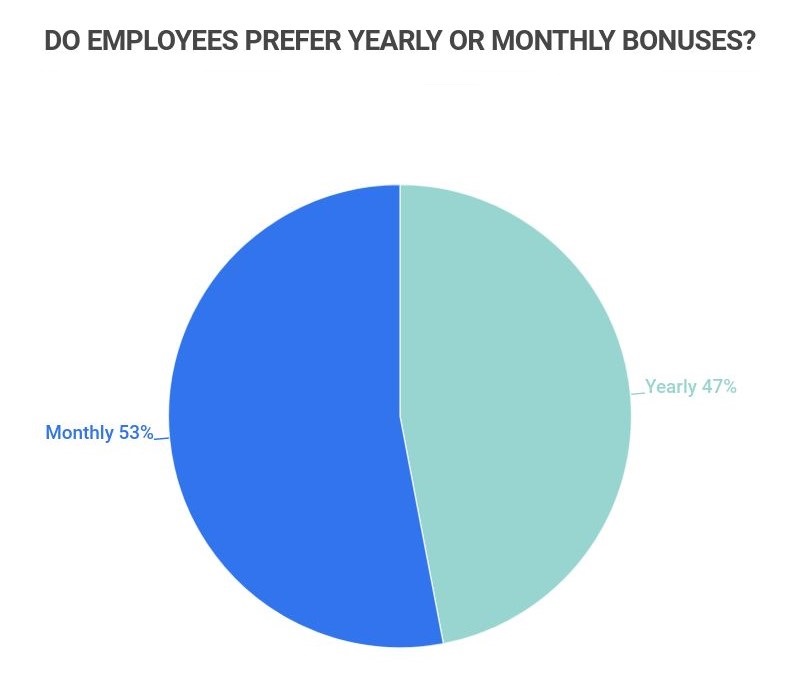
54% of employees favor monthly bonuses over annual ones.
In comparison, 46% still prefer a single yearly bonus, indicating a trend towards more frequent reward distribution.
-
One-third of employees would choose public recognition over a private $500 bonus.
This statistic underscores the significance of recognition in the workplace, with many valuing acknowledgment over monetary rewards.
Bonus Statistics FAQ
-
Bonuses are typically tied to performance and can be awarded monthly or yearly. Yearly bonuses are the most common, usually calculated as a percentage of salary or as a fixed amount. For example, a bonus might be 11% of your salary or a flat $1,000.
-
Why do companies give bonuses?
Bonuses serve to reward employees. Employers aim to encourage high performance and enhance retention. Consequently, employees are 8 times more engaged when receiving rewards like bonuses.
-
Bonuses can range from $50 to $5,000, varying widely based on pay and context. For example, a $40,000 salary with an 11% bonus results in $4,400. Conversely, a $30,000 salary yields $3,300. Average Christmas bonuses are around $300, while referral bonuses may reach $2,200.
-
A “good” bonus typically falls between 10-15%. Bonuses above 15% are considered excellent, as they are relatively rare.
-
What is a normal year-end bonus?
The average year-end bonus is 11% for exempt employees, 6.8% for nonexempt employees, and 5.6% for hourly employees. This percentage reflects total bonuses earned throughout the year, including year-end, holiday, and cash profit-sharing bonuses.
-
Yes, a 10% bonus is favorable. The average exempt employee earns 11% in bonuses, while nonexempt salaried employees receive 6.8%, making a 10% bonus good for all categories of employees.
-
Do bonuses have to be paid by March 15?
No, bonuses do not have to be paid by March 15. Companies can pay bonuses at their discretion, although many opt for this date for tax purposes.
-
How do you calculate a prorated bonus?
To calculate a prorated bonus, divide the number of days, weeks, or months worked by 365, 52, or 12, respectively, and multiply by the total expected bonus.
-
How do you calculate a KPI bonus?
To calculate a KPI bonus, multiply the number of KPIs met by the designated bonus rate. These KPIs serve as benchmarks for employee performance, impacting bonus calculations.
Conclusion
Despite the positive impact of bonuses on employee engagement and performance, currently only 42% of employees have access to them. This access varies widely across industries; for instance, 72% of employees in the information sector have access compared to only 20% in leisure and hospitality.
Overall, bonuses remain an effective tool for enhancing workplace morale and productivity. As companies adapt to changing economic conditions, the percentage of those offering bonuses has risen significantly, indicating a trend towards more robust employee compensation packages in the years ahead.
Sources:
-
U.S. Bureau of Labor Statistics. “Employer-provided bonuses: what are they, what types of businesses offer them, and who receives them?.” Accessed on August 18, 2021.
-
SHRM. “More Companies Offer Bonuses as a Challenging Year Ends.” Accessed on August 18, 2021.
-
SHRM. “Designing and Managing Successful Employee Referral Programs.” Accessed on August 19, 2021.
-
Undercover Recruiter. “Why Employee Referrals are the Best Source of Hire.” Accessed on August 19, 2021.
-
Governing. “How Public Employee Benefits (Beyond Pensions and Health Care) Compare to the Private Sector’s.” Accessed on August 19, 2021.
-
ValuePenguin. “2 in 3 Companies Expect to Offer Year-End Bonuses.” Accessed on August 19, 2021.
-
Benefits PRO. “Employee raises and bonuses are returning in 2021.” Accessed on August 19, 2021.
-
Bonusly. “What is Employee Engagement?.” Accessed on August 19, 2021.
-
GiftCards. “About Gift Card Statistics.” Accessed on August 19, 2021.
-
SHRM. “Better Pay and Benefits Loom Large in Job Satisfaction.” Accessed on August 19, 2021.
-
Human Resources Today. “2021 Compensation Budgeting Forecast Part 2: Incentives, Bonuses, and Variable Compensation.” Accessed on August 19, 2021.
- Income Statistics
- Average PTO Days
- What Percentage of Americans Live Paycheck to Paycheck?
- Average American Income
- Millionaire Statistics
- Average Salary out of College
- Average Bonus Statistics
- Minimum Wage Statistics
- Union Benefits Statistics
- Savings Statistics
- Average Annual Raise
- Income Inequality Statistics
- How Many People Make Over 100k?
- Average 401(k) Sstatistics
- Average Net Worth Statistics
- $100k After-Tax Income By State
- Average Global Income

Author

Jack Flynn is a writer for Zippia. In his professional career he’s written over 100 research papers, articles and blog posts. Some of his most popular published works include his writing about economic terms and research into job classifications. Jack received his BS from Hampshire College.