Find a Job You Really Want In
As we navigate the evolving landscape of the job market in 2026, the significance of STEM (Science, Technology, Engineering, and Mathematics) fields has never been more pronounced. With the surge in technological advancements and a shift towards digital ecosystems, incoming college students are increasingly gravitating towards STEM disciplines. This trend reflects a broader societal understanding of the importance of these fields, especially as businesses and organizations emphasize a need for skilled professionals in these areas.
Moreover, governments and educational institutions are actively encouraging students to pursue STEM majors, recognizing their vital role in driving economic growth and innovation. This brings us to an important question: who are these students entering STEM fields?
Insights from the Data
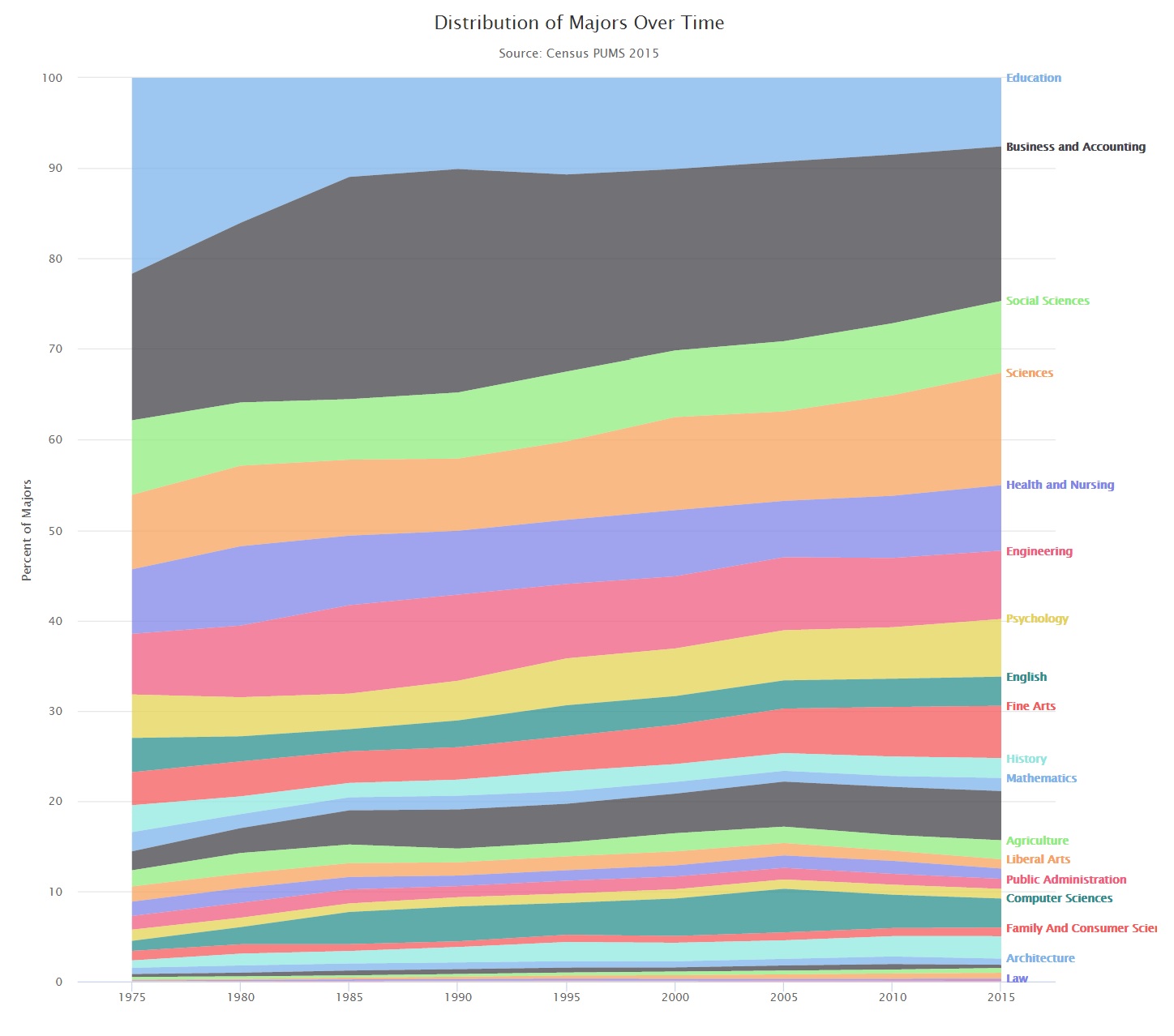
Our analysis of college major distributions across different racial and ethnic groups reveals some expected trends. We previously explored gender differences in major distributions, so let’s start with the overall distribution for all majors among American college students:
Click here for a downloadable image of the chart
The main observations align with our previous findings on the “feminization of education”: Business remains the most popular major at 17.1%, followed by Education, which has seen a decline to just 7.6%, and a steady representation of STEM majors like Science and Engineering.
As we analyze the data for white Americans, the distribution mirrors the overall trends, with slight variations in the popularity of specific majors.
While the differences are minor, they indicate that the general “Science” major is slightly less favored among white Americans, standing at 11.9% compared to 12.4% overall.
Shifts in distributions become more pronounced when examining other demographic groups.
For Black Americans, the data shows a similar trend, with a notable shift from Education majors towards STEM fields. This transition indicates a growing interest in these areas, paralleling the broader national trend.
However, the most intriguing data emerges from the distribution among Asian Americans.
Here, we observe a stark decline in Education majors, with the majority of students pursuing Business, Engineering, and Science majors. These areas have remained consistently popular over time, each comprising between 16-19% of total major distributions.
Additional charts provide insights into American Indian students:
While visually interesting, these charts highlight a limitation: insufficient PUMS data restricts our ability to draw significant conclusions about these groups.
Returning to the question of why Asian Americans exhibit such different trends in major selection, the answer may lie in cultural influences.
Cultural Pressures Surrounding STEM Fields
STEM majors are highly regarded in professional settings, yet they often lack the same cultural cachet as careers in the arts. This disparity can make creative fields seem less appealing, particularly for people of color (POC), who may face additional barriers in these industries. The pressure to pursue STEM careers is particularly acute within Asian communities, leading to significantly higher enrollment rates in these fields compared to Black, White, or Hispanic students.
Asian cultures generally emphasize the value of STEM careers, which may compel families to guide their children towards these paths. Given the rising costs of education, parents may prioritize fields perceived as more stable and lucrative. Additionally, the meritocratic nature of STEM jobs, where abilities and knowledge are prioritized, can be more appealing to marginalized groups facing systemic barriers.
Societal perceptions also play a role, with stereotypes suggesting that Asian individuals excel in math and science. While studies indicate that Asian Americans and White Americans have comparable IQ levels, the higher representation of Asian Americans in high-status occupations raises questions about the implications of these stereotypes.
Despite any potential advantages, stereotypes can be complicated, leading to both expectations of success and challenges related to discrimination and bias in the workplace.
In Conclusion: Navigating Complex Realities
As noted, the concept of “stereotype threat” can impact performance among Black Americans, while Asian Americans may experience a “stereotype promise” that enhances their performance. However, discrimination remains a significant issue, as evidenced by the limited upward mobility among Asian American professionals. The diligence and self-effacing nature associated with this demographic can hinder their ability to advocate for promotions, especially in environments where biases persist.
This challenge is exacerbated for Asian American women, who often find themselves competing for limited leadership positions, despite high educational attainment. While our exploration has shed light on who is entering STEM fields, it raises further questions: What barriers are hindering promotions for Asian Americans? How can we encourage POC to pursue creative careers while acknowledging the realities of job prospects in those fields?
These questions are complex and multifaceted, but through ongoing cultural shifts towards inclusivity and support, we can work to dismantle the “bamboo ceiling” and foster equitable opportunities in all professional domains.

Author

Ryan Morris was a writer for the Zippia Advice blog who tried to make the job process a little more entertaining for all those involved. He obtained his BA and Masters from Appalachian State University.