- Facts and Figures
- Social Security Statistics
- Social Media Statistics
- Cell Phone Usage Statistics
- Cryptocurrency Statistics
- White Collar Crime Statistics
- Crowdfunding Statistics
- Branding Statistics
- How Many Emails Are Sent Per Day
- Money Laundering Statistics
- Childcare Availability Statistics
- Cold Calling Statistics
- Automation And Job Loss Statistics
- Student Loan Statistics
- Spam Statistics
- Password Statistics
- Ransomware Statistics
- Christmas Spending Statistics
- Average Grocery Cost By State
- Average Screen Time Statistics
- Average Monthly Expenses
- IoT Statistics
- Gen Z Statistics
Research Summary. Cryptocurrency has rapidly evolved into one of the most dynamic and influential sectors globally. Since the inception of Bitcoin in 2009, the cryptocurrency landscape has expanded tremendously, both in terms of the number of digital currencies and their market capitalization. Here are the latest crypto facts and statistics you need to know:
-
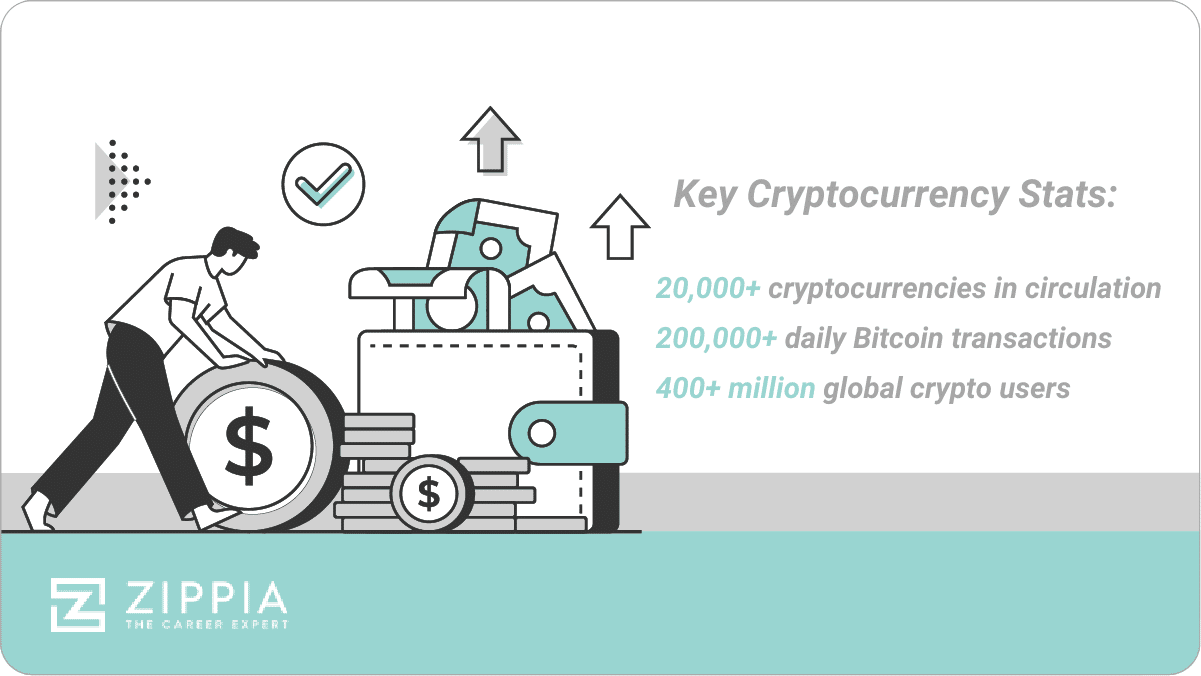
There are over 20,000 cryptocurrencies currently in circulation.
-
The leading cryptocurrencies by market cap are Bitcoin (BTC), Ethereum (ETH), and Tether (USDT).
-
As of early 2026, there are approximately 200,000 Bitcoin transactions daily.
-
There are around 45 million American crypto users and 420 million globally as of 2026.
-
16% of Americans report that they have used, invested in, or traded cryptocurrencies.
-
The global blockchain market value is projected to reach $67.4 billion by 2026, growing from $10.02 billion in 2022, with a CAGR of 68.4%.
For more detailed analysis, we have segmented the data into the following categories:
Bitcoin | Cryptocurrencies | Country | Trends and Projections
General Cryptocurrency Statistics
-
97% of users express confidence in cryptocurrencies.
Many of these users consider crypto investing not merely a hobby but a potential source of income.
The top three motivations for investing in cryptocurrency include creating a long-term investment strategy (55%), distrust of traditional financial systems (38%), and engaging in short-term trading (31%).
-
As of early 2026, there are over 84 million crypto wallets worldwide.
This figure has surged dramatically since 2015, when there were only 3.16 million wallets globally.
-
The 24-hour trading volume for cryptocurrencies peaked at over $500 billion in May 2021.
This spike represented a significant increase from the previous levels, although trading volumes fluctuated significantly in response to regulatory changes.
-
Top five crypto exchanges by traffic, liquidity, and trading volumes include Binance, Coinbase, FTX, Kraken, and KuCoin.
Due to the decentralized nature of cryptocurrencies, exchanges are not uniformly regulated, leading to a wide variety of operational structures.
Currently, an estimated 504 exchanges exist, with many still in early development stages.
-
Investment in cryptocurrency is more prevalent among men, with 16% of men and 7% of women participating.
Bitcoin Statistics
-
Bitcoin, created in 2009 by the pseudonymous Satoshi Nakamoto, remains the first decentralized cryptocurrency.
-
The current market cap for Bitcoin exceeds $457 billion as of early 2026.
-
Since 2010, Bitcoin’s value has surged by an astonishing over 46,449,400%.
-
In 2010, Bitcoin was priced at $0.09, and it is now valued at more than $23,000.
-
Market analysts forecast Bitcoin’s price may reach $100,000 in the near future.
-
65% of all cryptocurrency users hold Bitcoin in their portfolios.
Statistics on Different Cryptocurrencies
-
Ethereum, Tether, BNB, and USD Coin are among the most popular cryptocurrencies aside from Bitcoin as of early 2026.
Although these currencies have lower market caps compared to Bitcoin, Ethereum stands out with a market cap of approximately $202 billion.
Five Largest Cryptocurrencies by Market Cap
Cryptocurrency 2026 Market Cap Bitcoin $457.16 billion Ethereum $202.46 billion Tether $70.97 billion BNB $47.77 billion USD Coin $42.46 billion -
On January 6, 2022, there were 264,899 Bitcoin transactions.
In comparison, Ethereum recorded 1.212 million transactions on that date, highlighting the higher transaction volume associated with Ethereum as users tend to hold Bitcoin for long-term investments.
-
As of early 2026, Bitcoin is priced over $21,000 higher than Ethereum.
While Bitcoin is valued at over $23,000, Ethereum is trading close to $1,600, reflecting significant growth from its price of $133.76 in March 2020.
Cryptocurrency Users Statistics by Country
-
Globally, there are approximately 420 million cryptocurrency users as of 2026.
This marks an exponential increase, with user numbers growing by 190% globally between 2018 and 2020.
-
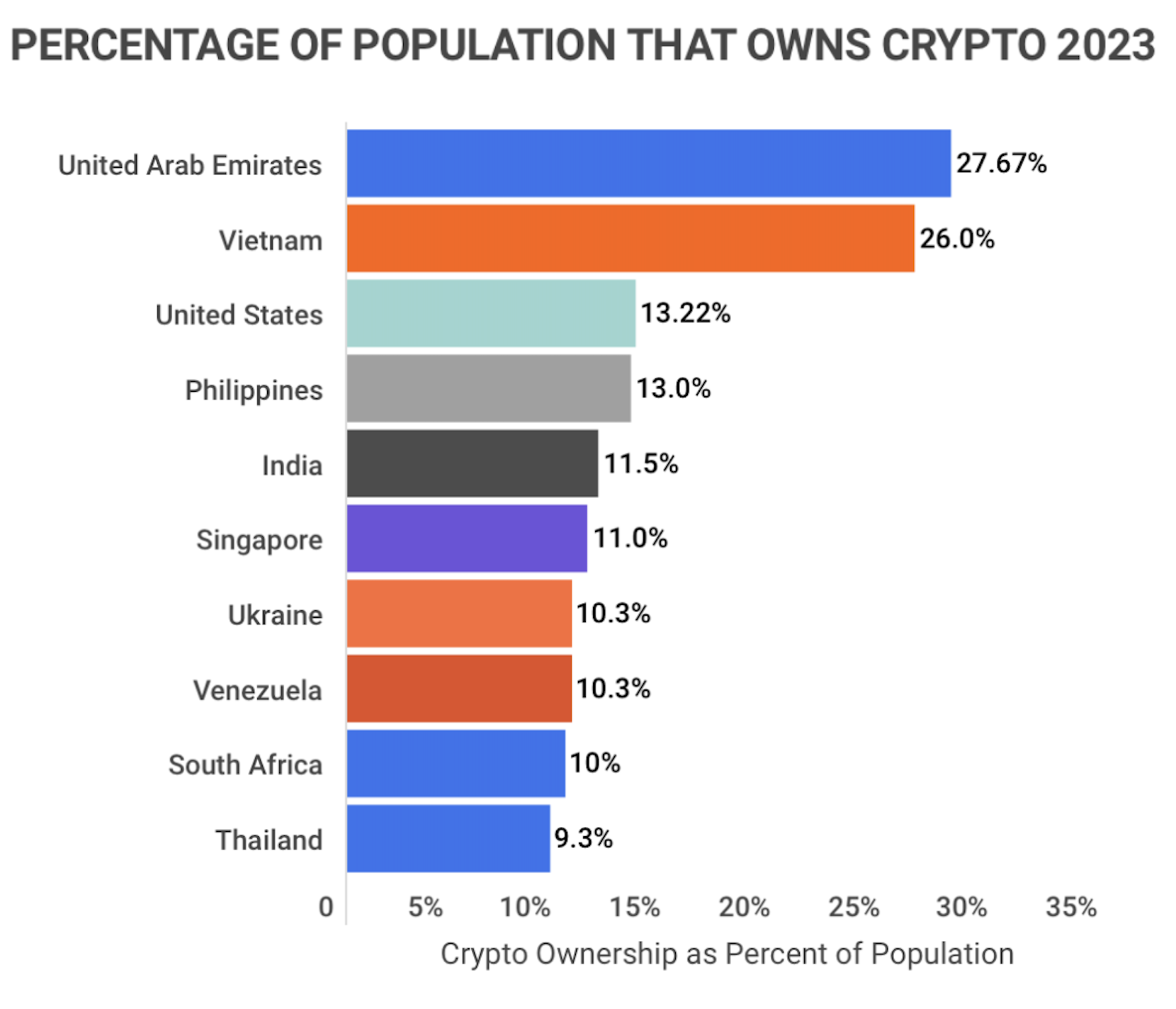
The United Arab Emirates leads in cryptocurrency ownership by percentage, with 27.67% of the population owning crypto.
Following the UAE are Vietnam (26%), the United States (13.22%), the Philippines (13%), and India (11.5%).
-
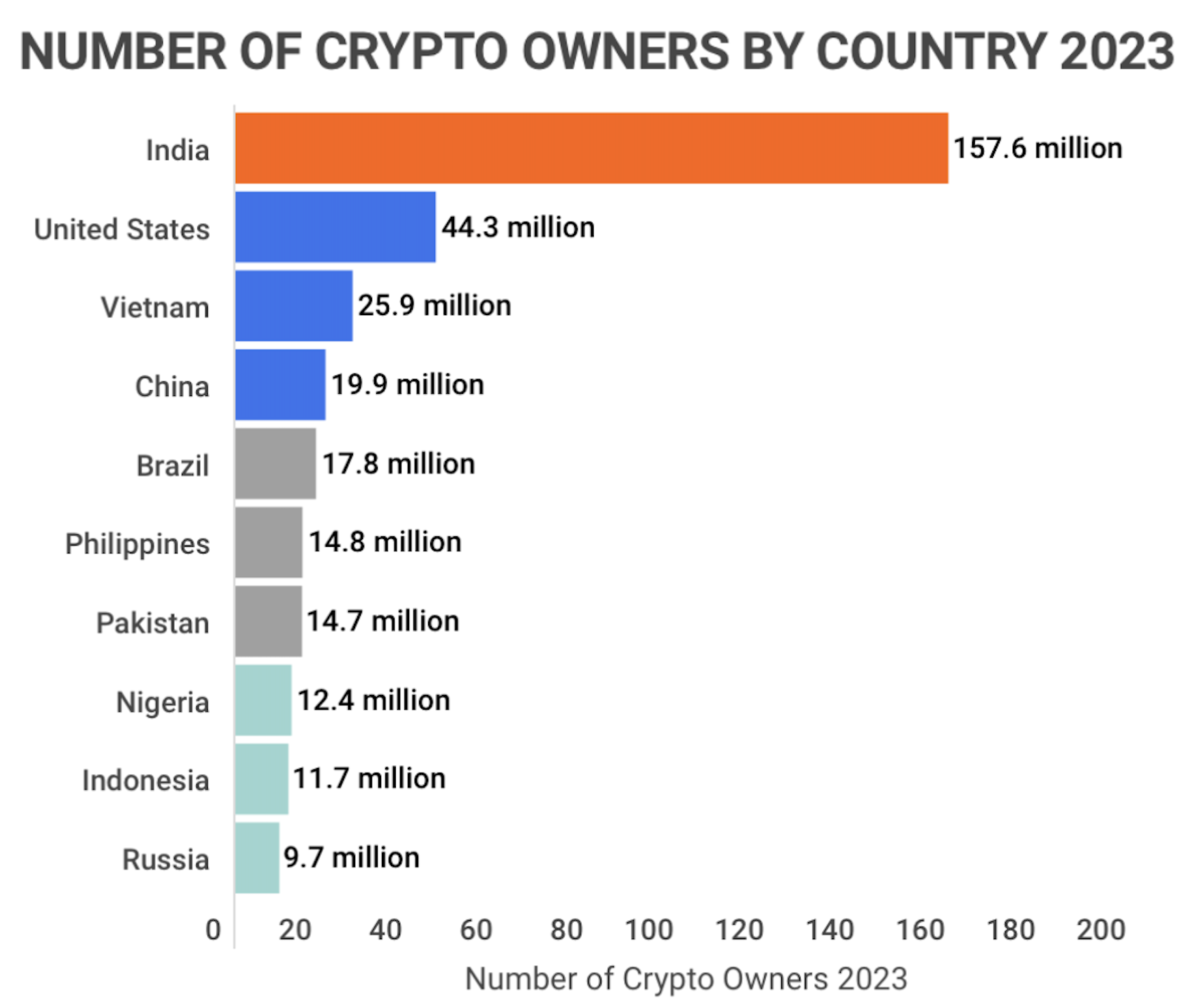
India has the largest total number of crypto owners globally, with approximately 157 million users as of 2026.
The United States follows with around 44.3 million crypto owners, while Vietnam, China, and Brazil round out the top five.
-
The United States has the highest number of cryptocurrency ATMs, with 17,436 operational as of 2021.
This is significantly higher than other countries, such as Canada (1,464 ATMs) and the United Kingdom (200 ATMs).
The rapid growth of crypto ATMs in the U.S. continues to outpace other regions.
Cryptocurrency Trends and Projections
-
The global cryptocurrency market is anticipated to grow at a CAGR of 56.4% from 2019 to 2025.
-
By 2026, the global blockchain technology market is set to accelerate with a CAGR of 68.4%.
-
The number of crypto wallets has surged by 1,271.97% since 2016.
-
In early 2016, there were 5.78 million crypto wallets globally, which increased to 84 million by mid-2022.
-
Adoption of cryptocurrency is expected to continue increasing, albeit with the expectation of stricter regulations in the near future.
Crypto Facts FAQ
-
A cryptocurrency is a form of digital currency created through cryptographic techniques using binary data. It enables secure buying, selling, or trading without a central monetary authority, like a government or financial institution.
While cryptocurrencies can be exchanged for goods and services, they are primarily utilized as long or short-term investment strategies in today’s market, with Bitcoin remaining the most popular cryptocurrency.
-
Are Blockchain and cryptocurrency the same thing?
No, Blockchain and cryptocurrency are distinct entities. Blockchain is the underlying technology that supports the cryptocurrency ecosystem, initially developed to facilitate Bitcoin transactions.
-
What is the purpose of cryptocurrency?
The primary purpose of cryptocurrency is to address the limitations of traditional currencies by giving control back to the currency holders rather than a central authority.
Cryptocurrency decentralizes finance, minimizing the risk of a financial crisis stemming from a single point of failure.
Additionally, cryptocurrencies have emerged as highly lucrative investments, allowing individuals to potentially achieve significant returns with timely investments.
-
What are cryptocurrency wallets, and why are they important?
A cryptocurrency wallet securely stores the private keys that provide access to your cryptocurrencies. This enables users to send and receive their crypto. Wallets can be physical devices or mobile applications.
These wallets do not store your crypto directly; rather, they manage your keys. Crypto holdings exist on the blockchain, accessed only through a private key that proves ownership. If you lose your private key, you lose access to your funds, making a reliable wallet essential.
-
Is cryptocurrency a wise investment?
The wisdom of investing in cryptocurrency depends on individual perspectives.
For early adopters who invested in Bitcoin at around nine cents, this has become one of their best investments, worth millions today.
Conversely, those who invested heavily during market highs may have faced severe losses, highlighting the volatile nature of cryptocurrency investments.
Despite its potential for high returns, the cryptocurrency market is unstable, making it crucial for investors to remain informed about market trends and blockchain technology.
Conclusion
Cryptocurrency has evolved from a niche concept to a mainstream financial tool over the past decade, becoming one of the most lucrative yet volatile investments of the 21st century. Bitcoin, the first decentralized cryptocurrency created in 2009, has paved the way for over 20,000 other cryptocurrencies.
Initially designed to facilitate online transactions without the control of traditional financial institutions, Bitcoin’s journey has seen its value rise exponentially. From a mere $0.09 in 2010 to over $23,000 today, Bitcoin’s growth has been phenomenal, with predictions of hitting $100,000 in the future.
As of 2026, the cryptocurrency market boasts around 420 million users globally, with significant ownership in countries like India and the UAE. The rapid increase in crypto wallets and ATMs signifies the growing adoption of digital currencies worldwide.
While the cryptocurrency market is projected to continue its growth trajectory, it is expected to face increased regulation, which could reshape its landscape. This evolution may paradoxically shift away from the decentralized ethos that cryptocurrencies were founded upon.
References
-
Globe Newswire. “Global Blockchain Market Report 2021: Market Size is Projected to Grow from $4.9 Billion in 2021 to $67.4 Billion by 2026, at a CAGR of 68.4%”. Accessed on January 7, 2022
-
Investopedia. “10 Important Cryptocurrencies Other Than Bitcoin”. Accessed on January 7, 2022
-
Statistica. “Number of daily transactions on the blockchain of Bitcoin from January 2017 to September 13, 2021”. Accessed on January 7, 2022
-
Statistica. “Men and women who own a cryptocurrency in the United States in 2019”.
-
TripleA. “Cryptocurrency across the world”. Accessed on January 7, 2022
-
Pew Research Center. “16% of Americans say they have ever invested in, traded or used cryptocurrency”. Accessed on January 7, 2022
-
Binance Research. “2021 – Global Crypto User Index”. Accessed on January 7, 2022
-
FinancesOnline. “Number of Blockchain Wallet Users 2021/2022: Breakdowns, Timelines, and Predictions”. Accessed on January 7, 2022
-
Forbes. “Which Countries Have The Most Crypto ATMs? [Infographic]”. Accessed on January 7, 2022
-
Statistica. “Overall cryptocurrency 24h trade volume from July 1, 2019 to November 3, 2021”. Accessed on January 7, 2022
-
Coin Market Cap. “Top Cryptocurrency Spot Exchanges”. Accessed on January 7, 2022
-
Cryptimi. “How Many Cryptocurrency Exchanges are There?”. Accessed on January 7, 2022
-
CNBC. “Cryptocurrency investing has a big gender problem”. Accessed on January 7, 2022
-
Money Control. “Cryptocurrency Prices Today: Bitcoin marginally up, global market cap increases”. Accessed on January 7, 2022
-
Coin Market Cap. “Bitcoin Overview” Accessed on January 7, 2022
-
Fortune. “Even amid crypto’s early-2022 jitters, some analysts still think Bitcoin at $100,000 is in reach”. Accessed on January 7, 2022
-
Ycharts. “Bitcoin Transactions Per Day”. Accessed on January 7, 2022
-
ADVFN. “Top CryptoCurrencies (By Market Cap)”. Accessed on January 7, 2022
-
Ycharts. “Ethereum Transactions Per Day”. Accessed on January 7, 2022
-
Statistica. “Ethereum (ETH) price per day from August 2015 to January 7, 2022”. Accessed on January 7, 2022
-
Cision. “Global cryptocurrency market is expected to grow with a CAGR of 56.4% over the forecast period from 2019-2025”. Accessed on January 7, 2022
-
Statistica. “Number of Blockchain wallet users worldwide from November 2011 to November 22, 2021”. Accessed on January 7, 2022
-
Binance. “Binance Research Releases First-Ever Global Report on Crypto User Motivations, Behaviors, and Preferences”. Accessed on January 7, 2022
-
The Motley Fool. “6 Crypto Trend Predictions for 2022”. Accessed on January 7, 2022
-
PWC. “Bitcoin, cryptocurrency, blockchain… So what does it all mean?”. Accessed on January 7, 2022
-
Coinbase. “What is a crypto wallet?”. Accessed on January 7, 2022
-
CoinMarketCap. “All Cryptocurrencies”. Accessed on February 28, 2023.
-
Statista. “Number of Bitcoin (BTC) transactions per day on the blockchain from January 2009 to November 6, 2022”. Accessed on February 28, 2023.
-
TripleA. “Cryptocurrency Ownership Data”. Accessed on February 28, 2023.
-
Grand View Research. “Crypto Wallet Market Size, Share, and Trends Report, 2022-2030”. Accessed on February 28, 2023.
- Facts and Figures
- Social Security Statistics
- Social Media Statistics
- Cell Phone Usage Statistics
- Cryptocurrency Statistics
- White Collar Crime Statistics
- Crowdfunding Statistics
- Branding Statistics
- How Many Emails Are Sent Per Day
- Money Laundering Statistics
- Childcare Availability Statistics
- Cold Calling Statistics
- Automation And Job Loss Statistics
- Student Loan Statistics
- Spam Statistics
- Password Statistics
- Ransomware Statistics
- Christmas Spending Statistics
- Average Grocery Cost By State
- Average Screen Time Statistics
- Average Monthly Expenses
- IoT Statistics
- Gen Z Statistics

Author

Sky Ariella is a professional freelance writer, originally from New York. She has been featured on websites and online magazines covering topics in career, travel, and lifestyle. She received her BA in psychology from Hunter College.