Find a Job You Really Want In
As college students navigate their educational journeys, they often encounter two frustrating questions:
“What are you going to do with that degree?”
“I’ve never even heard of that major.”
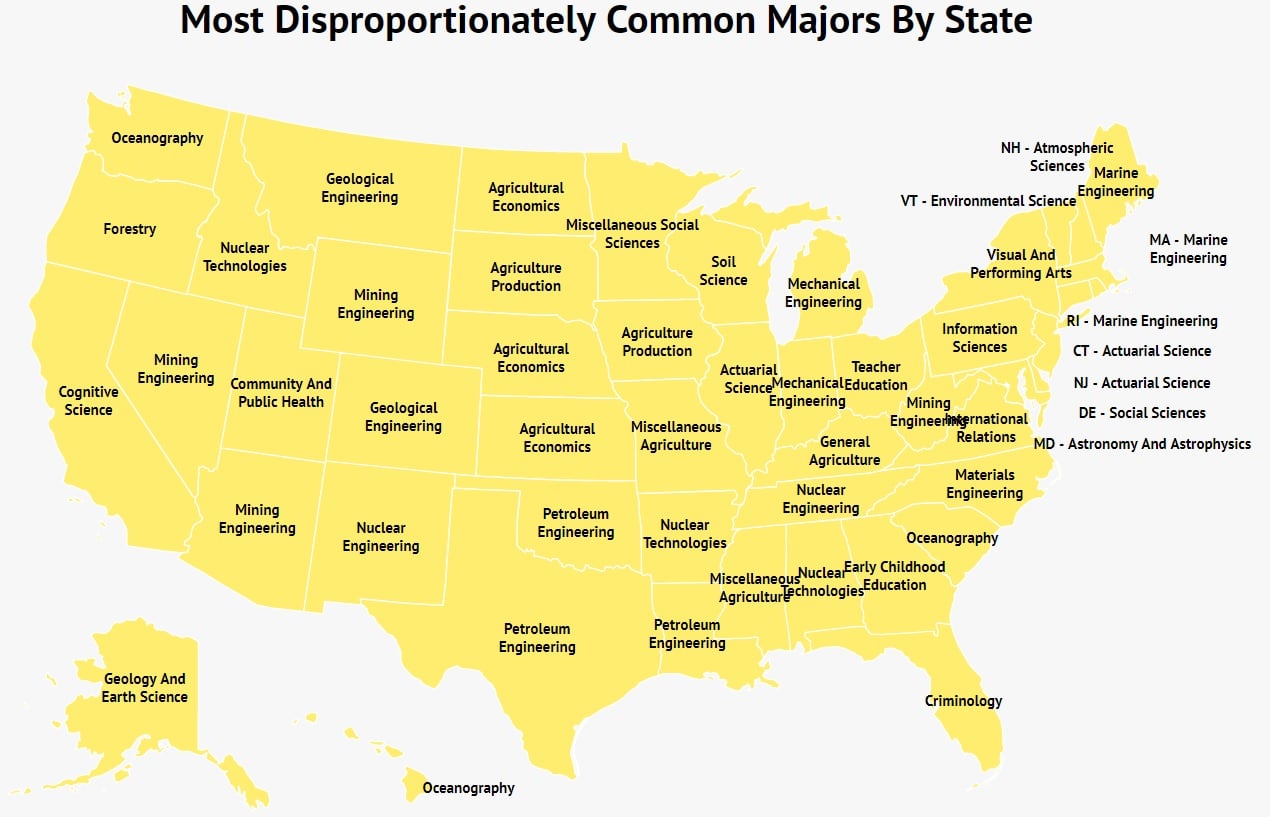
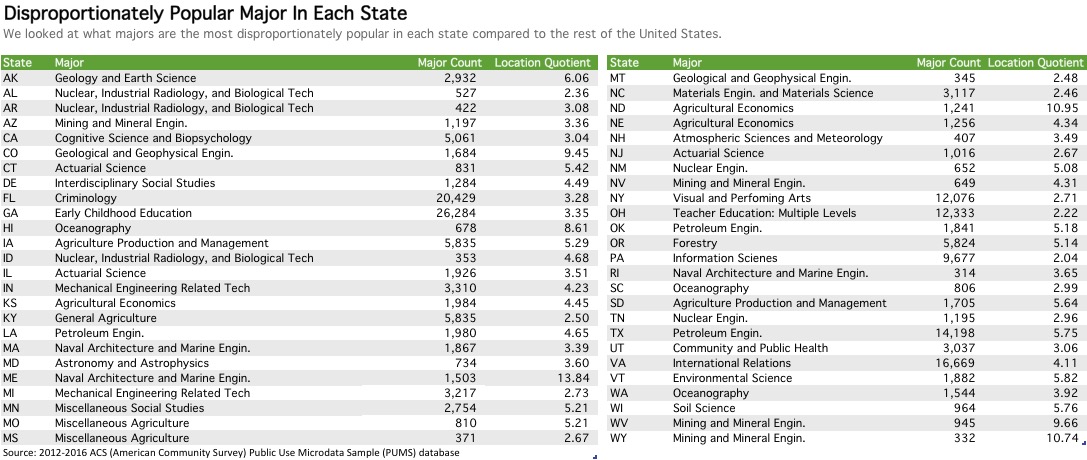
Such responses highlight a key issue: certain majors are significantly more prevalent in specific regions than the national average. This article explores the most disproportionately popular majors across the United States, emphasizing how regional education can shape career opportunities.
Utilizing the latest PUMS data from the 2018-2022 American Community Survey (ACS), we reveal the majors that stand out in each state. This analysis focuses on location quotients, which measure the concentration of a particular major in a state relative to the national average. A higher location quotient indicates a stronger regional emphasis on that major.
Summary of Findings
- The major with the highest location quotient is Maine’s Naval Architecture and Marine Engineering, with a location quotient of 13.84.
- This same major holds a location quotient of 3.39 in Massachusetts.
- Out of the analyzed majors, 42 can be categorized under the STEM umbrella, while states like DE, FL, GA, MN, NY, OH, UT, and VA stand as outliers.
- Pennsylvania features the lowest location quotient for its Information Sciences major at 2.04.
- Georgia leads in unique major count with 26,284 students enrolled in Early Childhood Education.
- Three states exhibit location quotients exceeding 10 for their respective majors:
- Maine – Naval Architecture and Marine Engineering
- North Dakota – Agricultural Economics
- Wyoming – Mining and Mineral Engineering
- Mining and Mineral Engineering is notably the most represented major, appearing in four states.
- Hawaii shares its oceanography major with South Carolina and Washington, aligning well with its geographical context.
How We Conducted This Analysis
This research identifies degrees that are held at a disproportionately high rate in each state compared to national averages, rather than simply listing the most popular degrees overall.
For this analysis, we specifically examined individuals over the age of 25 who possess a degree. The methodology employed involves calculating the location quotient, which quantifies the concentration of a particular major in a state relative to the national average.
For instance, Alaska’s unique major in Geology and Earth Science has a location quotient of 6.06, determined as follows:
First, we divide the total number of degree holders in Alaska (2,932) by the state’s population (736,855), then multiply by 100,000.
This results in a ratio of 2,932/736,855 = 0.00397907, which when multiplied by 100,000 equals 397.07.
We compare this state figure against the national total for that major to derive the location quotient.
While this data highlights disproportionately common majors, it’s worth noting that the most popular degrees across the U.S. are less varied. A mere six majors dominate all 50 states.
Business Management and Administration remains the most sought-after major, with 36 states identifying it as their leading degree, amounting to over 3.3 million graduates in this field.
The state with the highest enrollment in this major is California, boasting over 467,000 students majoring in Business Management and Administration.
Most Popular Majors
- Business Management and Administration – 36
- Elementary Education – 6
- Psychology – 4
- General Education – 2
- Nursing – 1
- Accounting – 1
There remains a notable concentration of nursing professionals in Alaska and accountants in New Jersey, reflecting the diverse educational landscape across states.


Author

McLeod Brown is a former writer and researcher for the Zippia Career Advice blog. His work at Zippia focused on understanding the relationship between colleges, debt, and jobs. A graduate of the University of North Carolina at Wilmington with a BA in Business Administrator, he is now pursuing a masters of science in analytics from the Institute of Advanced Analytics.