- Workplace Statistics
- Time Management Statistics
- Employee Wellness Statistics
- Employment Discrimination Statistics
- Employee Recognition Statistics
- Employee Referral Statistics
- Workplace Violence Statistics
- Gamification Statistics
- Employee Feedback Statistics
- Agile Statistics
- Productivity Statistics
- Meeting Statistics
- Cell Phones At Work Statistics
- Social Media At Work Statistics
- Workplace Injury Statistics
- Workplace Stress Statistics
- Leadership Statistics
- Workplace Collaboration Statistics
- Job Satisfaction Statistics
- Paid Holiday Statistics
- Communication In The Workplace Statistics
- Wasting Time At Work Statistics
- 4-day Workweek Statistics
25 Incredible Employee Referral Statistics [2026]: Facts About Employee Referrals In The U.S.
Research Summary. As the job market continues to evolve in 2026, the significance of employee referrals has never been more pronounced. Employee referrals consistently yield higher hiring success rates compared to other methods. Employers are increasingly drawn to trusted candidates recommended by their current workforce. Our comprehensive analysis reveals that:
-
Referrals are 4x more likely to be offered a job than candidates who apply through traditional job boards.
-
45% of referred hires remain with the company for over four years, compared to just 25% of hires from job boards.
-
Employee referrals account for 30-50% of all new hires.
-
The average cost-per-hire through employee referrals is $1,000 less than other hiring channels.
-
88% of employers consider employee referral programs the most effective source of quality applicants.
-
Referred candidates are 2.6% to 6.6% more likely to accept job offers compared to non-referred candidates.
For detailed insights, we have categorized the data as follows:
Performance | Frequency | Referral Programs
Employee Referral Statistics By Retention
High turnover remains a significant challenge for employers, wasting time and resources. Therefore, effective hiring practices are crucial. Here’s how referrals contribute to improved retention:
-
Utilizing referrals increases retention by 40%.
On average, referral hires enjoy a retention rate of 46%, significantly higher than the 33% retention rate for employees sourced via job posting websites. This increased retention translates to a 41% reduction in hiring expenses associated with employee turnover.
-
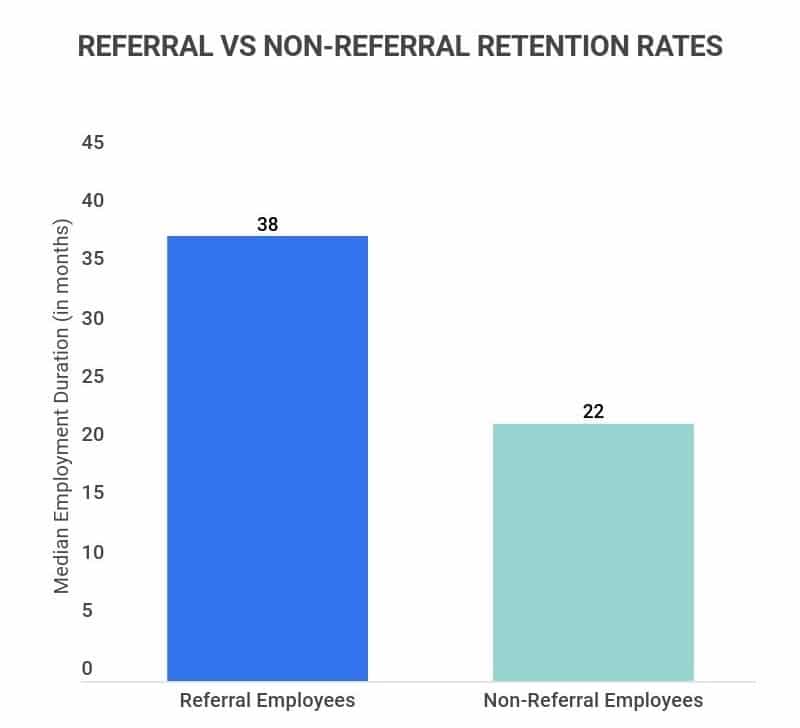
Referred hires stay 70% longer than non-referrals.
The difference is striking, with 50% of referral employees remaining with the company for at least three years, while 50% of non-referrals leave within just over a year and a half.
-
Hiring through referrals can reduce turnover by up to 20%.
Even when referrals account for only 30% of new hires, companies experience a turnover reduction of approximately 6%.

Employee Referral Statistics By Performance
Consistent hiring via employee referrals correlates with enhanced performance metrics for both employees and employers. This improved performance can lead to notable savings. Our research indicates that:
-
88% of employers rate employee referrals as the highest return on investment (ROI) for talent sourcing.
This is largely due to the cost savings and performance efficiencies that referrals bring, as they often possess the skills that employers prioritize.
Additionally, utilizing referrals helps prevent understaffing by maintaining a continuous pool of candidates.
-
Referral employees are 25% more profitable.
This includes the average cost-per-hire savings of $1,000 compared to other hiring sources, coupled with lower turnover rates and enhanced job performance.
-
70% of businesses believe referrals provide the best cultural fit.
A strong workplace culture is vital, and employers find that referred candidates are often more aligned with their organizational values.
Employee Referral Statistics By Frequency
With the proven effectiveness of employee referrals, employers are increasingly relying on this method rather than traditional job boards. Our findings suggest:
-
Up to 45% of internal hires come from referrals.
This means that if a company internally hires 500 employees in a year, about 225 will be referred candidates, which is notable considering that only around 7% of all applicants are referrals.
-
Around 71% of employers in the U.S. have established a referral program.
Employers are increasingly providing bonuses and other incentives to employees who participate in these programs. For instance, Dell leverages its referral program to gather 40,000-50,000 referrals annually.
-
Referrals represent only 7% of total U.S. applicants as of 2022.
This figure is surprisingly low, given that referrals account for 30-50% of hires. For example, in a scenario where 200 people apply for 10 positions, only 14 are referrals.
However, 4 out of 14 referred candidates are hired, compared to just 5 out of 186 non-referrals, demonstrating a 28.5% hiring probability for referrals versus only 2.7% for non-referrals.
-
Booz Allen Hamilton boasts one of the most successful referral programs in the nation, attributing 55% of their hires to referrals.
Employees at the firm can earn up to $3,000 for successful referrals.
-
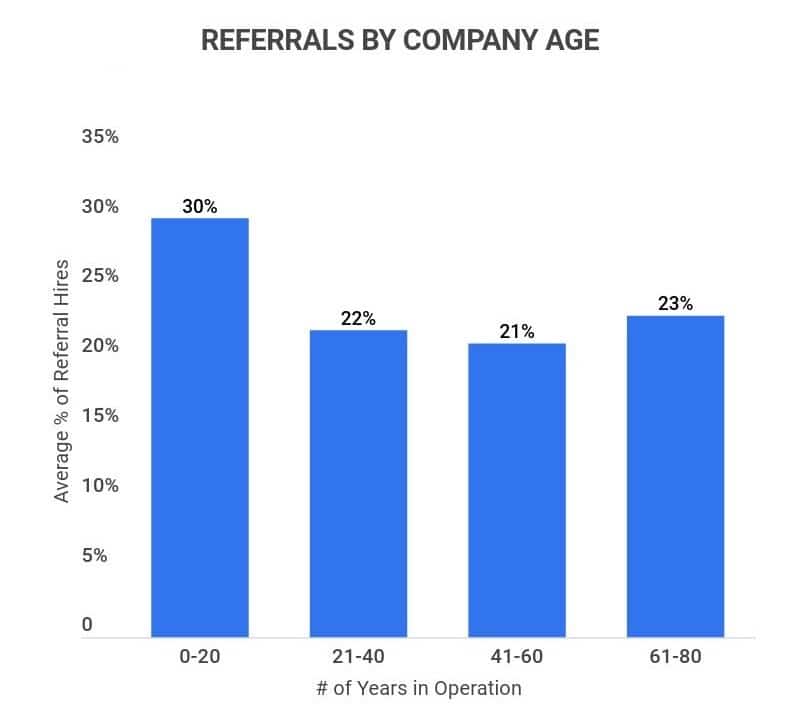
Companies aged 0-20 years are more reliant on referrals, with nearly 30% of all hires coming from this source.
This is significantly higher than the 21% for companies aged 41-60 years.
-
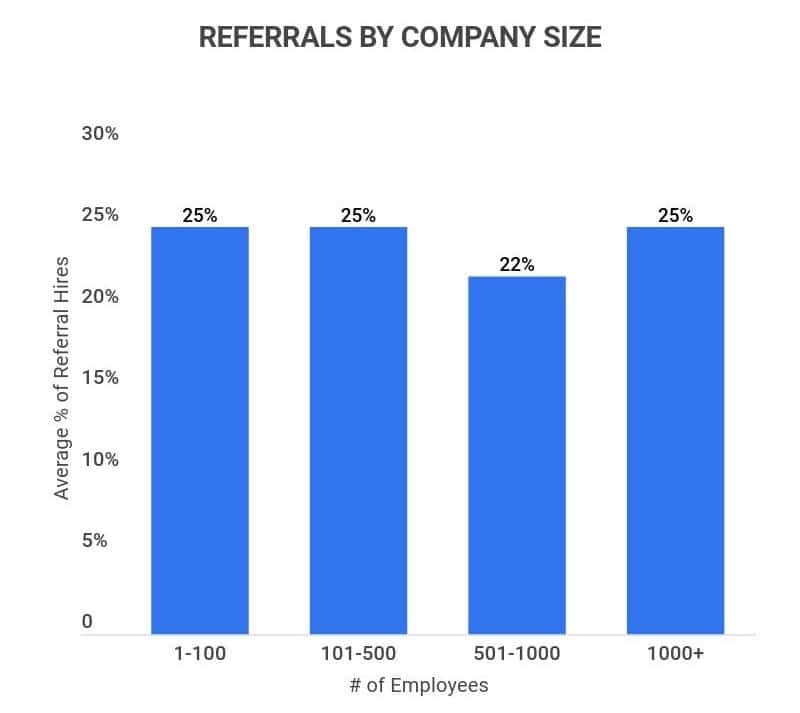
All companies, regardless of size, receive over 20% of their hires through referrals.
While companies with 500-1,000 employees see the lowest referral rate at about 22%, all sizes equally benefit from referrals.
-
72% of interviews conducted are for referred candidates.
Despite making up only 7% of applicants, referrals constitute a staggering 72% of interviews. For instance, out of 300 applicants, if only 30 are interviewed, 21 of those will be referrals.
Employee Referral Statistics By Referral Programs
Many U.S. companies implement referral programs to attract high-quality hires while rewarding referring employees. Here are some key insights:
-
Companies can expand their talent pool by 10x through employee referrals.
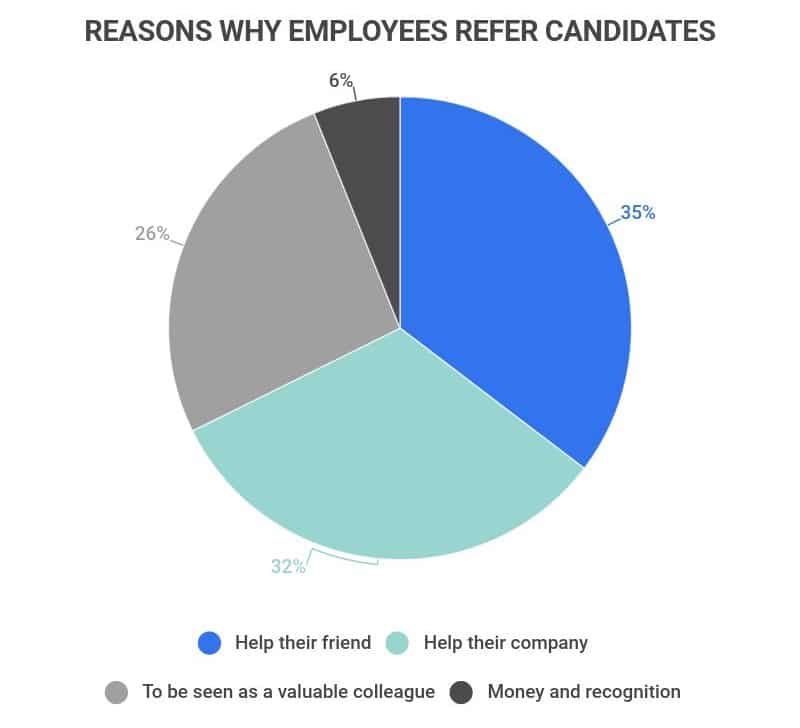
Most employees are willing to assist in this process without financial compensation, with 67% referring to help friends or the company, while only 6% do it for money.
-
Only 4% of referral programs successfully achieve a 30% referral hire rate.
This low success rate often stems from inadequate employee incentives, indicating that many companies have room for improvement in their referral strategies.
-
The average employee referral bonus is $2,500.
However, bonuses can vary between $1,000 and $5,000 based on factors like employee seniority.
-
35% of employees refer candidates to help friends.
Additionally, 32% do it to assist their company, while 26% wish to be seen as valuable colleagues; only 6% refer for financial gain.
-
69% of companies offer referral bonuses ranging from $1,000-$5,000.
These incentives aim to boost employee participation in referral programs.
-
Referrals take an average of 13+ days less to hire.
The typical hiring process lasts 42 days, but this can be shortened to 29 days for referral candidates, saving up to 31% of hiring time.
Employee Referral Statistics FAQ
-
What percentage of hires are employee referrals?
As of 2022, employee referrals constitute 30-40% of hires. Factors such as company size, longevity, and the effectiveness of referral programs influence these statistics.
For instance, companies under 20 years old have a 30% referral rate, while it drops to 21% for those aged 41-60.
Overall, referrals comprise a significant portion of hires, considering that only 7% of applications are referrals.
-
What is the average employee referral bonus amount?
The average employee referral bonus is $2,500. However, amounts typically range from $1,000 to $5,000, reflecting a substantial incentive for many employees.
-
How effective is an employee referral program?
Employee referral programs are highly effective for sourcing quality employees and reducing costs. Successful programs can save over $1,000 in hiring costs and reduce the hiring process by more than 13 days.
The primary challenge lies in incentivizing employees, as only 6% participate for financial rewards. Fostering a positive company culture may prove more effective.
-
What percentage of companies have an employee referral program?
71% of U.S. companies have a referral program. Nonetheless, only 4% of these successfully achieve a 30% referral hire rate, revealing potential for improvement.
Encouraging employees to engage with their networks is crucial, as 35% refer primarily to assist friends.
-
Do referred employees stay longer?
Yes, referred employees remain with their employers 70% longer. Referral hires have a retention rate of 46%, compared to just 33% for job board hires, representing a 40% increase in retention. Small companies particularly benefit, with referral hires staying 122% longer than non-referrals.
-
Do companies prefer referrals?
Yes, companies indeed prefer referrals. The advantages of referrals include:
-
Faster hiring times. Employers save an average of 13 days when hiring a referral.
-
Lower hiring costs. Employers save over $1,000 when bringing on a referral.
-
Longer retention. Referrals tend to stay 70% longer on average, with 45% remaining for over four years compared to 25% from job boards.
-
Better cultural fit. 70% of employers believe referrals align best with their company culture, as these candidates often have prior knowledge about their roles and potential colleagues.
-
Conclusion
Employee referrals have emerged as a critical and effective strategy for organizations aiming to hire top talent. Despite making up only 7% of the applicant pool, referrals account for 30-50% of successful hires.
Referrals provide employers with numerous advantages, including significant cost savings and longer employee tenures. To maximize the benefits of referral hiring, organizations should focus on refining their referral programs. Financial incentives alone may not yield the desired results; fostering a positive workplace culture and encouraging networking among employees could lead to a more robust referral system.
Sources
-
Undercover Recruiter. “Why Employee Referrals are the Best Source of Hire.” Accessed on March 13th, 2022.
-
Talentspotting. “How can employee referral help you cut recruitment costs?” Accessed on March 13th, 2022.
-
ICIMS. “How Employee Referrals Impact Retention.” Accessed on March 13th, 2022.
-
HRTechSeries. “How Employee Referrals Can Reduce Hourly Worker Turnover.” Accessed on March 13th, 2022.
-
CareerBuilder. “How Employee Referral Programs Turn Good Employees Into Great Recruiters and Grow Your Bottom Line.” Accessed on March 13th, 2022.
-
CareerBuilder. “2020 Employee Referral Programs Benchmark Report.” Accessed on March 13th, 2022.
-
BLR. “Fuel Your Employee Referral Program with a Marketer Mindset.” Accessed on March 13th, 2022.
-
TalentCulture. “How to Get More People to Use Your Employee Referral Program.” Accessed on March 13th, 2022.
-
Monster. “How to Create a Successful Employee Referral Program.” Accessed on March 13th, 2022.
-
SHRM. “Employee Referrals Remain Top Source for Hires.” Accessed on March 13th, 2022.
-
LinkedIn. “The Ultimate List of Hiring Statistics.” Accessed on March 14th, 2022.
-
Firstbird. “The future of employee referrals after COVID-19.” Accessed on March 14th, 2022.
- Workplace Statistics
- Time Management Statistics
- Employee Wellness Statistics
- Employment Discrimination Statistics
- Employee Recognition Statistics
- Employee Referral Statistics
- Workplace Violence Statistics
- Gamification Statistics
- Employee Feedback Statistics
- Agile Statistics
- Productivity Statistics
- Meeting Statistics
- Cell Phones At Work Statistics
- Social Media At Work Statistics
- Workplace Injury Statistics
- Workplace Stress Statistics
- Leadership Statistics
- Workplace Collaboration Statistics
- Job Satisfaction Statistics
- Paid Holiday Statistics
- Communication In The Workplace Statistics
- Wasting Time At Work Statistics
- 4-day Workweek Statistics

Author

Jack Flynn is a writer for Zippia. In his professional career he’s written over 100 research papers, articles and blog posts. Some of his most popular published works include his writing about economic terms and research into job classifications. Jack received his BS from Hampshire College.