- Demographic Reports
High school job research summary. Securing employment as a teenager offers invaluable professional experience, helps fund college aspirations, and provides extra spending money.
Our research team has compiled the latest statistics on high school jobs in the U.S.:
-
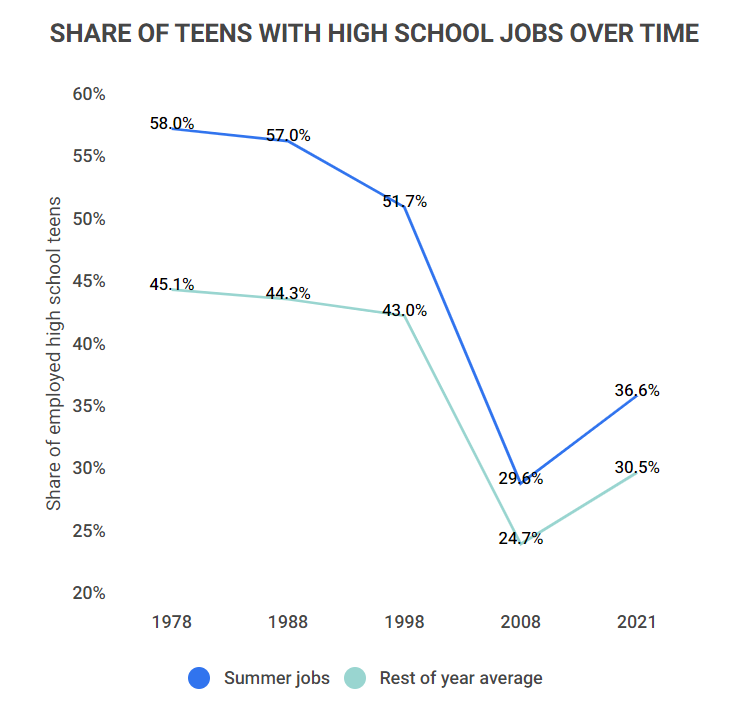
As of 2023, only 30.5% of teens ages 16 to 19 had jobs.
-
Approximately 36.6% of teens in this age bracket held summer jobs in 2023.
-
Since 2000, the percentage of teens employed in summer jobs has decreased from 51.7% to 36.6%.
-
From 2000 to 2023, the proportion of teens working during non-summer months has dropped from 43% to 30.5%.
For more in-depth insights, explore the following sections:
Types | Summer Jobs | Trends and Predictions
General High School Job Statistics
Since the pandemic, the number of teens with high school jobs has seen a gradual increase from its low in 2020. However, current employment levels are still below those recorded in 2019. Here are some key statistics about high school jobs in the U.S.:
-
Approximately 6 million teens aged 16 to 19 are currently employed.
This figure represents an average over the year, with the highest employment rates typically occurring during July, August, and September.
-
During the non-summer months of 2023, an average of 30.5% of teens held jobs.
In contrast, 36.6% were employed during the summer months, reflecting a seasonal uptick as many students take on work during these periods.
-
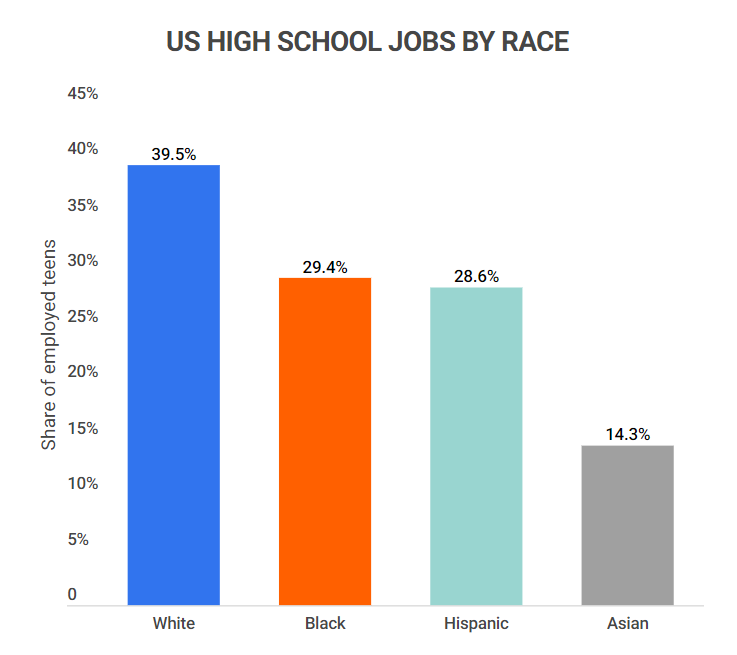
Employment rates vary among different racial demographics.
In summer 2021, around 39.5% of white teens held jobs, compared to 29.4% of Black teens, 28.6% of Hispanic teens, and 14.3% of Asian teens. These trends persist throughout the year.
-
The median weekly earnings for teenage workers is $497.
This translates to an annual income of approximately $25,844 for those working full-time, although these figures fluctuate seasonally.
Types of High School Jobs Statistics
High school jobs often share similarities due to the limited experience of teenage workers. Employers willing to hire teens typically offer training, which narrows the job pool.
-
In 2023, food preparation and serving-related occupations were the most commonly held jobs among high school workers, with 1.231 million positions.
Specifically, 268,000 teens worked as cooks, 262,000 as fast food and counter workers, 259,000 as waitstaff, and 180,000 as food prep workers.
-
18.7% of food preparation and serving-related jobs in 2023 were filled by teens aged 16 to 19.
This percentage slightly trails behind the 20- to 24-year-olds at 20.6% and 25- to 34-year-olds at 21.1%.
-
High school-age workers predominantly occupy cashier roles.
In 2023, teens aged 16 to 19 held 682,000 out of 2.552 million cashier positions, followed by 20- to 24-year-olds with 633,000.
Summer Job Statistics
Summer employment is particularly appealing for teens, who often face limitations during the school year. Here are some key statistics about summer jobs:
-
In 2023, 36.6% of teens secured summer jobs.
This marks an increase from 28.6% during the financial crisis of 2008, yet it remains lower than the 51.7% recorded in 2000.
-
The accommodation and food services sector accounted for 36.2% of teen summer jobs in 2023.
Retail trade followed with 21.3%, while arts, entertainment, and recreation provided 8.1% of summer employment opportunities.
-
Approximately 2.3 million teens engaged in food preparation and serving-related summer jobs in 2023.
This was the highest among job categories, followed by sales-related roles employing 1.4 million teens.
High School Job Trends and Projections
Teen summer employment has fluctuated over the years. Although numbers are improving since the pandemic and the 2008 recession, youth employment remains significantly lower than in previous decades. Here are some notable trends and projections:
-
In 2023, teens constituted 1.21% of the full-time workforce, down from 2.25% in 2000.
This decline can be attributed to shorter summer breaks, increased emphasis on extracurricular activities, internships, and volunteer work, all aimed at enhancing college applications.
-
Between February and April 2020, 1.9 million teens lost their jobs due to pandemic-related closures.
Consequently, the number of employed teens in July 2020 was significantly lower than in July 2019, with only 30.8% working that summer.
-
As of May 2023, 33.7% of teens were employed, marking the highest rate for that month since 2008.
While this indicates recovery from pandemic lows, the overall trend of decreasing teen employment persists.
High School Job FAQ
-
What percentage of high school-age students have jobs?
Just over 30% of high school-age students have jobs. This percentage is higher for those with summer jobs, as 36.6% of 16- to 19-year-olds worked during the summer of 2023.
-
Is having a job in high school worth it?
Generally, yes, having a job in high school is beneficial.
Success in balancing work and school responsibilities can impress college admissions counselors and hiring managers, showcasing responsibility, organization, and drive.
-
How many hours can teens work each week?
Teens aged 16 and older can work any number of hours weekly. They must adhere to the same hourly restrictions as adults, though some states may impose stricter regulations. Federal law imposes no hour limits for those 16 and older.
14- and 15-year-olds face restrictions, with a maximum of 18 hours during school weeks and 40 during non-school weeks, along with time-of-day limitations to ensure school attendance.
-
Why are fewer teens working?
Fewer teens are working due to reduced job availability and increased competition. The perception that modern teens are less motivated is misleading; older workers are often preferred for available positions, as they are seen as more stable and committed.
With over 40% of workers aged 55 and older actively seeking employment, teens face stiff competition for retail and service jobs traditionally held by their age group.
Conclusion
Approximately one-third of teenagers aged 16 to 19 are currently employed. While many work during the school year, summer employment remains the most prevalent.
These young workers primarily occupy roles in the food service and retail sectors, including positions as cashiers, servers, cooks, and stockers.
The pandemic had a profound impact on summer employment in 2020, with 1.9 million teens losing their jobs within a few months. The summer of 2020 saw the lowest employment rate since the Great Recession, with only 30.8% of teens working.
While recovery has been noted since 2021, the overall employment rate for 16- to 19-year-olds has declined steadily over the past decade.
Factors contributing to this trend include a greater emphasis on internships, volunteer work, and extracurricular activities aimed at enhancing college applications.
References
-
U.S. Bureau of Labor Statistics. “Data Retrieval: Labor Force Statistics (CPS).” Accessed on June 23, 2023.
-
Pew Research Center. “During the Pandemic, Teen Summer Employment Hit Its Lowest Point Since the Great Recession.” Accessed on June 23, 2023.
-
U.S. Bureau of Labor Statistics. “Labor Force Statistics From the Current Population Survey.” Accessed on June 23, 2023.
-
U.S. Department of Labor. “Fair Labor Standards Act Advisor.” Accessed on June 23, 2023.
- Demographic Reports

Author

Chris Kolmar is a co-founder of Zippia and the editor-in-chief of the Zippia career advice blog. He has hired over 50 people in his career, been hired five times, and wants to help you land your next job. His research has been featured on the New York Times, Thrillist, VOX, The Atlantic, and a host of local news. More recently, he's been quoted on USA Today, BusinessInsider, and CNBC.