Find a Job You Really Want In
When sending in a job application, cover letters are your chance to show off your personality and why you’re a great fit for the position. It can be difficult to strike a good balance between talking about your qualifications and adding some personality and flavor to your cover letter.
Making sure your cover letter shines is a great way to make your job application stand out and get noticed by hiring managers.
So many of the cover letters and applications that pass through hiring teams are bland, so taking the time to perfect your cover letter can really impress hiring teams.
Key Takeaways:
-
Selling yourself in a cover letter is your chance to show how you are qualified, unique, and valuable.
-
To sell yourself in a cover letter, first match your skills and values with that of the employer.
-
Use the four paragraph, 250-400 words structure of a cover letter to demonstrate your skills and how they can be used for the employer.
-
Use keywords from the job description to stand out.
Why Is It Important To Sell Yourself In A Cover Letter?
Cover letters are opportunities to promote your qualifications in a manner that is more personal and in-depth than a resume. You will want to use this opportunity because a cover letter lets you show:
-
How you are qualified. A cover letter gives you a chance to explain your skills and experience with more context. The reader should be able to see that you can back up your resume.
-
Why you are unique and valuable. You can use a cover to stand out among other applicants and show what you will be able to contribute to as an employee.
-
Personality. Inevitably, with writing, your personality and interpersonal skills come through. The reader can interpret a little bit more about who you are as a person and what kind of fit you would be for the company.
Combined, all these should impress the reader and make them want to learn more about you.
How To Sell Yourself In A Cover Letter
To sell yourself in a cover letter you want to:
-
Match your skills and values with the employer. You need to be relevant. What’s more, you need to be indispensably relevant. By aligning yourself to the needs of the company, you show that you have potential to be an invaluable asset.
-
Demonstrate your skills with an engaging example. Now that your skills are matched up, you need to back them up. Provide an example that shows how your skills were successfully put into action.
-
Show how your skills can help the employer. Underscore how your skills can contribute to success. You want to convince the reader that your skills are tools that would be best put to use within the company.
You are making an argument for yourself. Take the reader along, prove to them your worth, and convince them that you are exactly who they need.
Using The Cover Letter Format To Sell Yourself
A successful cover letter all comes down to how you structure your argument and what you focus on. The format of a cover letter should explore how your skills have been successfully put into action in the past and demonstrate what you can offer to your potential employer.
A cover letter is between 250 and 400 words long and is broken up into four paragraphs. Generally a cover letter follows this structure:
-
Introduction. This both provides context and is your hook that makes the reader want to learn more about you.
-
Previous experience. Explore one or two previous experiences that demonstrate how your skills were put into action and led to success. It is particularly helpful if you can provide quantifiable results.
-
What you have to offer. Match your skills and values with that of the company to show how you can fulfill their needs. You want to make yourself an asset to their success.
-
Conclusion. Wrap everything up in a logical manner and provide a call to action to prepare for the next steps of the application process.
However, understand that is is only a guideline. What’s more important is that you show how you are qualified and what you have to offer for your employer’s future success.
Tips for Writing a Winning Cover Letter
While there’s no sure-fire formula for writing a winning cover letter, there are a few things that you can do to make sure your letter stands out. Here are a few tips to help you get noticed and write the perfect cover letter every time:
-
Switch it up. When you apply for a new job, you should write a new cover letter. Not every job description and company is the same, so it’s best to edit your cover letter to specifically address each job posting and company.
Tailor the experiences you talk about to the job description and make sure you sell yourself for that specific job and company.
-
Focus on the opening. Cover letters are often dull, so to really put your best foot forward you should make the opening extra interesting.
If you can pull your reader in from the beginning, you can make a great impression. If you want to make your opening extra attention-grabbing you can start by:
-
Showing off your passions
-
Connecting with the company
-
Telling a story
-
Writing a belief statement
-
Highlight a mutual connection
-
List your accomplishments
-
-
Avoid rewriting your resume. Cover letters get a bad rap since they often repeat what’s already written on a resume. While you can’t avoid repeating some things on the two documents, it’s a good idea to make them pretty separate.
Use the opportunity to spice up what’s on your resume and go in-depth about your responsibilities at a previous job or talk about how you ended up in the industry.
-
Keep it positive. You should always have a positive tone and show that you love what you do. Talk about your favorite professional experiences or what you loved doing in past jobs.
Being able to show passion for your field will help you get noticed and make a good impression.
-
Make it personal. If you can find the name of the hiring manager, you should personally address them in the salutation.
Start your letter off with “Dear [hiring manager],” so you can show that you did your research and you’re more engaged than the average applicant.
-
Talk about potential deal-breakers. Sometimes you might have something on your resume that would give an employer pause, so cover letters are the perfect time to try and calm their worries.
If you have gaps in your work history or anything that might make you a less-than-ideal candidate, you can talk about what happened and convince them that it won’t be an issue.
-
Leave your education behind. If you’re a few years out of school and you have your education history on your resume, you don’t have to detail your education. Only bring up your college or advanced degrees if it’s particularly relevant to the job.
-
Go short and sweet. You might think that the more you can pack into your cover letter, the more impressive it will be, but you should go for short and sweet.
This way, you can show the most important parts of yourself and show employers that you know how to be concise.
-
Find job keywords. Job postings usually use certain keywords that are related to the skills employers are looking for and the responsibilities that they’re looking for someone to fill.
Adding some of these keywords to your cover letter and talking about how you demonstrate them is a great way to align yourself with the job description and impress hiring managers.
-
Highlight what you can do for the company. Often people write cover letters to express why the company is the best fit or what the company can do for them. Instead, you should focus on what skills and expertise you can bring to the company.
Find ways to make yourself invaluable to the company and sell them in your cover letter.
-
Pick the most relevant examples. Cover letters can get lengthy when you try to include everything that might be useful for a hiring manager to know. Instead, focus on what’s most relevant to the job description and the industry of the company.
-
Bring out stats. Whenever you can use numbers and stats, you have a chance to impress hiring managers. Instead of explaining that you boosted sales, find a number that expresses that better, like “increased sales by 125%” to give proof.
Sample Cover Letter
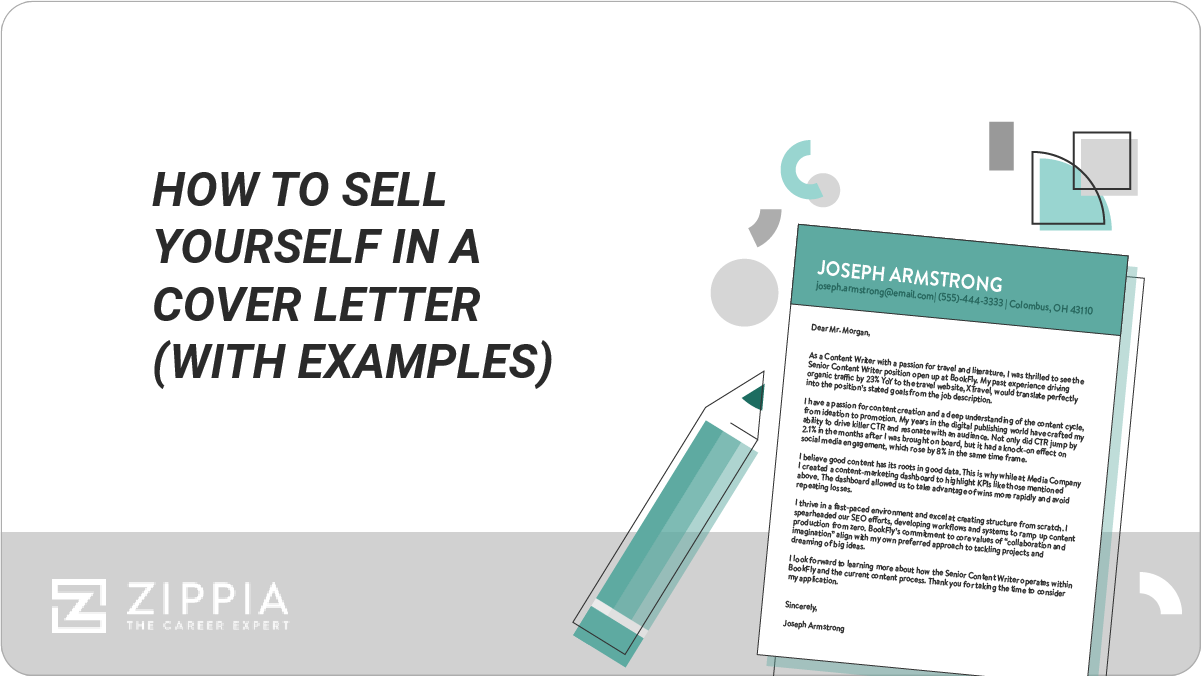
We’re going to show you a sample cover letter that will stand out from the rest of the applicants’ letters. You can use this as a starting point to make your cover letter the best it can be.
Dear Mrs. Smith,
As soon as I learned that ABC Tech was hiring, I knew that I had to apply. Ever since I was a little girl, I’ve loved working with computers. That has followed me into my professional life and I am passionate about connecting people with their perfect device, starting with my first job at ABC Tech’s New York City location as a sales associate.
My extensive history in sales for tech companies uniquely positions me to excel with ABC Tech. I have worked in consumer-facing tech sales since 2009 and have worked in managerial positions since 2016. My first job was with ABC Tech and I understand the catalog extensively after working with you and keeping up with your new product releases.
In response to the responsibilities that were listed on the job description, I have:
Experience in customer-facing sales positions
Experience with customer service
Managerial skills
A proven record of exceeding sales goals
Award-winning leadership skills
I am eager to hear back from you. If you have any questions about my skills or qualifications, please do not hesitate to reach out. Thank you for taking the time to consider my application.
Sincerely,
David Baum
Why Are Cover Letters Important?
Cover letters are an important way to highlight how your unique blend of experience and skills matches the job description’s requirements. This gives you the opportunity to stand out among other applicants.
To really get the most out of your cover letter, you need to include experiences that aren’t on your resume or explain your work history, plus add a little bit of personality.
Since cover letters are more open-ended than resumes, you get a unique opportunity to really sell yourself to an employer. They can be especially helpful if employers don’t require you to fill out questions when submitting your application.
Cover letters are also a chance to show off your personality and help the employer determine if there’s a culture fit. These days, companies look for new hires who will not only contribute their skills to advance company goals, but also help them create a welcoming and vibrant company culture.
Finding ways to include personality in your cover letter can help you stand out and prove that you’d be a great culture fit.

Author

Amanda is a writer with experience in various industries, including travel, real estate, and career advice. After taking on internships and entry-level jobs, she is familiar with the job search process and landing that crucial first job. Included in her experience is work at an employer/intern matching startup where she marketed an intern database to employers and supported college interns looking for work experience.
Expert
Matt Warzel a President of a resume writing firm (MJW Careers, LLC) with 15+ years of recruitment, outplacement, career coaching and resume writing experience. Matt is also a Certified Professional Resume Writer (CPRW) and Certified Internet Recruiter (CIR) with a Bachelor of Science in Business Administration (Marketing Focus) from John Carroll University.