- Job Offer And Requirements
- How To Accept A Job Offer
- How To Decline A Job Offer
- Employment Contract
- Pre Employment Physical
- How To Get Secret Clearance
- Pre Employment Drug Tests
- How To Respond To A Job Rejection Email
- What Does Employers Look For In A Background Check
- How Long For A Career Background Check
- How To Ask For Time To Consider A Job Offer
- How To Turn Down A Job Offer But Keep The Door Open
Find a Job You Really Want In
Understanding how to decline a job offer is essential in today’s dynamic job market. You may find yourself in a situation where the role doesn’t align with your career aspirations, or the company culture doesn’t resonate with your values. When you decide to decline a job offer, it’s crucial to be certain of your decision and to communicate your choice to the employer promptly.
In this article, we will discuss respectful ways to decline a job offer and provide example emails for various scenarios you might face.
Key Takeaways:
-
Keep your communication concise and straightforward when declining a job offer.
-
Inform the recruiter or employer of your decision as soon as you are certain.
-
It is possible to decline a job offer even after previously accepting it.
How to Reject a Job Offer
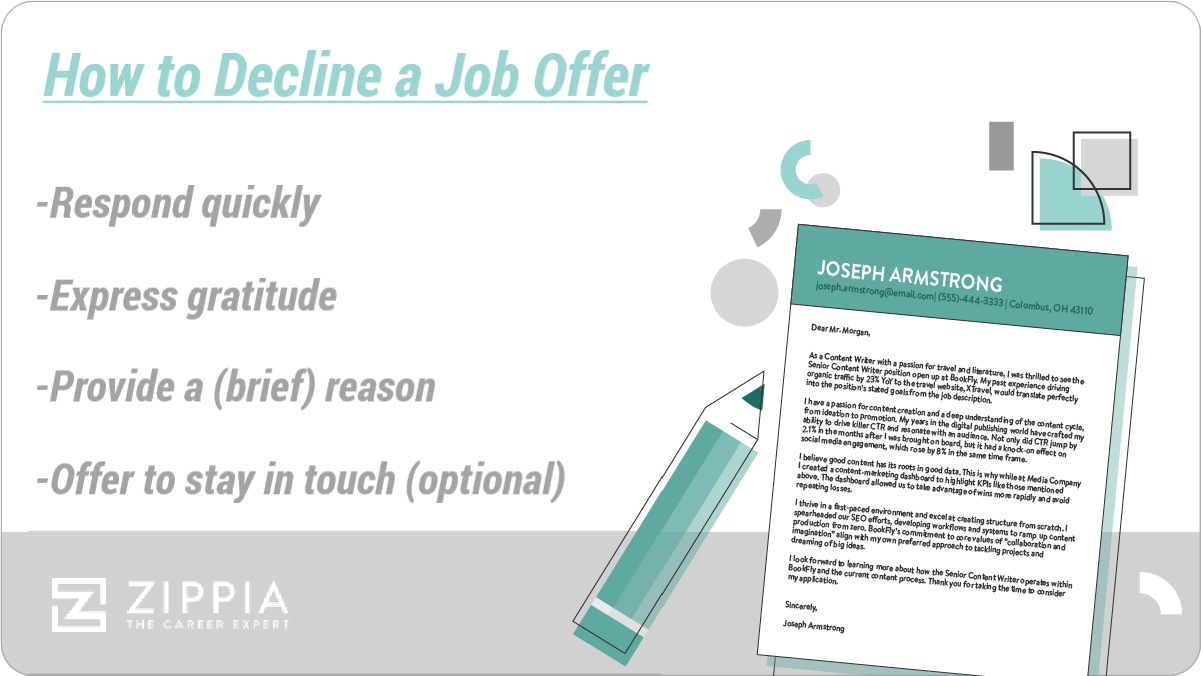
Before you decline a job offer, ensure that it’s the right decision for you. Respond as quickly as possible once you’ve made your choice. Here’s a detailed guide on how to reject a job offer:
-
Be Certain. Once you inform a recruiter or hiring manager of your decision, there’s no turning back. An employer is unlikely to reconsider you for that position after you send a rejection email, and a recruiter may hesitate to work with you again if you change your mind too easily.
Reflect on your reasons for declining. If the role is a necessary stepping stone towards broader career goals, you might consider accepting it—especially if the company has potential for long-term satisfaction.
-
Respond Quickly. While it’s important to be sure of your decision, aim to respond to the employer or recruiter as early as possible within the timeframe they provide. Promptness demonstrates professionalism.
-
Email or Call. A rejection email is appropriate in most cases, but if you prefer a more personal touch or had a great rapport with the interviewer, consider making a phone call. This can help you stand out for future opportunities with the company.
-
Express Gratitude. Acknowledge the time and effort invested in your interview process. You made a positive impression; show appreciation for the opportunity.
-
Provide a Reason. Keep your explanation brief and professional. Avoid negative comments about the interviewer or the company culture. A simple statement like “the job didn’t align with my career goals” usually suffices. You can also mention accepting another offer or deciding to remain in your current position.
-
Don’t Ramble. It’s natural to want to soften the blow with excessive compliments, but stick to the point. Clearly communicate your decision without unnecessary elaboration.
-
Offer to Stay in Touch. If you had a positive interaction with someone during the interview process, consider offering to stay connected. A well-crafted rejection email can help expand your professional network.
How to Turn Down a Job Offer: Example Emails
Below are example emails for different scenarios, including how to decline a job offer due to salary concerns or to remain with your current employer. Tailor these templates to your specific situation.
-
Declining a Job Offer Due to Lack of Fit
If you appreciate the company but feel the position isn’t the right fit, you can express this in your email. Mention your key skills and the type of responsibilities you are seeking.
Dear Mr. Captain Planet,
Thank you for offering me the position of Office Assistant with Carolina Solar Services. I appreciate the time you took to consider me for the role and for answering my questions about the company.
After careful consideration, I have decided not to accept the position, as it does not align with my career goals. I am seeking a role that allows me to directly apply my knowledge of solar energy in the field, moving me closer to my goal of becoming a solar technician. If a more suitable position becomes available in the future, I would be grateful to be considered.
Thank you once again for your consideration, and I wish you the best.
Best regards,
Captain AmericaBy explaining your career aspirations, you may keep the door open for future opportunities within the company.
-
Declining a Job Offer Due to Company Culture
If you feel the company isn’t right for you, it’s important to communicate this without being negative. Thank them for the opportunity and express your decision in a professional manner.
Dear Mr. Shrek Ogre,
Thank you for taking the time to interview me last week. It was a pleasure meeting the team and learning about the Swamp Cleaner position.
While I appreciate the offer, I have decided that it is not the right time for me to leave my current position. I sincerely thank you for the opportunity and regret that it didn’t work out. I wish you success in finding the right candidate for the role.
Best regards,
Hank Hill -
Declining a Job Offer Due to Salary
If salary negotiations did not meet your expectations, you can politely decline while expressing gratitude and interest in the role.
Dear Mr. Cheap Bastard,
Thank you for the opportunity to interview for the Money Counter position. I enjoyed meeting the team and appreciate the offer.
However, I must decline, as the salary does not align with my financial needs. Based on my research, the typical range for this position is between $35,000 and $40,000. If there is flexibility in the compensation, I would be eager to discuss further.
Thank you for your time and consideration.
Best regards,
A Poor Person -
Declining a Job Offer After Accepting Another
Having multiple offers can be challenging, but it’s essential to express gratitude and be honest about your decision.
Dear Mr. Fox Mulder,
Thank you for offering me the Junior Alien Hunter position. I appreciate the time you devoted to our discussions.
While this role is appealing, I have decided to pursue another opportunity that better aligns with my career goals.
It was a pleasure getting to know you, and I hope our paths cross again in the future.
Best regards,
Dana Scully -
Declining a Job Offer to Stay with Current Employer
If you’ve received a promotion or feel satisfied with your current job, it’s perfectly acceptable to decline a new offer.
Dear Mr. Mario,
Thank you for the offer for the Associate Plumber position. I appreciate your time and insights about your company’s history.
While this opportunity is enticing, I have decided to remain with my current employer.
It was a pleasure meeting you, and I wish you success in your endeavors.
Sincerely,
Wario -
Declining a Job Offer Due to Personal Reasons
Life events may necessitate declining an offer, and it’s crucial to maintain professionalism and gratitude in your communication.
Dear Mr. Mark,
I hope this message finds you well. Thank you for extending the job offer for the Marketing Manager position at XYZ Company. I appreciate the effort your team invested during the interview process.
After careful consideration, I have decided to decline the offer due to personal reasons. This was not an easy decision, as I have great respect for your company.
Thank you once again for the opportunity, and I wish you continued success.
Best regards,
Everly Thompson
How to Politely Decline a Job Offer: FAQ
-
What is the best reason to reject a job offer?
The best reason to decline a job offer is that you do not feel enthusiastic about the role or that it doesn’t align with your career objectives. Hiring managers may initially be disappointed, but they will appreciate your honesty and professionalism.
Other valid reasons include salary concerns, accepting another offer, or receiving a promotion at your current job. Although personal feelings about the work environment can be legitimate, they may not be the best reasons to communicate when declining, especially if you wish to maintain a relationship with the company.
-
Is it unprofessional to decline a job offer?
No, it is not unprofessional to decline a job offer. Companies understand that candidates are interviewing multiple opportunities. However, ignoring an offer or taking too long to respond is unprofessional. Politely declining involves quick communication, gratitude for the offer, and a brief explanation of your decision.
-
Is it okay to turn down a job offer after acceptance?
Yes, it is acceptable to decline a job offer after accepting it; however, this should be done cautiously. Most job markets operate under at-will employment, allowing both parties to back out. While it may be awkward, it’s better to decline than to accept and later leave shortly after starting.
-
How do you politely turn down a job offer?
To politely turn down a job offer, reach out to the hiring manager via email or call. Express your gratitude for their time and consideration, then clearly state that you will not be accepting the offer. You may include a brief reason, but keep it to one or two sentences. Politeness involves being appreciative, straightforward, and timely.
-
How do you say I’m not interested politely?
Here are some polite ways to express disinterest:
-
“I appreciate the offer, but I can’t commit at this time.”
-
“I’m honored by the offer, but I must decline.”
-
“It doesn’t seem like the right fit for me.”
-
“Unfortunately, it’s not aligned with what I’m looking for.”
-
Final Thoughts
Turning down a job offer can be challenging, akin to ending a budding relationship. However, prioritizing your career aspirations, salary expectations, or personal happiness is crucial. When rejecting a job offer, always express gratitude, provide a brief reason for your decision, and maintain professionalism.
Avoid burning bridges; you never know when you might cross paths with the employer again or encounter opportunities in the future. Now that you know how to decline a job offer gracefully, it’s time to craft your polite response.
References
Expert Opinion
How to Decline a Job Offer
Sarah Brocks
Career Coach | Managing Director of Eaglerock Career Services
Receiving a job offer is an accomplishment. You’ve made a positive impression, and they want you on their team. Take a moment to feel proud and reflect on what worked. Remember, every job offer can bring you closer to finding the one that truly meets your needs.
In addition to notifying your main contact, I recommend emailing others you met during the interview process. Thank them for their time, share your decision to decline, and express interest in staying connected. You never know when your paths may cross again. Following up with LinkedIn connection requests is also a great idea.
How to Decline a Job Offer
Alison Lobus
Chief Career Officer/Owner
Compass Career Counseling
When declining a job offer, it’s vital to maintain professionalism and express appreciation. Most industries have networks where you may encounter people from that organization in the future. Thus, expressing gratitude for the offer and the interview experience is essential. Connecting with your contact on LinkedIn and checking in periodically can also prove beneficial.
- Job Offer And Requirements
- How To Accept A Job Offer
- How To Decline A Job Offer
- Employment Contract
- Pre Employment Physical
- How To Get Secret Clearance
- Pre Employment Drug Tests
- How To Respond To A Job Rejection Email
- What Does Employers Look For In A Background Check
- How Long For A Career Background Check
- How To Ask For Time To Consider A Job Offer
- How To Turn Down A Job Offer But Keep The Door Open

Author

Maddie Lloyd was a writer for the Zippia Advice blog focused on researching tips for interview, resume, and cover letter preparation. She's currently a graduate student at North Carolina State University's department of English concentrating in Film and Media Studies.