Find a Job You Really Want In
Congratulations to the recent graduates! You’ve reached an exciting milestone in your life.
As you step into this new chapter, you’ll discover numerous advantages, including:
- A fulfilling work life
- Increased financial responsibilities
- A nostalgic longing for the carefree days of college
- The need to schedule your own doctor appointments as adulting brings unexpected health concerns
- Occasional moments of existential reflection questioning your career trajectory
With these thoughts in mind, you might wonder, “Is pursuing a master’s degree worth it?” We’ve done the research to provide clarity on this important decision.
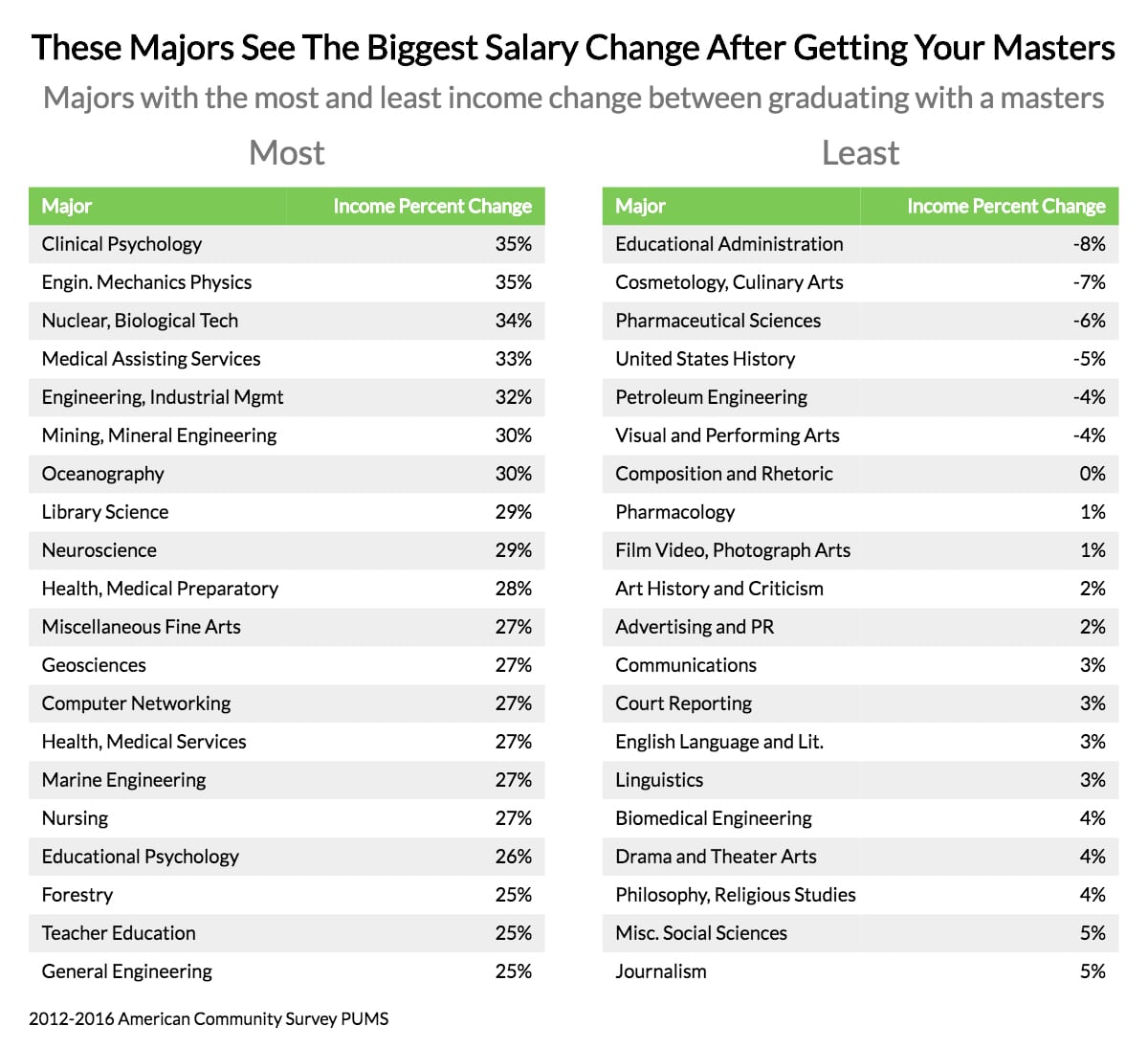
We analyzed data to identify which majors see the most significant shifts in income after obtaining a master’s degree.
Majors With Largest Salary Increase After Graduating With a Master’s
- Clinical Psychology: 35%
- Engineering Mechanics Physics: 35%
- Nuclear, Biological Technology: 34%
- Medical Assisting Services: 33%
- Engineering, Industrial Management: 32%
Majors With Largest Salary Decrease After Graduating With a Master’s
- Educational Administration: -8%
- Cosmetology, Culinary Arts: -7%
- Pharmaceutical Sciences: -6%
- United States History: -5%
- Petroleum Engineering: -4%
Interestingly, pursuing a master’s degree doesn’t always equate to higher earnings. However, for those in STEM fields, advanced education can be particularly beneficial.
As of 2026, approximately 75% of all bachelor degree holders in STEM do not work in STEM-related jobs. This reality underscores the growing necessity of a master’s degree for those aiming for specialized careers in these sectors.
While returning to school in your 30s may seem daunting, the chance to engage in unique research opportunities and enhance your marketability to future employers are compelling reasons to consider graduate school.
Summary of Findings
- Master’s degree holders in seven fields experience a neutral or negative impact on their income, with educational administration leading to an 8% income decrease.
- Petroleum engineering and pharmaceutical sciences graduates see income declines of 4% and 6%, respectively.
- Clinical psychology and engineering mechanics boast the highest pay increases, each at 35%.
- Nuclear technologies graduates enjoy a substantial salary increase of 34%.
- STEM majors are significantly impacted financially, gaining the most from obtaining a master’s degree.
How We Conducted Our Research
This analysis utilized data from the Census Bureau, specifically the American Community Survey PUMS dataset from 2017-2021.
Our study focused on full-time workers aged 30 to 54, allowing sufficient time for individuals to earn their master’s degrees (as graduating with a master’s at 22 is uncommon).
To determine the percentages, we calculated the average income for bachelor’s and master’s degree holders within each major, then analyzed the differences to derive the income changes.
In conclusion: Consider your educational path carefully; pursuing a master’s degree can be advantageous, but it’s essential to align it with your career goals.

Author

McLeod Brown is a former writer and researcher for the Zippia Career Advice blog. His work at Zippia focused on understanding the relationship between colleges, debt, and jobs. A graduate of the University of North Carolina at Wilmington with a BA in Business Administrator, he is now pursuing a masters of science in analytics from the Institute of Advanced Analytics.