Male vs. Female Jobs: Gender Disparities in the Workforce
As of 2026, women make up 46.8% of the U.S. workforce, according to the Bureau of Labor Statistics (BLS). However, the distribution of male and female workers varies significantly across different occupations. For example, the likelihood of encountering a male kindergarten teacher is about 1 in 100, and if your air conditioning unit breaks, there’s only a 1% chance that the technician who arrives to repair it will be a woman.
This gender disparity can be attributed to a mix of societal norms, personal preferences, and long-standing stereotypes. Below we explore the occupations that are heavily dominated by one gender and what this situation might indicate for today’s job market.
-
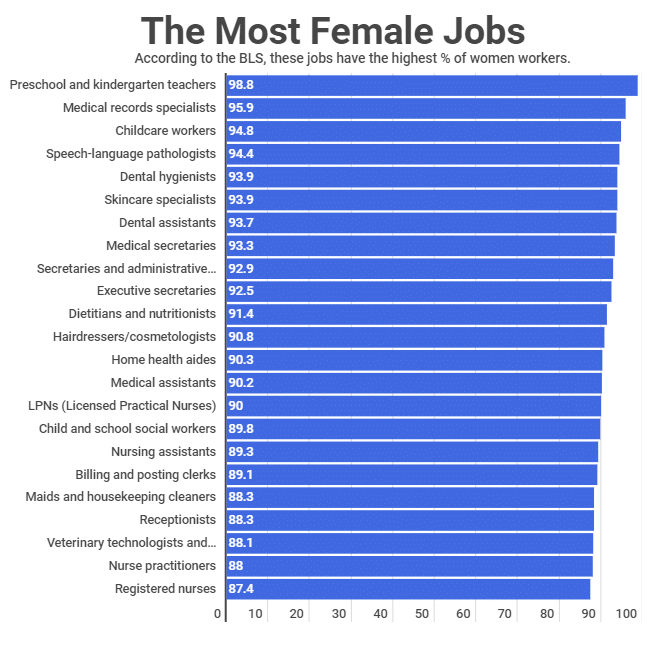
Preschool and kindergarten teachers are predominantly female, with 98.8% of these positions held by women.
-
Other female-dominated roles include secretarial positions and various nursing roles.
-
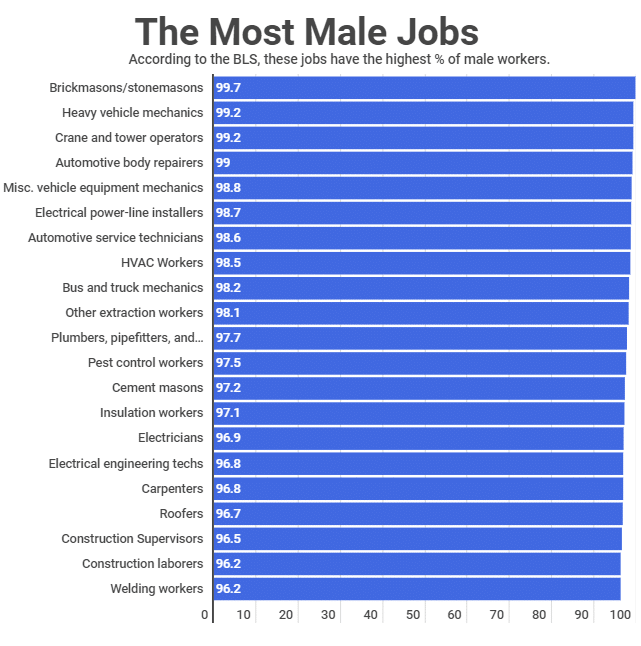
On the male side, the occupation with the highest concentration of men is that of brick masons.
-
Overall, the trades are significantly male-dominated.
-
Carpenters, electricians, HVAC technicians, plumbers, and various types of mechanics are all more than 96% male.
-
While many professions exhibit a stark gender gap, some roles maintain a near-equal distribution, including technical writers, bartenders, and insurance sales.
A technical writer, an insurance salesperson, and a bartender have something in common: they are equally likely to be men or women in their respective roles.
Below is a visual representation of jobs with the fewest female workers.
Methodology
The information presented in this article is derived from the BLS’s latest report on the gender distribution within over 500 job categories. We sorted the data by the percentage of female workers to identify the occupations where women hold the majority. The number of male workers was then calculated by subtracting the number of female workers from the total workforce in each category.
Some job titles in the charts have been revised for better clarity and readability.
Male vs. Female Jobs FAQ
-
Which job is the most female-dominated?
Preschool and kindergarten teaching roles are the most female-dominated jobs, with 98.8% of workers being women. To put this in perspective, among every 100,000 teachers for this age group, approximately 98,800 would be female. Here are the other top five female-dominated professions:
-
Medical records specialists: 95.9% female
-
Childcare workers: 94.8%
-
Speech-language pathologists: 94.4%
-
Dental hygienists: 93.9%
-
-
Which job is the most male-dominated?
Brickmasons and stonemasons hold the title for the most male-dominated jobs, with 99.7% of workers being male. This statistic translates to about 99,700 male brickmasons out of every 100,000 in this field (only about 300 would be female). Here are the other top five male-dominated professions:
-
Brickmasons/stonemasons: 99.7% male
-
Heavy vehicle mechanics: 99.2%
-
Crane and tower operators: 99.2%
-
Automotive body repairs: 99.0%
-
-
What jobs are limited by gender?
There are certain occupations that are legally restricted by gender. These include:
-
Entertainment jobs: Roles for dancers, singers, and actors often require specific gender identities. For example, a record label may seek a female soprano, and a film with a male protagonist would typically require a male actor.
-
Bathroom attendants: Many patrons feel more comfortable when a bathroom attendant matches their gender, leading companies to hire based on gender for these roles. This is also a practical matter, as attendants of the opposite gender may need to wait for privacy to clean.
-
Catholic priests/nuns: Various religious traditions, including Catholicism, have delineated roles for men and women, requiring priests to be male and nuns to be female.
-
Sports jobs: Most sports organizations maintain separate teams for men and women, meaning athletes are typically recruited based on gender.
-
An Unfortunate Implication
One unfortunate reality of the job market is the persistent gender pay gap. Occupations predominantly held by women tend to offer lower salaries compared to those dominated by men. This disparity becomes even more pronounced when considering the education levels required for various roles.
For instance, while teachers in all states are required to hold a Bachelor’s Degree—and often a Master’s as well—their salaries frequently fall below the average earnings of other professions that require similar qualifications. Similarly, despite the high demand for nurses, positions in healthcare fields that are largely female-dominated still lag in compensation.
Historically, many of these professions were among the few available to educated women, resulting in a surplus of qualified candidates and limited job options. However, to remain competitive and address workforce shortages, these fields may need to actively recruit from the entire population, especially targeting underrepresented groups.
Moreover, many trades are also facing significant labor shortages. Yet, in some essential trades, over 90% of the workforce is male. This raises critical questions about inclusivity and the future of these industries.

Author

Kathy is the head of content at Zippia with a knack for engaging audiences. Prior to joining Zippia, Kathy worked at Gateway Blend growing audiences across diverse brands. She graduated from Troy University with a degree in Social Science Education.