- HR Statistics
- Average Labor Cost Percent Of Sales
- Average Time to Reach Profitability At A Startup
- Office Space Per Employee
- Recruitment Statistics
- Employee Engagement Statistics
- Work-Life Balance Statistics
- BYOD Statistics
- Paternity Leave Statistics
- Onboarding Statistics
- Average Paid Maternity Leave In Us
- Average Cost Of A Bad Hire
- Employee Theft Statistics
- Paid Family Leave Statistics
- Cost Of Hiring Statistics
- Employee Turnover Statistics
- Average Cost Of Employer Sponsored Health Insurance Statistics
- Sexual Harassment In The Workplace Statistics
- HR Statistics
- PTO Statistics
- Social Media Recruitment Statistics
- Hiring Statistics
- Out Of Prison Employment Statistics
20+ Must-Know Startup Statistics [2026]: Average Time to Reach Profitability At A Startup
Research Summary. Startup companies are typically founded by ambitious entrepreneurs eager to introduce innovative products or services to the market. Iconic brands such as Facebook, Amazon, Apple, and Netflix started as humble startups. However, achieving profitability in the startup arena is often more challenging than anticipated:
-
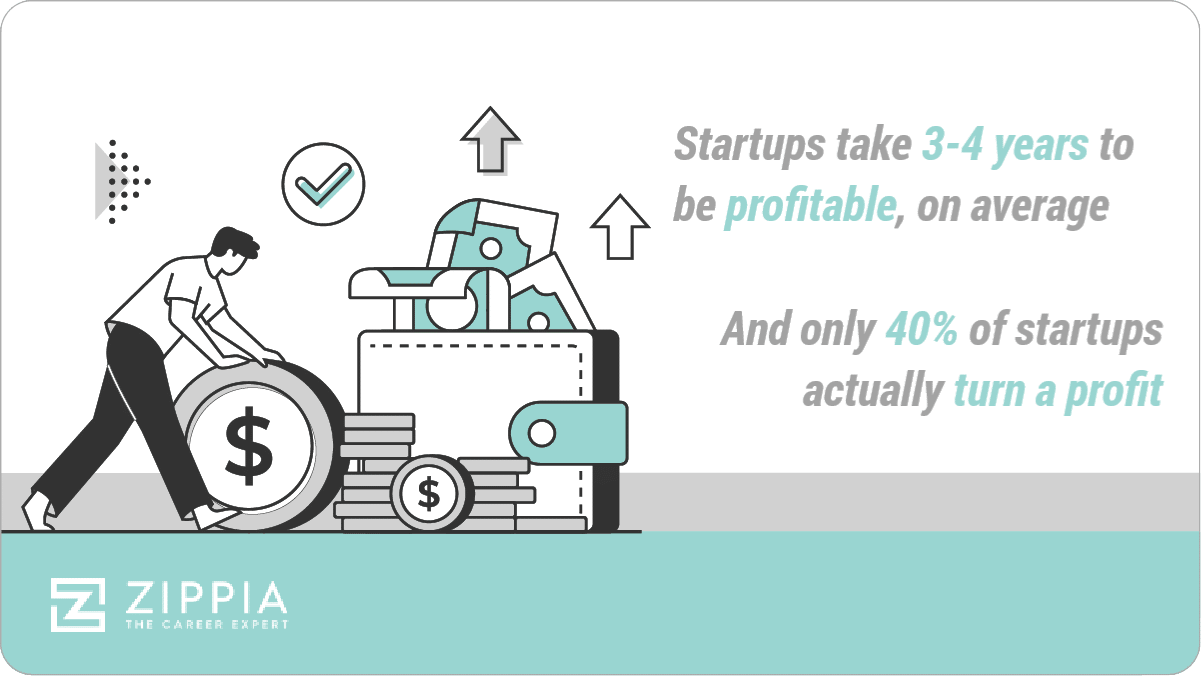
Startups take 3-4 years to become profitable, on average.
-
Only 40% of startups actually achieve profitability.
-
As of 2023, the United States has approximately 70,000 startups operating nationwide.
-
About 90% of startups ultimately fail, with 10% of them closing their doors within the first year.
-
The average small business requires about $10,000 in startup capital, yet only 0.05% of startups successfully secure venture capital.
-
44% of startups fail due to running out of cash.
For further analysis, we broke down the data in the following ways:
Failure | Success | Industry | Founder
General Startup Statistics
Startups operate like traditional businesses but place a strong emphasis on rapid growth and innovation. The primary objective for most startups is to quickly develop their ideas, beginning with a minimum viable product (MVP) that they can test and iterate until market-ready.
Building a customer base during this testing phase is crucial for gaining market share. This process can be daunting, regardless of the industry, as highlighted by the following statistics:
-
Globally, around 305 million startups are launched each year.
Approximately 1.4 million of these startups are tech-related.
-
Virtually no startup is profitable in its first year.
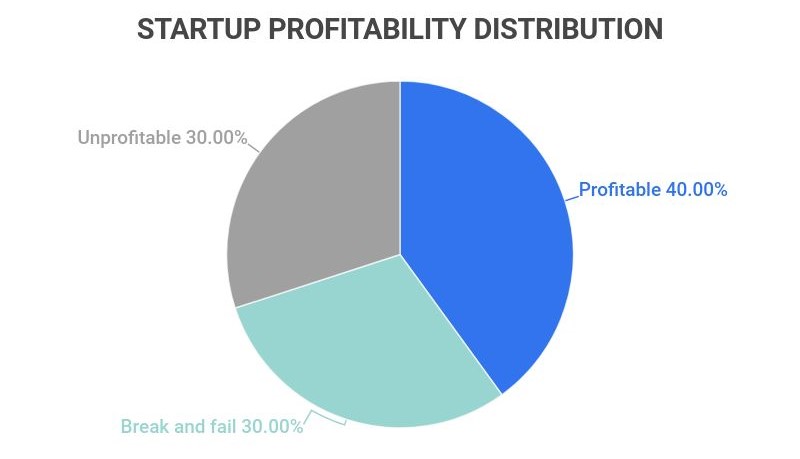
Over its lifespan, only 40% of startups will turn a profit, while 30% will fail, and the remaining 30% will continue operating at a loss.
-
As of 2023, startups in the United States have seen an average growth rate of 75.62%.
Companies investing more in sales and marketing generally experience faster growth than those that do not.
-
It typically takes 3 to 4 years for a startup to reach profitability.
Most earnings in the first year are allocated to expenses and reinvestment. In the second year, a modest withdrawal may occur after settling debts, but the majority should be reinvested back into the business.
Startup Statistics by Failure Rates
The competitive nature of the startup ecosystem means that many startups do not survive. However, not all failures occur quickly; some businesses may operate for several years before closing. Understanding the statistics related to startup failure is essential for prospective entrepreneurs:
-
More than 90% of startups ultimately fail.
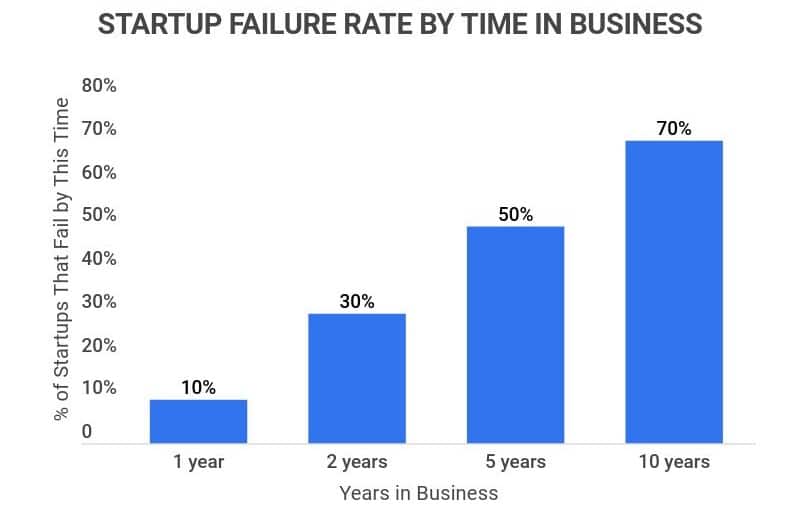
By the end of their second year, 30% of startups will fail. By the end of the fifth year, this number rises to 50%, and by the end of the tenth year, 70% of startups will have failed.
-
47% of startups cite lack of financing or investors as the primary reason for failure.
In 2023, 44% of startups failed due to running out of cash, 21% due to poor timing, and another 21% due to discord among team members or investors. An additional 25% attributed their failure to economic instability.
Here are the top reasons why startups said they failed in 2023:
Most Common Reasons for Startup Failure in 2023
Reason for Failure Percentage of Failed Startups Lack of Financing/Investors 47% Running Out of Cash 44% Economic Instability 25% Poor Timing 21% Disharmony Among Team/Investors 21% Legal Challenges 19% Lack of Business Model 16% Burnout 16% Economic Uncertainty 14% Poor Marketing 12% Product Not User Friendly 9% Market Competition 7% Pricing/Cost Issues 7% Lack of Product Demand 7% Losing Focus 7% Failure to Pivot 7% Failed Geographical Expansion 7% Financial Market Downturn 7% Not Having the Right Team 5% -
30-40% of investors lose their entire initial investment in startups.
Furthermore, 75% of venture-backed startups never manage to return cash to their investors.
Startup Statistics by Success Rates
While the statistics may seem daunting, not all startups fail. If you can navigate the initial challenges, you can set your business up for success. It’s crucial to establish goals, conduct thorough research, and find joy in your work. In tough times, persistence is key, especially if you believe in your product or service.
-
While 90% of startups survive at least one year, only 50% make it past five years.
Understanding customer needs is vital for maintaining profitability and success. Generating new business can be challenging, but having a strategy to retain customers is equally important.
-
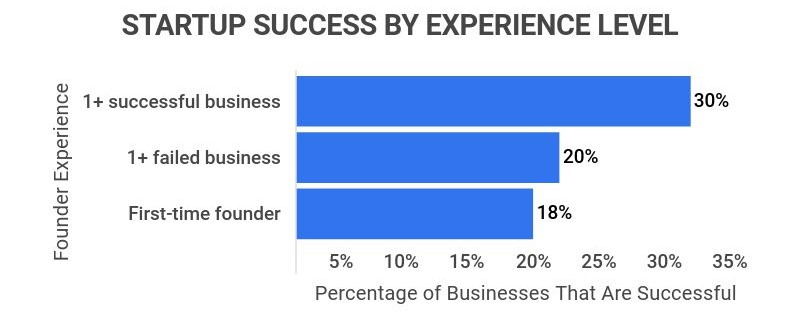
Founders of previously successful businesses have a 30% chance of success in their next venture.
Founders who have previously failed still hold a 20% chance of success, while first-time founders have an 18% success rate.
-
82% of successful business owners report possessing the right qualifications and relevant experience to manage a company.
This holds true even for startups facing cash flow challenges.
Startup Statistics by Industry
Although many startup statistics are consistent across sectors, certain industries exhibit higher startup success rates. Consider these insights:
-
The highest five-year survival rate for new businesses is in the mining sector, at 51.3%.
As of 2023, the United States healthcare startup industry remains robust, generating significant revenue and fostering numerous Inc. 5000 companies.
-
The information sector has the highest failure rate nationally, with 25% of these businesses failing within the first year.
40% will fail within the first three years, and 53% within the first five years.
Startup Statistics by Founder
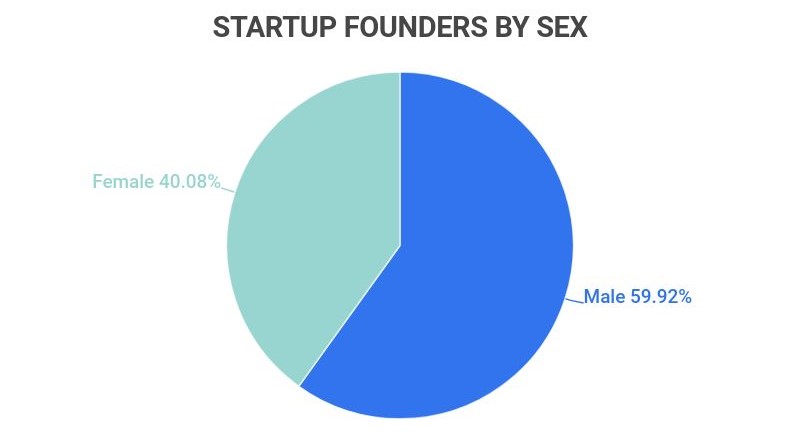
The startup sector grapples with a diversity gap, particularly in tech. However, fostering a diverse team can significantly enhance growth potential. The benefits and disparities of diversity are underscored by the following statistics:
-
Male entrepreneurs own 14.8 million small businesses in the United States.
In comparison, female entrepreneurs own only 9.9 million small businesses.
-
Companies with a female founder perform 63% better than those with all-male founding teams.
Yet, only 53% of American startups have at least one woman in an executive position.
-
25% of all new businesses in the United States are started by immigrants.
Businesses founded by immigrant entrepreneurs create 42% more jobs in America compared to those established by U.S.-born entrepreneurs.
Startup Statistics FAQ
-
How long does the average startup last?
The average startup lasts between two and five years. On average, 90% of startups survive one year. 69% of small businesses endure two years, but only 50% make it to five years.
-
How long should you give a new business to succeed?
While each business and industry is unique, it’s advisable to allow your business seven to ten years to achieve success. The first three years typically involve finding your direction and establishing your business.
-
When should a startup company expect profit?
A startup should aim to achieve profitability within 18 to 24 months after launch. This underscores the importance of having a solid business plan and sufficient funding during the initial years.
-
What percentage of startups succeed?
Approximately 10% of all startups will succeed. However, about 25% of venture-backed startups achieve success. For many of these businesses, a lack of profitability and funding ultimately leads to their downfall.
-
How many startups are profitable?
Only 2 in 5 startups are profitable, while 1 in 3 break even and another 1 in 3 operate at a loss, indicating that profitable startups are a minority.
-
How many startups fail in the first five years?
50% of startups will fail within the first five years. About 10% will close within the first year, with most failures occurring due to an inability to reach profitability in the following years.
Conclusion
Embarking on a startup journey is an exhilarating venture for many entrepreneurs. The prospect of having your own company and team working on a product you are passionate about can be incredibly fulfilling. However, with this excitement comes the reality of risk and the potential for failure, as startups are inherently vulnerable.
Don’t be discouraged by these statistics. If you’re passionate about your idea and can secure seed funding, you have a strong chance of success. Many startups grow into larger companies through acquisition, expansion into new markets, or increased revenue and hiring.
Learn from both your own mistakes and those of others, and appreciate your competition while carving out your place in the market.
References
-
Netshop. “How Many Tech Startups Are Created Each Year?” Accessed on September 27, 2023.
-
Failory. “Startup Failure Rate: Ultimate Report + Infographic” Accessed on September 27, 2023.
-
Small Business Trends. “Startup Statistics – The Numbers You Need to Know.” Accessed on September 27, 2023.
-
Statista. “Rate of Startup Growth in the United States from 2000 to 2023.” Accessed on September 27, 2023.
-
LinkedIn. “How Soon Should a Startup be Profitable?” Accessed on September 27, 2023.
-
Fundera. “What Percentage of Small Businesses Fail? (And Other Need-to-Know Stats).” Accessed on September 27, 2023.
-
Embroker. “106 Must-Know Startup Statistics for 2023.” Accessed on September 27, 2023.
-
AdvisorSmith. “What Percentage of Small Businesses Fail?” Accessed on September 27, 2023.
-
Findstack. “The Ultimate List of Startup Statistics for 2023.” Accessed on September 27, 2023.
-
Skynova. “Why Startups Failed in 2023.” Accessed on February 20, 2023.
- HR Statistics
- Average Labor Cost Percent Of Sales
- Average Time to Reach Profitability At A Startup
- Office Space Per Employee
- Recruitment Statistics
- Employee Engagement Statistics
- Work-Life Balance Statistics
- BYOD Statistics
- Paternity Leave Statistics
- Onboarding Statistics
- Average Paid Maternity Leave In Us
- Average Cost Of A Bad Hire
- Employee Theft Statistics
- Paid Family Leave Statistics
- Cost Of Hiring Statistics
- Employee Turnover Statistics
- Average Cost Of Employer Sponsored Health Insurance Statistics
- Sexual Harassment In The Workplace Statistics
- HR Statistics
- PTO Statistics
- Social Media Recruitment Statistics
- Hiring Statistics
- Out Of Prison Employment Statistics

Author

Chris Kolmar is a co-founder of Zippia and the editor-in-chief of the Zippia career advice blog. He has hired over 50 people in his career, been hired five times, and wants to help you land your next job. His research has been featured on the New York Times, Thrillist, VOX, The Atlantic, and a host of local news. More recently, he's been quoted on USA Today, BusinessInsider, and CNBC.