- Office Etiquette
- Office Etiquette
- Dating A Coworker
- April Fools Pranks For Work
- How To Be A Good Employee
- Pet Peeves List
- How To Write A Project Proposal
- Qualities Of A Good Worker
- How To Get Along With Your Boss
- What Engaged Employees Do Differently
- What To Say Instead Of Sorry
- How To Send A Friendly Reminder Email
- How To End A Conversation
- Sorry For The Delay
- Tattoos In The Workplace
- Sorry For The Late Reply
- How To Respond To A Compliment
- New Employee
- How To Introduce Yourself Professionally
- Welcome New Employee Announcement
- Welcome Letter
- Thank You Note To Colleague
- 30/60/90 Plan
- Getting To Know You Questions
- Job Satisfaction
- Team Building Activities
- At Will Employment
- Company Culture
- Corporate Culture
- How To Succeed At Your New Remote Job
- How To Prepare For New Job Orientation
- How To Create An Employee Handbook
- Hostile Work Environment
- Hostile Work Environment
- How To Deal With A Difficult Coworker
- What Is Human Resource Development (HRD)?
- I Hate My Job
- Burnt Out At Work
- Condescending Coworker
- Sexual Harassment In The Workplace
- Work Environment
- My Job Sucks
- Favoritism At Work
- Respect In The Workplace
- Wagner Act
- Documentation In The Workplace
- Unconscious Bias
- Ageism
- What To Do When You Feel Unappreciated At Work
- How To Respond To A Warning At Work
- How To Deal With A Passive Aggressive Coworker
- What To Do When You're Unhappy At Work
- I Hate My Boss
- Gaslighting Boss
- Signs You're Underpaid
- Insubordination At Work
- Missing Work
- Communicating
- Send Retirement Wishes
- Write A Congratulations Email
- Professional Voicemail Greeting Examples
- Made A Mistake At Work
- Google Tricks
- Appeal Letter
- Employee Morale
- How To Write A Professional Email
- Out Of Office Message
- Small Group Icebreakers
- Memo Format
- Memo Examples
- Cell Phone At Work
- Meeting Minutes
- Communication Barriers
- How To Take Notes
- How To Brainstorm
- Ask For A Mental Health Day
- Transfer Request Letter And Email Examples
- How To Write A Business Proposal
- How To Deal With A Lazy Coworker
- How To Write A Rejection Letter
- How To Say No
- Scheduling
- Personal Goals
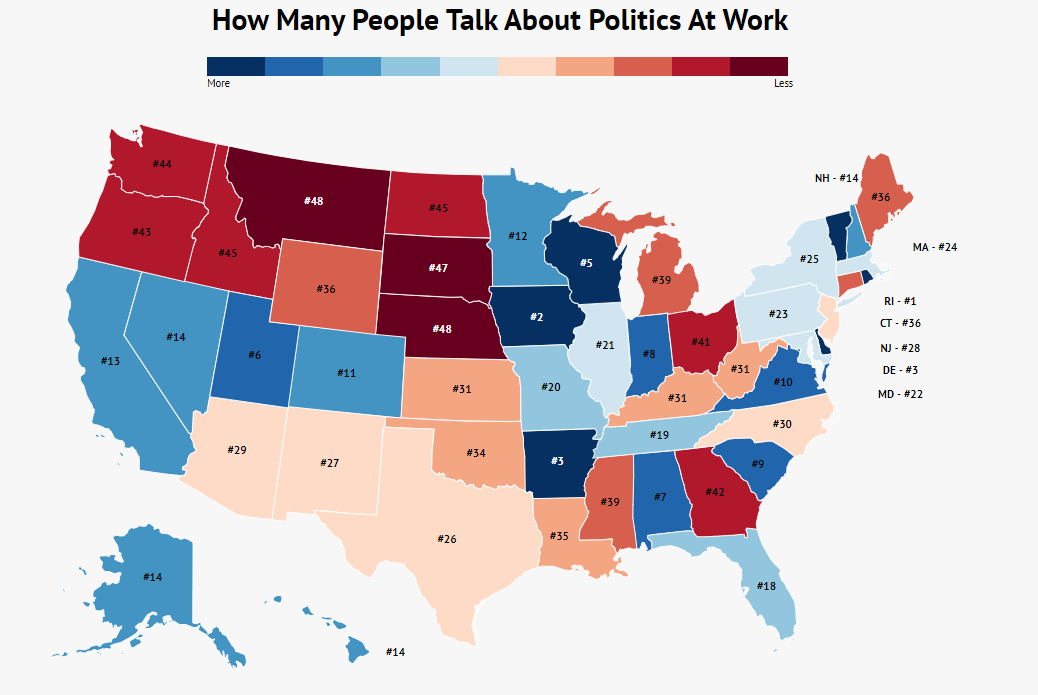
In Rhode Island, a significant 71% of workers engage in political discussions at work.
Conversely, Nebraska and Montana have a much lower engagement rate, with only 25% of workers discussing politics.
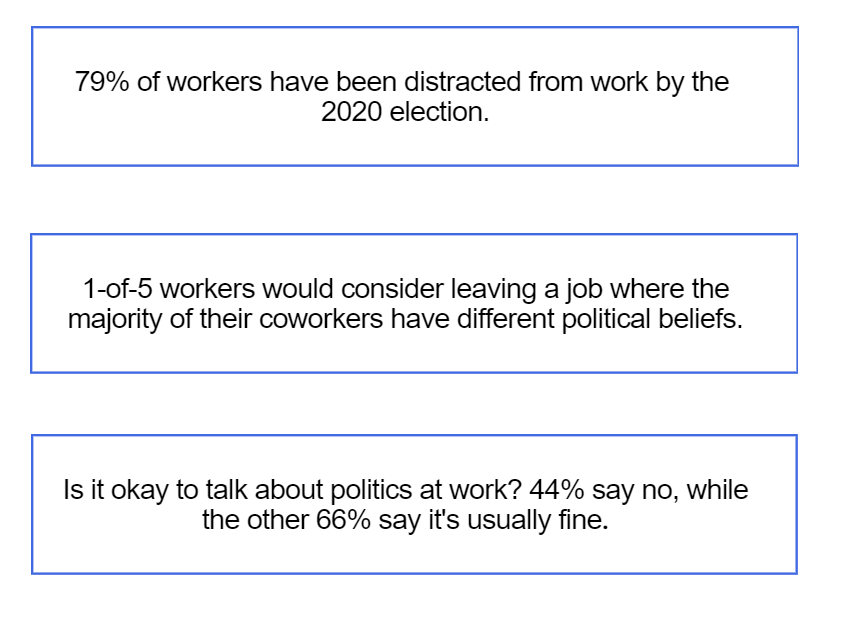
Overall, 54% of U.S. workers prefer to avoid political conversations in the workplace.
Just 44% of Americans feel that discussing politics at work is acceptable.
Struggling to maintain focus at work?
You’re not alone. With the rise of remote and hybrid work environments, the integration of technology in daily tasks, and a continually charged political atmosphere, staying on task has become increasingly challenging.
Political memes on platforms like Slack and passionate debates can distract not only from current events but also from the work at hand.
In a recent survey of 2,000 workers, we explored how political discourse affects workplace focus. The findings reveal that a majority of employees find politics distracting, with nearly half feeling the urge to share their views while on the clock.
Other Insights
Additional Findings
-
While many are distracted by politics, 21% of workers report that they can stay focused.
-
Approximately 47% of employees admit to discussing political topics at work.
-
Over 56% of workers choose to keep their political affiliations hidden from their employers.
-
More than 1-in-3 employees believe that revealing their political beliefs could lead to negative consequences.
-
Furthermore, 44% of job seekers express hesitance about applying to companies that support a political party differing from their own.
- Another 21% would outright refuse to apply.
Is It Acceptable to Discuss Politics at Work?
Deciding whether to remain silent or share political views in the workplace can be a challenge. While a significant portion of employees refrain from political discussions, many recognize the potential for respectful political expression:
Reasons Supporting Political Discussions at Work
-
Civil conversations with like-minded colleagues are seen as acceptable.
-
Respectful discussions can foster understanding.
-
Breaks and lunch hours are considered appropriate for such discussions.
-
Many find it uncomfortable to hide personal beliefs during working hours.
-
Political issues can directly affect workplace dynamics (laws, regulations, etc.).
-
In certain environments, political discussions are quite common.
Interestingly, many workers feel that conversations about politics are acceptable among colleagues with similar beliefs, even though a large percentage keep their political views private. Now, let’s look at the counter-argument from the 44% who feel political discussions are inappropriate:
Reasons Against Political Discussions at Work
-
Power dynamics can make political discussions risky.
-
Some employees may feel alienated based on differing political beliefs.
-
Political discussions can lead to a hostile work environment.
-
Many find political discourse uninteresting or boring.
-
Topics like “sex, politics, and religion” are often deemed unsuitable for the workplace.
Overall, many individuals distinguish between discussions among colleagues and those with management, indicating that political discourse may be more acceptable among peers.
METHODOLOGY
According to Zippia, a career resource website, a study was conducted involving 2,000 American workers focused on workplace politics.
Each participant responded to questions regarding their feelings, thoughts, and personal experiences concerning political discussions at work.
Note that Vermont was excluded from the study due to sample size limitations.
Navigating Politics at Work
Your willingness to discuss politics at work may depend on your workplace culture and personal comfort levels.
It’s crucial to remember that your “like-minded” colleague might not feel the same way or could simply be too uncomfortable to share their opinions. Aim for respectful dialogue, and avoid targeting coworkers who are focused on their tasks.
If political alignment is significant to you, consider seeking employment with organizations that reflect your values.
How Many Workers Talk Politics at Work?
| State | Percent of Workers |
|---|---|
| Alabama | 56% |
| Alaska | 50% |
| Arizona | 44% |
| Arkansas | 60% |
| California | 50% |
| Colorado | 51% |
| Connecticut | 40% |
| Delaware | 60% |
| Florida | 50% |
| Georgia | 37% |
| Hawaii | 50% |
| Idaho | 33% |
| Illinois | 47% |
| Indiana | 53% |
| Iowa | 63% |
| Kansas | 43% |
| Kentucky | 43% |
| Louisiana | 42% |
| Maine | 40% |
| Maryland | 47% |
| Massachusetts | 45% |
| Michigan | 38% |
| Minnesota | 51% |
| Mississippi | 38% |
| Missouri | 49% |
| Montana | 25% |
| Nebraska | 25% |
| Nevada | 50% |
| New Hampshire | 50% |
| New Jersey | 44% |
| New Mexico | 44% |
| New York | 45% |
| North Carolina | 44% |
| North Dakota | 33% |
| Ohio | 38% |
| Oklahoma | 42% |
| Oregon | 37% |
| Pennsylvania | 47% |
| Rhode Island | 71% |
| South Carolina | 53% |
| South Dakota | 33% |
| Tennessee | 49% |
| Texas | 45% |
| Utah | 58% |
| Virginia | 52% |
| Washington | 34% |
| West Virginia | 43% |
| Wisconsin | 58% |
| Wyoming | 40% |
- Office Etiquette
- Office Etiquette
- Dating A Coworker
- April Fools Pranks For Work
- How To Be A Good Employee
- Pet Peeves List
- How To Write A Project Proposal
- Qualities Of A Good Worker
- How To Get Along With Your Boss
- What Engaged Employees Do Differently
- What To Say Instead Of Sorry
- How To Send A Friendly Reminder Email
- How To End A Conversation
- Sorry For The Delay
- Tattoos In The Workplace
- Sorry For The Late Reply
- How To Respond To A Compliment
- New Employee
- How To Introduce Yourself Professionally
- Welcome New Employee Announcement
- Welcome Letter
- Thank You Note To Colleague
- 30/60/90 Plan
- Getting To Know You Questions
- Job Satisfaction
- Team Building Activities
- At Will Employment
- Company Culture
- Corporate Culture
- How To Succeed At Your New Remote Job
- How To Prepare For New Job Orientation
- How To Create An Employee Handbook
- Hostile Work Environment
- Hostile Work Environment
- How To Deal With A Difficult Coworker
- What Is Human Resource Development (HRD)?
- I Hate My Job
- Burnt Out At Work
- Condescending Coworker
- Sexual Harassment In The Workplace
- Work Environment
- My Job Sucks
- Favoritism At Work
- Respect In The Workplace
- Wagner Act
- Documentation In The Workplace
- Unconscious Bias
- Ageism
- What To Do When You Feel Unappreciated At Work
- How To Respond To A Warning At Work
- How To Deal With A Passive Aggressive Coworker
- What To Do When You're Unhappy At Work
- I Hate My Boss
- Gaslighting Boss
- Signs You're Underpaid
- Insubordination At Work
- Missing Work
- Communicating
- Send Retirement Wishes
- Write A Congratulations Email
- Professional Voicemail Greeting Examples
- Made A Mistake At Work
- Google Tricks
- Appeal Letter
- Employee Morale
- How To Write A Professional Email
- Out Of Office Message
- Small Group Icebreakers
- Memo Format
- Memo Examples
- Cell Phone At Work
- Meeting Minutes
- Communication Barriers
- How To Take Notes
- How To Brainstorm
- Ask For A Mental Health Day
- Transfer Request Letter And Email Examples
- How To Write A Business Proposal
- How To Deal With A Lazy Coworker
- How To Write A Rejection Letter
- How To Say No
- Scheduling
- Personal Goals

Author

Kathy is the head of content at Zippia with a knack for engaging audiences. Prior to joining Zippia, Kathy worked at Gateway Blend growing audiences across diverse brands. She graduated from Troy University with a degree in Social Science Education.