- Common Questions
- Interview Questions
- How To Answer Tell Me About Yourself?
- Elevator Pitch
- Where Do You See Yourself In 5 Years?
- What Are Your Career Goals?
- When Can You Start?
- How Do You Define Success?
- Describe Your Work Ethic
- Where Are Your Current Duties?
- What Are Your Learning Goals?
- Intrinsic Vs Extrinsic Motivation
- What Is Your Desired Salary?
- What Makes You Unique?
- Why Are You The Best Person For This Job?
- Reasons For Termination
- What Are Your Work Values
- How To Make A Hard Decision?
- What Are You Most Proud Of?
- Personal Code Of Ethics
- Problem Solving Interview Questions
- Taking Initiative Example
- How Do You Prioritize Your Work
- Explain Gaps In Employment
- Most Rewarding College Experience
- What Is Your Work Style
- Tell Me About A Time When You Made A Mistake On The Job
- Tell Me About Gaps In Employment
- What Are You Passionate About
- What Skills Would You Bring To The Job
- Who Is Your Mentor?
- Tell Me About Gaps In Employment
- How To Answer Tell Me About A Time You Disagreed With Your Boss
- How To Answer Common Screening Questions
- How Do You Handle Stress
- Are You Willing To Travel?
- Do You Work Well With Others?
- Why Do You Want To Work Here?
- What Is Your Greatest Weakness?
- Where Else Are You Interviewing?
- Tell Me About A Time You Failed
- How Do You Like To Be Managed?
- Do You Have Any Questions For Me?
- What Gets You Up In The Morning?
- What Do You Know About Our Company?
- What Is Your Greatest Strength?
- What Is Your Dream Job?
- What Is Your Ideal Work Environment?
- Why Are You Looking For A New Job?
- Why Should We Hire You?
- What Motivates You?
- What Else Should We Know About You?
- When Have You Made A Split Second Decision?
- Tell Me About A Challenge You've Faced At Work
- Types Of Questions
- Situational Interview Questions
- Promotion Interview Questions
- Internal Interview Questions
- Open Ended Interview Questions
- Tough Interview Questions
- Leadership Interview Questions
- Teamwork Interview Questions
- Interview Questions About Communication
- Personality Interview Questions
- Internship Interview Questions
- Ice Breaker Questions
- Recruiter Interview Questions
- Brain Teaser Interview Questions
- Group Interview Questions
- Competency Based Interview Question
- Grad School Interview Questions
- Scrum Interview Questions
- Excel Interview Questions
- Common Phone Interview Questions And Answers
- Job Specific Questions
- Why Did You Choose Nursing?
- Why Do You Want To Be A Teacher?
- Why Do You Want To Be A Doctor?
- Why Do You Want To Be A Police Officer?
- Police Officer Interview Questions
- Why Do You Want To Be An Accountant?
- Sales Interview Questions
- Interview Questions For Managers
- Retail Interview Questions
- Teacher Interview Questions
- Accounting Interview Questions
- Teaching Philosophy Examples
- Management Philosophy Examples
- Leadership Philosophy
- What Does Customer Service Mean To You
Find a Job You Really Want In
When faced with the interview question “Tell me about a challenge or conflict you’ve faced at work,” it’s crucial to succinctly describe the challenge and the actions you took to address it. Interviewers often pose this question to gauge your problem-solving abilities and how you handle conflicts in a professional setting.
In this article, we’ll explore effective strategies for answering this common interview question, provide sample answers, and outline common pitfalls to avoid.
Key Takeaways:
-
Interviewers ask about challenges or conflicts to evaluate your problem-solving skills and decision-making approach relevant to the position.
-
Keep your narrative concise; avoid rambling or providing excessive detail.
-
Utilize the STAR (Situation, Task, Action, Results) method to structure your response.
- How to Answer “Tell Me About a Conflict or Challenge You’ve Faced at Work”
- Example Answers to “Tell Me About a Conflict or Challenge You’ve Faced at Work”
- Why Interviewers Ask “Tell Me About a Conflict or Challenge You’ve Faced at Work”
- Utilize the STAR Method (With Example Answer)
- Common Mistakes to Avoid When Answering
- FAQs on Answering Interview Questions About Conflict at Work
- Final Thoughts
- References
- Expert Opinion
- Sign Up For More Advice and Jobs
How to Answer “Tell Me About a Conflict or Challenge You’ve Faced at Work”
Your goal when answering this question should be to highlight past experiences that align with what interviewers are seeking. Here’s a refined approach to answering this interview question:
-
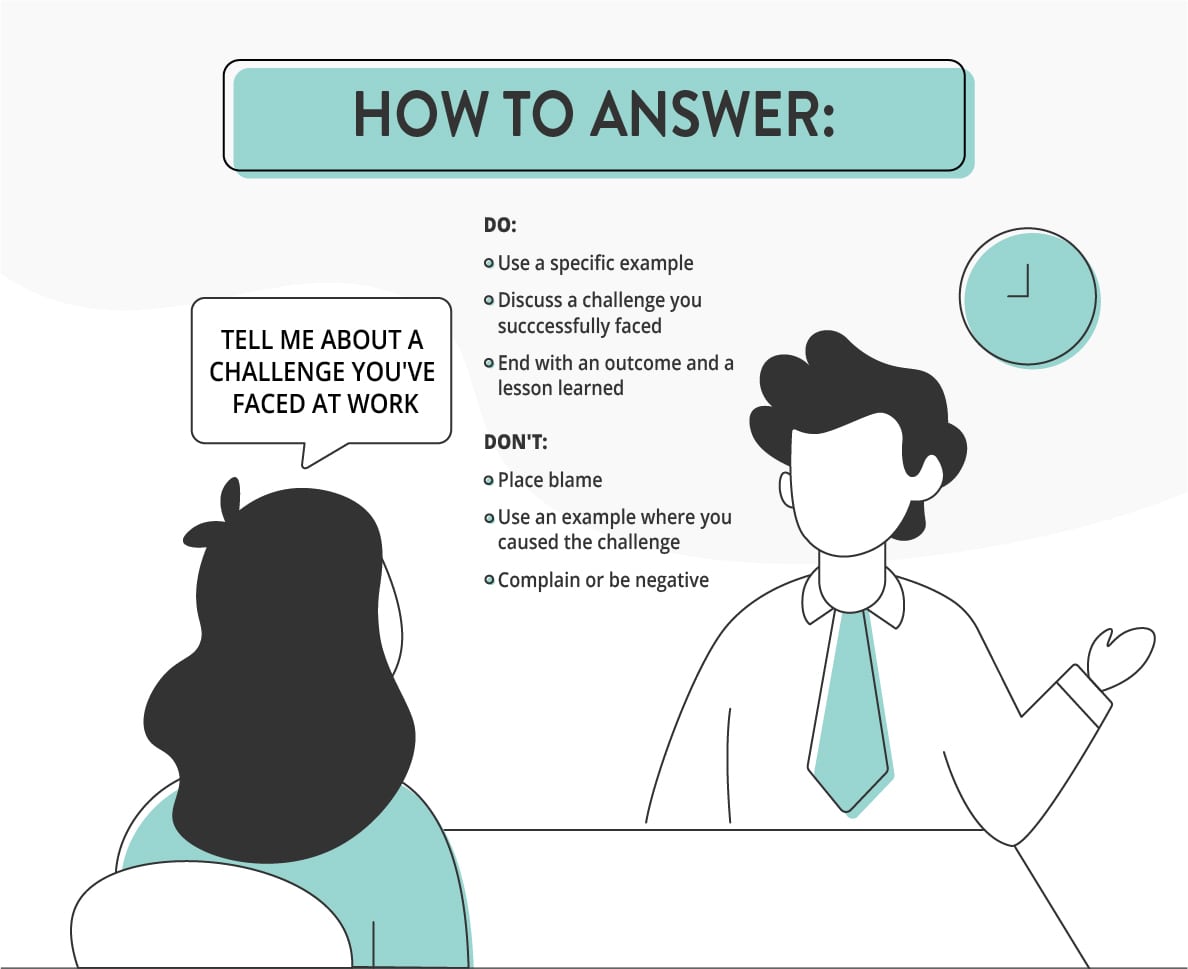
Select a Relevant Professional Issue. Choose a conflict that pertains to your professional experience and is relevant to the role you’re applying for. Interviewers are interested in understanding how you resolve workplace conflicts, not personal grievances or minor office drama.
-
Describe the Situation. Apply the STAR method in your response. Set the context for the conflict, providing only the essential details necessary for the interviewer to understand the scenario.
-
Prepare Concrete Examples. Interviewers prefer specific examples over general claims of being a “team player” or “problem solver.” Demonstrating past performance helps illustrate how you might manage similar situations in the future.
Focus on your actions and solutions rather than dwelling on the problem. This approach reflects positively on your character and problem-solving abilities.
-
Discuss the Actions You Took. This is your opportunity to showcase your problem-solving skills. Detail how you approached the conflict and resolved it, giving the interviewer insight into your conflict resolution style.
-
Share the Outcome. Conclude with the results of your actions. Highlight any positive outcomes and lessons learned, reinforcing your ability to effectively manage workplace challenges.
Example Answers to “Tell Me About a Conflict or Challenge You’ve Faced at Work”
Now, let’s put the advice into practice with sample answers that effectively utilize the STAR method:
-
Example Answer: Resolving Client Issues
In my last role in sales, I faced a situation where a client was dissatisfied with our agreement.
As the primary contact, I took it upon myself to address the issue and find a solution that worked for both parties.
Initially, I engaged with the client to understand their concerns regarding delivery costs and software usability. After discussing the key sticking points, we reached a new arrangement that satisfied their needs. Additionally, I ensured they had a dedicated customer success representative for ongoing support.
What began as a potential loss became a success, as the client not only continued with us but also upgraded to our full-service package, ultimately ranking among our top clients the following year.
-
Example Answer: Learning a New Process
Recently, my team encountered challenges with a new software implementation that was causing delays.
As the manager, I took the initiative to assess how the software was impacting each team member’s workflow.
While some team members expressed frustration over the added workload, I organized a meeting where everyone could voice their concerns. By collaborating and redistributing tasks, we managed to troubleshoot the issues effectively without overwhelming anyone.
The outcome was a 19% increase in our overall efficiency, proving that taking on the challenge was worthwhile.
-
Example Answer: Conflict with a Colleague
In my previous position, I found myself in a conflict with a colleague regarding the division of responsibilities on a critical project.
To resolve this, I initiated a private conversation where we could openly discuss our perspectives. By listening actively and sharing my own concerns, we identified the core misunderstandings that had led to the conflict.
Ultimately, we clarified our strengths and realigned our responsibilities, allowing us to work more effectively together.
-
Example Answer: Conflict with a Supervisor
I once faced a disagreement with my supervisor over a project’s direction and timeline. The project was crucial, and our differing opinions created tension.
I requested a meeting to discuss our viewpoints openly. By presenting data to support my suggestions and actively listening to my supervisor’s concerns, we found common ground and adjusted the timeline to allow for thorough research while maintaining project urgency.
Why Interviewers Ask “Tell Me About a Conflict or Challenge You’ve Faced at Work”
Hiring managers value this behavioral interview question as it provides insight into your strengths and how you might fit into their organization. Understanding your problem-solving skills is essential since every job entails challenges. Reflecting on past experiences allows interviewers to gauge your future decision-making capabilities.
Utilize the STAR Method (With Example Answer)
The STAR method is beneficial for addressing all behavioral interview questions, including discussions about career goals, accomplishments, and weaknesses.
-
Situation: Provide context for your story.
We brought this employee on board due to her exceptional writing skills and experience from a daily newspaper, where she was accustomed to meeting deadlines.
-
Task: Explain the task and the nature of the conflict.
While her writing was excellent, we struggled with project delays due to her inconsistency. When I addressed this, she initially reacted negatively and became emotional.
-
Action: Describe how you constructively acted to resolve the situation.
Recognizing her emotional response, I stepped back to explain how missed deadlines impacted the organization’s performance. I highlighted that while her work was top-notch, her inconsistency overshadowed her contributions.
This conversation opened her eyes to the broader impact of her work, leading us to schedule regular check-ins to monitor progress on assignments.
-
Results: Share the positive outcome of your actions.
She apologized for her initial reaction and thanked me for my understanding. Since then, she has consistently met deadlines, and we implemented status updates for the entire team, resulting in fewer missed deadlines and improved collaboration.
Always provide a real example, even if you need to adjust the details slightly. Focus on the key points, be concise, and avoid blaming others; instead, take ownership of the outcome.
Common Mistakes to Avoid When Answering
Steer clear of memorized responses and focus on providing a balanced viewpoint. Here are additional mistakes to avoid when addressing “Tell me about a conflict you’ve faced at work.”
-
Practice your delivery, but avoid memorization. Rigidly memorized responses tend to raise red flags for interviewers, regardless of the stage in the interview process.
-
Don’t dwell on complaints or avoid responsibility. While it’s tempting to blame others, remember that most interviewers want to see how you handle conflict maturely.
-
Avoid examples of self-created problems. Instead of discussing a conflict you instigated, focus on situations where you played a constructive role in resolving issues.
-
Keep it concise. While it’s natural to have feelings about the conflict, avoid spending excessive time on the setup at the expense of demonstrating your resolution skills.
-
Avoid outright blame or insults. Your narrative should reflect personal growth and professional development, not airing grievances about colleagues.
-
Don’t over-explain why it wasn’t your fault. If interviewers perceive that you’re deflecting blame, they may infer that you were indeed responsible.
-
Refrain from combative language. This includes both your examples and your tone; maintain a calm and professional demeanor throughout your response.
Remember, conflict is a part of the workplace, and this question is simply a way for interviewers to understand your conflict management style.
FAQs on Answering Interview Questions About Conflict at Work
-
What is a good example of a conflict at work?
A common workplace conflict example is poor communication leading to misunderstandings. Addressing these situations promptly is essential to prevent escalation and improve team dynamics.
-
What are important conflict resolution skills?
Key skills include remaining calm and actively listening. Managing emotions and fostering understanding can significantly aid in resolving conflicts.
-
How do you answer “Tell me about a conflict at work?”
Begin by briefly describing the conflict, followed by your approach and the actions taken. Interviewers seek to evaluate your problem-solving skills and conflict management strategies.
-
How do leaders handle conflict?
Effective leaders seek to resolve conflicts swiftly while remaining neutral. They often identify potential issues early and foster an environment conducive to open communication.
-
What are other ways “Tell me about a conflict you’ve had at work” can be asked?
Other common variations include:
-
“Tell me about a time you had a disagreement with your manager.”
-
“Tell me about a time you disagreed with a colleague.”
-
“How do you handle disagreements with your manager?”
-
“Have you ever disagreed with a company or department policy?”
-
Final Thoughts
Ultimately, your interviewer likely has encountered similar situations, making this question an opportunity to connect and demonstrate your suitability for the role. Avoid framing yourself as someone who shies away from conflict; instead, show your willingness to address issues constructively.
Think of your approach as part of your professional narrative. Just like a well-engineered car that can handle rough terrain, your ability to navigate challenges reflects your capacity to thrive in the workplace. How you manage conflict signals your readiness to tackle future obstacles.
References
-
The Muse – 3 Ways You’re Messing Up the Answer to “Tell Me About a Conflict You’ve Faced at Work”
-
Indeed.com – 5 Common Interview Questions About Conflict
Expert Opinion
How To Answer The Interview Question “Tell Me About A Challenge Or Conflict You’ve Faced At Work”

Debra Arviso
Career Coach CEO, Mindful Career Guide
Briefly describe the problem or goal without criticizing others. Focus on the solution and the specific steps you took to collaboratively resolve the issue. Your story should highlight your emotional intelligence, showcasing your ability to listen, empathize, and build relationships. Employers want to see evidence of your teamwork skills and your respect for diverse opinions.
If you’re struggling to recall a conflict, it’s acceptable to create a hypothetical scenario. The employer is interested in your communication and problem-solving abilities, so having a story prepared is wise.
How To Answer The Interview Question “Tell Me About A Challenge Or Conflict You’ve Faced At Work”

Danny Ghitis
High Performance Coach
Being solutions-focused is critical, especially when discussing conflicts. Highlight how you leveraged your strengths to overcome obstacles. Prepare go-to examples in advance and structure them using the STAR method to ensure a compelling narrative that resonates with the interviewer.
- Common Questions
- Interview Questions
- How To Answer Tell Me About Yourself?
- Elevator Pitch
- Where Do You See Yourself In 5 Years?
- What Are Your Career Goals?
- When Can You Start?
- How Do You Define Success?
- Describe Your Work Ethic
- Where Are Your Current Duties?
- What Are Your Learning Goals?
- Intrinsic Vs Extrinsic Motivation
- What Is Your Desired Salary?
- What Makes You Unique?
- Why Are You The Best Person For This Job?
- Reasons For Termination
- What Are Your Work Values
- How To Make A Hard Decision?
- What Are You Most Proud Of?
- Personal Code Of Ethics
- Problem Solving Interview Questions
- Taking Initiative Example
- How Do You Prioritize Your Work
- Explain Gaps In Employment
- Most Rewarding College Experience
- What Is Your Work Style
- Tell Me About A Time When You Made A Mistake On The Job
- Tell Me About Gaps In Employment
- What Are You Passionate About
- What Skills Would You Bring To The Job
- Who Is Your Mentor?
- Tell Me About Gaps In Employment
- How To Answer Tell Me About A Time You Disagreed With Your Boss
- How To Answer Common Screening Questions
- How Do You Handle Stress
- Are You Willing To Travel?
- Do You Work Well With Others?
- Why Do You Want To Work Here?
- What Is Your Greatest Weakness?
- Where Else Are You Interviewing?
- Tell Me About A Time You Failed
- How Do You Like To Be Managed?
- Do You Have Any Questions For Me?
- What Gets You Up In The Morning?
- What Do You Know About Our Company?
- What Is Your Greatest Strength?
- What Is Your Dream Job?
- What Is Your Ideal Work Environment?
- Why Are You Looking For A New Job?
- Why Should We Hire You?
- What Motivates You?
- What Else Should We Know About You?
- When Have You Made A Split Second Decision?
- Tell Me About A Challenge You've Faced At Work
- Types Of Questions
- Situational Interview Questions
- Promotion Interview Questions
- Internal Interview Questions
- Open Ended Interview Questions
- Tough Interview Questions
- Leadership Interview Questions
- Teamwork Interview Questions
- Interview Questions About Communication
- Personality Interview Questions
- Internship Interview Questions
- Ice Breaker Questions
- Recruiter Interview Questions
- Brain Teaser Interview Questions
- Group Interview Questions
- Competency Based Interview Question
- Grad School Interview Questions
- Scrum Interview Questions
- Excel Interview Questions
- Common Phone Interview Questions And Answers
- Job Specific Questions
- Why Did You Choose Nursing?
- Why Do You Want To Be A Teacher?
- Why Do You Want To Be A Doctor?
- Why Do You Want To Be A Police Officer?
- Police Officer Interview Questions
- Why Do You Want To Be An Accountant?
- Sales Interview Questions
- Interview Questions For Managers
- Retail Interview Questions
- Teacher Interview Questions
- Accounting Interview Questions
- Teaching Philosophy Examples
- Management Philosophy Examples
- Leadership Philosophy
- What Does Customer Service Mean To You

Author

David Luther was the Content Marketing Editor for the Zippia Advice blog. He developed partnerships with external reporting agencies in addition to generating original research and reporting for the Zippia Career Advice blog. David obtained his BA from UNC Chapel Hill.