Find a Job You Really Want In

Income inequality continues to be a pressing issue in America, shaping the landscape of our cities and communities. As we navigate the complexities of modern life, the disparities in earnings among different populations raise important questions about economic equity and quality of life.
While some individuals enjoy affluence, others grapple with financial constraints, leading to varied lifestyles and opportunities. This dichotomy is evident across various regions, with some cities exhibiting significant income inequality compared to others.
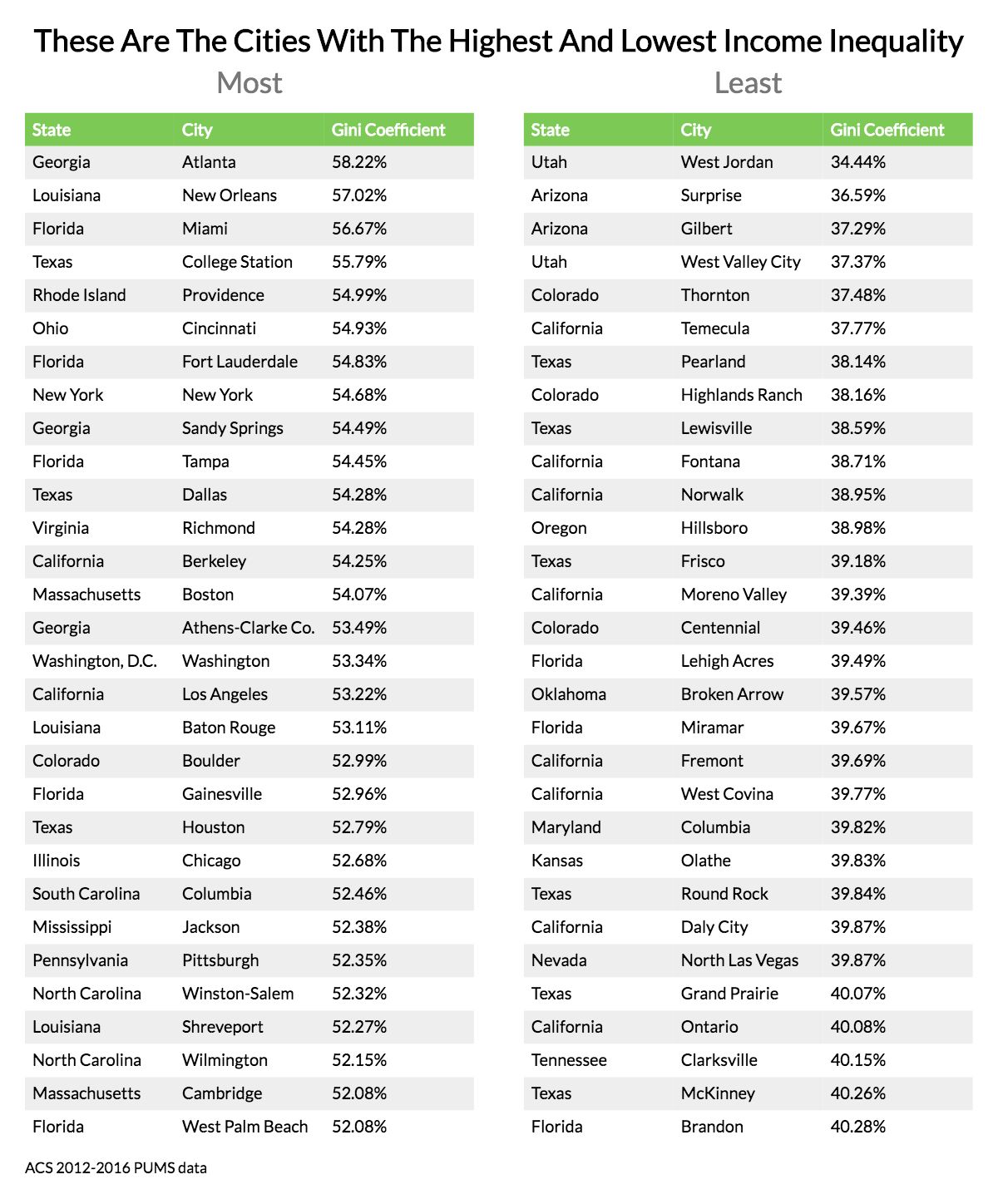
In our previous analysis, we examined the states with the highest and lowest income inequality. Now, we are focusing on metropolitan areas to identify those with the most pronounced disparities in income.
Here are the 10 cities with the highest income inequality in 2026:
- Atlanta, GA
- New Orleans, LA
- Miami, FL
- College Station, TX
- Providence, RI
- Cincinnati, OH
- Fort Lauderdale, FL
- New York, NY
- Sandy Springs, GA
- Tampa, FL
Conversely, here are the 10 cities with the lowest income inequality:
- West Jordan, UT
- Surprise, AZ
- Gilbert, AZ
- West Valley City, UT
- Thornton, CO
- Temecula, CA
- Pearland, TX
- Highlands Ranch, CO
- Lewisville, TX
- Fontana, CA
These findings highlight not only major urban centers but also smaller communities, revealing the diverse economic landscapes across the nation. What can we learn from this data?
Summary of Findings
- Atlanta ranks as the metro area with the highest income inequality.
- New Orleans and Miami complete the top three.
- Florida is home to four of the top 20 metros with the highest income inequality.
- West Jordan, UT has the lowest income inequality among major cities.
- Five states—Utah, Arizona, Colorado, California, and Texas—comprise 14 of the 15 metros with the least income inequality.
How We Conducted This Analysis
For this analysis, we utilized the most recent American Community Survey dataset available up to 2026.
We calculated the Gini coefficient for each city with a population exceeding 100,000, where a higher coefficient indicates greater income inequality.
For further understanding, the Gini coefficient is a normalized measure of inequality, and we scaled it by 100 for enhanced readability. To provide context, here are Gini coefficients for various countries from credible sources:
- The United States ranks among the highest in income inequality with a Gini coefficient of approximately 39.1%.
- South Africa is the most unequal country globally, with a Gini coefficient of 62%.
- Costa Rica follows with a Gini coefficient of 48%.
- Brazil, Mexico, and Chile round out the five most unequal countries.
- Iceland boasts the most equal income distribution, with a Gini coefficient of 24.6%.
- Slovenia, Slovakia, the Czech Republic, and Finland are also among the most equal countries.
Additionally, we included median rental prices and home values in the analyzed cities to provide insight into the cost of living in these areas.

Author

McLeod Brown is a former writer and researcher for the Zippia Career Advice blog. His work at Zippia focused on understanding the relationship between colleges, debt, and jobs. A graduate of the University of North Carolina at Wilmington with a BA in Business Administrator, he is now pursuing a masters of science in analytics from the Institute of Advanced Analytics.