What does an advisory engineer do?
Advisory engineer responsibilities
Here are examples of responsibilities from real advisory engineer resumes:
- Lead development of lithographic techniques for sub-micron technologies and develop processes to support manufacturing transition from bipolar to cmos.
- Develop processes producing features and leverage IBM technology into RF and MEMS devices.
- Develop system design budgets for RF gain, noise figure and phase noise.
- Design custom ASIC base IR transceiver option cards for PCMCIA, ISA and MCA computing platforms.
- Prepare designs for pack columns dealing with distillation, absorption, stripping, and direct contact heat transfer.
- Translate customer objectives into PCB requirements.
- Provide electrical & mechanical design engineers with RoHS component options.
- Research component manufacturers for their RoHS compliant product offerings and part identification.
- Conduct geotechnical and environmental subsurface investigations.
- Design internal drum / vacuum system to maintain strict media location during laser imaging.
- Design and develop press room, material handling, laser, and arc welding systems for the automotive industry.
- Work on new diskette products with multiple OEM's and partners.
- Gain hands on experience with automotive and HVAC systems while running standardize tests of vehicles.
- Prioritize development of firmware features by developing and executing a process to quantitatively predict the impact of say features.
Advisory engineer skills and personality traits
We calculated that 23% of Advisory Engineers are proficient in API, JavaScript, and Technical Support. They’re also known for soft skills such as Speaking skills, Writing skills, and Creativity.
We break down the percentage of Advisory Engineers that have these skills listed on their resume here:
- API, 23%
Started career in BlackBerry Development as Test Developer included Binary compatibility verification, API testing, and Application testing.
- JavaScript, 17%
Developed software in Java, JavaScript for Centralized Management of SNMPv3 and IPMI user accounts for IBM PureSystems Flexible System Manager.
- Technical Support, 7%
Provided technical supports to resolve manufacturing equipment issues and improve equipment efficiency for the company's global operation.
- Technical Leadership, 6%
Provided technical leadership in wafer bumping development and manufacturing across multiple sites and divisions
- Development Environment, 6%
Led effort to set up UNIX development environment and port the simulator to UNIX (SunOS).
- Java, 5%
Utilized a variety of software including Rational tools, JBuilder6, RoboHelp, Java, and XML.
Common skills that an advisory engineer uses to do their job include "api," "javascript," and "technical support." You can find details on the most important advisory engineer responsibilities below.
Speaking skills. The most essential soft skill for an advisory engineer to carry out their responsibilities is speaking skills. This skill is important for the role because "industrial engineers sometimes have to explain their instructions to production staff or technicians before they can make written instructions available." Additionally, an advisory engineer resume shows how their duties depend on speaking skills: "presented research paper evaluating the impact of using various flavors of unix. "
Writing skills. Another soft skill that's essential for fulfilling advisory engineer duties is writing skills. The role rewards competence in this skill because "industrial engineers must prepare documentation for other engineers or scientists, or for future reference." According to an advisory engineer resume, here's how advisory engineers can utilize writing skills in their job responsibilities: "worked with hardware engineers to test a dma engine and external bus interface by writing c programs. "
Creativity. advisory engineers are also known for creativity, which are critical to their duties. You can see how this skill relates to advisory engineer responsibilities, because "industrial engineers use creativity and ingenuity to design new production processes in many kinds of settings in order to reduce the use of material resources, time, or labor while accomplishing the same goal." An advisory engineer resume example shows how creativity is used in the workplace: "used microsoft's ribbon component along with the power of wpf layouts and data binding to produce creative ui applications. "
Listening skills. A big part of what advisory engineers do relies on "listening skills." You can see how essential it is to advisory engineer responsibilities because "these engineers often operate in teams, but they also must solicit feedback from customers, vendors, and production staff." Here's an example of how this skill is used from a resume that represents typical advisory engineer tasks: "communicated with vendors inquiring about datasheets and rohs compliance. "
Math skills. A commonly-found skill in advisory engineer job descriptions, "math skills" is essential to what advisory engineers do. Advisory engineer responsibilities rely on this skill because "industrial engineers use the principles of calculus, trigonometry, and other advanced topics in mathematics for analysis, design, and troubleshooting in their work." You can also see how advisory engineer duties rely on math skills in this resume example: "determined product specifications and design through the use of cad, computer and mathematical analysis. "
Problem-solving skills. Lastly, "problem-solving skills" is an important element of what an advisory engineer does. Advisory engineer responsibilities require this skill because "in designing facilities for manufacturing and processes for providing services, these engineers deal with several issues at once, from workers’ safety to quality assurance." This resume example highlights how advisory engineer duties rely on this skill: "create and execute module experiments, order failure analysis, present data to larger group, and offer solutions. "
The three companies that hire the most advisory engineers are:
- Frontier Technologies4 advisory engineers jobs
- BWX Technologies2 advisory engineers jobs
- Ricoh2 advisory engineers jobs
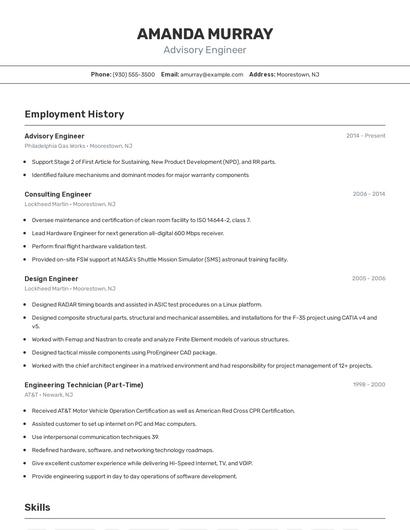
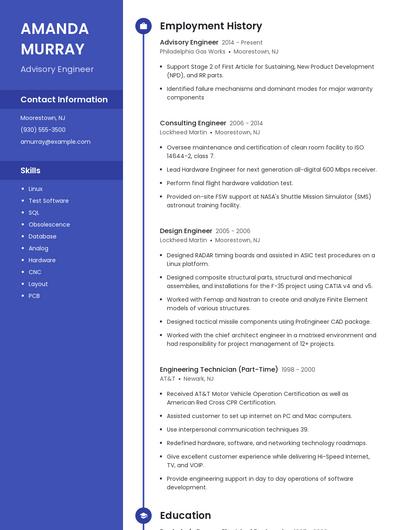
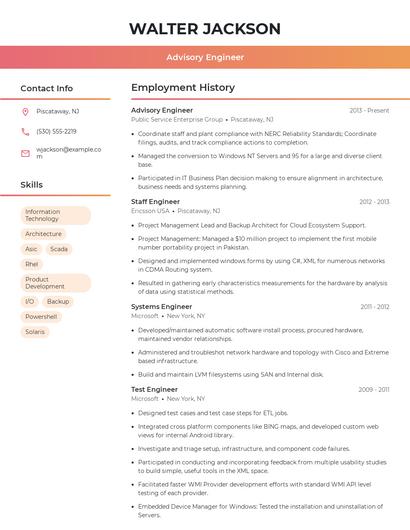
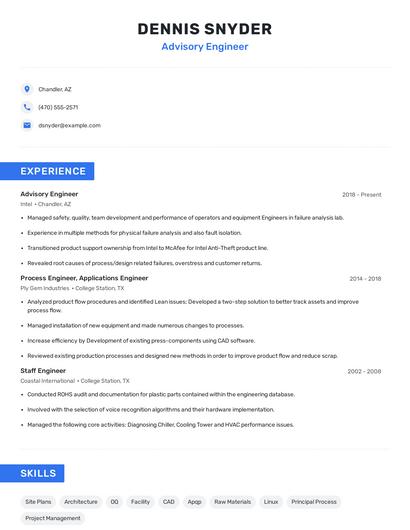
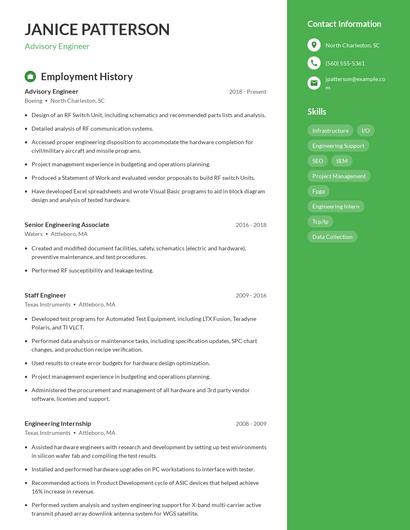
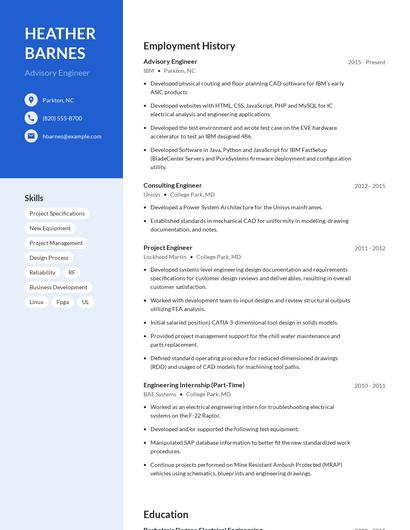
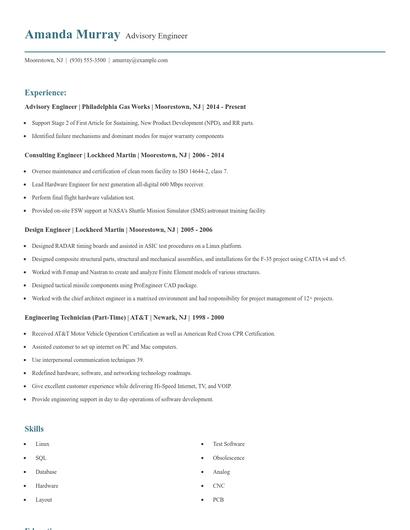
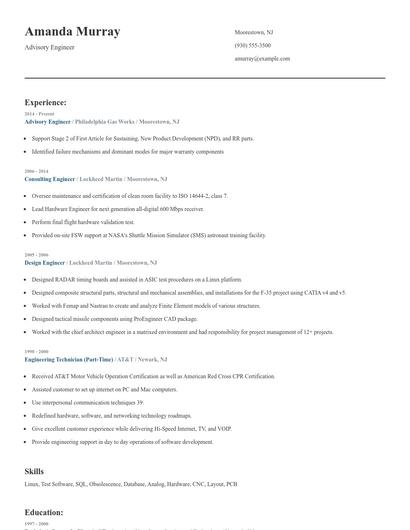
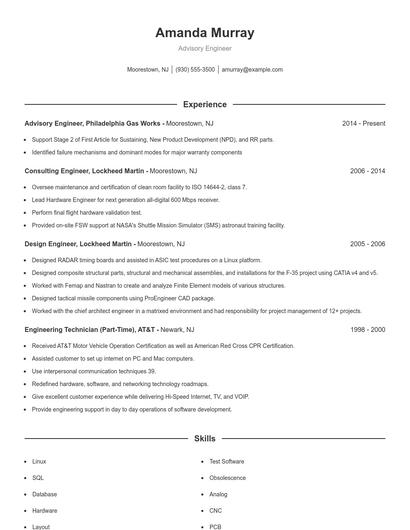
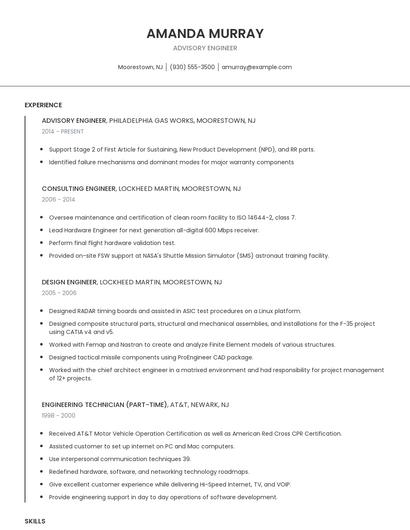
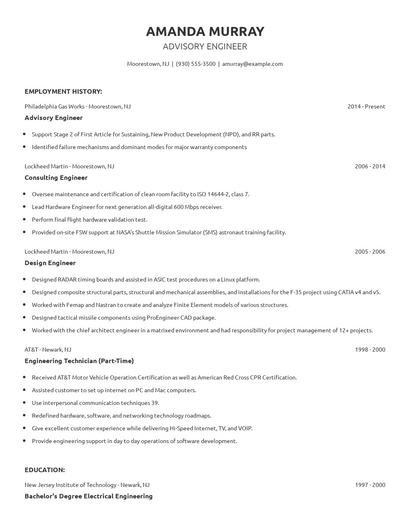
Choose from 10+ customizable advisory engineer resume templates
Build a professional advisory engineer resume in minutes. Our AI resume writing assistant will guide you through every step of the process, and you can choose from 10+ resume templates to create your advisory engineer resume.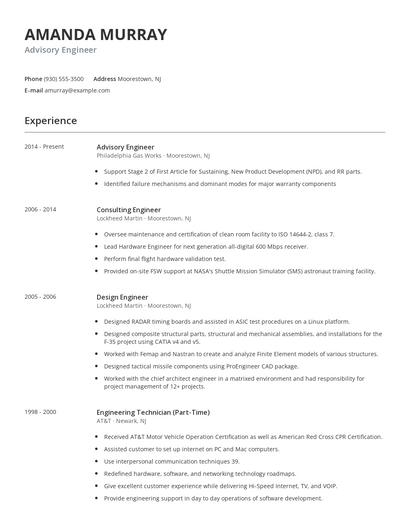
Compare different advisory engineers
Advisory engineer vs. Process improvement engineer
A process improvement engineer specializes in conducting research and analysis to develop new strategies and ideas to improve the processes in a manufacturing plant or a similar setting. They prioritize efficiency and profitability. Most of the time, engineers participate in a series of meetings where they coordinate with fellow engineers to determine opportunities for product growth and development. Moreover, a process improvement engineer is also responsible for crafting new policies and regulations, upgrading systems, and developing new practices to ensure product quality and customer satisfaction.
These skill sets are where the common ground ends though. The responsibilities of an advisory engineer are more likely to require skills like "api," "javascript," "technical leadership," and "development environment." On the other hand, a job as a process improvement engineer requires skills like "lean six sigma," "project management," "healthcare," and "data analysis." As you can see, what employees do in each career varies considerably.
Process improvement engineers really shine in the technology industry with an average salary of $89,829. Comparatively, advisory engineers tend to make the most money in the technology industry with an average salary of $93,423.The education levels that process improvement engineers earn slightly differ from advisory engineers. In particular, process improvement engineers are 4.9% less likely to graduate with a Master's Degree than an advisory engineer. Additionally, they're 10.6% less likely to earn a Doctoral Degree.Advisory engineer vs. Consulting engineer
A consulting engineer is an individual who aids in the planning, designing, and construction of a project from the public and private clients. Consulting engineers are required to advise on the best component suitable according to the needs of their clients. They can manage the project by coordinating with designers, architects, and relevant persons who have commissioned the project. They may incorporate green sustainable energy solutions based on the demands of their clients. Consulting engineers must also conduct a feasibility study and prepare the estimated cost for the project.
While some skills are similar in these professions, other skills aren't so similar. For example, resumes show us that advisory engineer responsibilities requires skills like "technical support," "technical leadership," "development environment," and "sem." But a consulting engineer might use other skills in their typical duties, such as, "working independently," "c #," "project management," and "azure."
On average, consulting engineers earn a higher salary than advisory engineers. Some industries support higher salaries in each profession. Interestingly enough, consulting engineers earn the most pay in the technology industry with an average salary of $99,126. Whereas advisory engineers have higher pay in the technology industry, with an average salary of $93,423.Average education levels between the two professions vary. Consulting engineers tend to reach similar levels of education than advisory engineers. In fact, they're 4.8% less likely to graduate with a Master's Degree and 10.6% less likely to earn a Doctoral Degree.Advisory engineer vs. Principal engineer
A principal engineer is responsible for monitoring the overall design phase of the construction process, including coordinating with the client for progress and updates, as well as performing adjustments as needed based on clients' specifications and requirements. Principal engineers also inspect the materials and resources used to ensure that the project stays within the budget goals and set timeframe. They should have excellent communication and organizational skills, especially in preparing reports and training new staff.
Some important key differences between the two careers include a few of the skills necessary to fulfill the responsibilities of each. Some examples from advisory engineer resumes include skills like "development environment," "sem," "process control," and "labs," whereas a principal engineer is more likely to list skills in "architecture," "python," "c #," and "software development. "
Principal engineers earn the best pay in the telecommunication industry, where they command an average salary of $125,415. Advisory engineers earn the highest pay from the technology industry, with an average salary of $93,423.Most principal engineers achieve a similar degree level compared to advisory engineers. For example, they're 0.0% more likely to graduate with a Master's Degree, and 5.6% more likely to earn a Doctoral Degree.Advisory engineer vs. Senior principal engineer
A senior principal engineer is responsible for leading engineering tasks within an organization and reports project updates to senior management. Senior principal engineers develop strategic methods and principles to improve the technical stability and efficiency of the company's systems, creating business proposals according to clients' specifications, and negotiating contracts with suppliers and other service providers. They also train new staff and identify innovations and business opportunities that would generate more revenue resources for the company.
Types of advisory engineer
Updated January 8, 2025
