
Automatically apply for jobs with Zippia
Upload your resume to get started.
Analyst internship skills for your resume and career

15 analyst internship skills for your resume and career
1. Financial Statements
A financial statement is a report of an individual or a company that includes all the information about the declared assets, the use of money, income, and also the contribution of shareholders over a certain period.
- Analyzed financial statements, designed key performance indicators, and assessed financial and operating performance of companies.
- Ensured accuracy of firm partnership database by analyzing and auditing quarterly financial statements of 100+ companies.
2. Data Analysis
- Supported financial manager with data accuracy checking and reporting Skills Used Financial book keeping, financial reports, financial data analysis
- Facilitated profit growth and infrastructure development in a five-year plan based on data analysis and forecasting and delivering useful recommendations.
3. Management System
A management system is a set of policies, processes, and procedures taken by an organization or a business to ensure it can fulfill its tasks and achieve its objectives. A management system makes sure that the company excels financially and improves the user experience. The management system also takes care of the worker's and employees' needs and manages their workload and oversees their performance. Apart from interior matters of the company, a management system also deals with exterior matters like legislations, tax matters, and law issues.
- Collected data to analyze cause and effect for prevention of inventory discrepancies related to Red Prairie warehouse management system.
- Validated online operation and management system preventing lost customer data and improved retrieval efficiency of data type identification.
4. Python
Python is a widely-known programming language. It is an object-oriented and all-purpose, coding language that can be used for software development as well as web development.
- Validated and enhanced the efficiency of an orbit optimal control model in Python
- Developed software for analyzing corporate member excel databases (Python 2.7) - Used HTTP and CSS to implement changes to website
5. Data Entry
Data entry means entering data into a company's system with the help of a keyboard. A person responsible for entering data may also be asked to verify the authenticity of the data being entered. A person doing data entry must pay great attention to tiny details.
- Excelled at data entry/accounting responsibilities.
- Recorded volume and daily data entry of negotiated Park and Loan transactions, and verified calculations for processing and pricing.
6. Strong Analytical
- Utilize strong analytical skills and database skills to create performance metrics and evaluate various portfolio characteristics, primarily using Excel spreadsheets.
- Demonstrated strong analytical skill through evaluating financial statement of Client Company.
Choose from 10+ customizable analyst internship resume templates
Build a professional analyst internship resume in minutes. Our AI resume writing assistant will guide you through every step of the process, and you can choose from 10+ resume templates to create your analyst internship resume.7. R
R is a free software environment and a language used by programmers for statistical computing. The R programming language is famously used for data analysis by data scientists.
- Develop a data mining GUI using R scripts incorporating cutting-edge machine learning algorithms for advanced remote sensing image classification.
- Performed Cluster Analysis in R to compare medical providers based on various calculated Statistics and services rendered.
8. Analyze Data
Analyze data or data analysis refers to the practice of studying, organizing, and transforming data to make it more useful. It also includes the cleansing of non-useful information which helps in better decision making regarding any particular matter. Analyze data is a practice that is used widely in the field of business, social sciences, and science.
- Used MS Office to analyze data and prepare reports/recommendations to Director and other Facility Personnel.
- Developed new tool to analyze data error distribution and represented practical enhancement methods.
9. Market Research
Market research is a collective effort to collect information related to a consumer's needs and wants. It is a systematic approach that involves recording and analysis of both qualitative and quantitative data. Market research helps a business to identify a target market correctly and identify the gaps in potential consumer's expectations.
- Increased value-added benefits by providing comprehensive market research, maintaining industry and regulatory contacts abroad, and country-specific sales strategy training.
- Conducted financial analysis and market research using Wind; evaluated 8 investment projects and composed competitive analysis reports.
10. Windows
Windows is a chain of operating systems that controls a computer and is developed by Microsoft. Every version of Windows consists of GUI (graphical user interface), with a desktop that allows the user to open their files.
- Installed, tested, documented and supported commercial off-the-shelf software on Microsoft Windows operating systems.
- Provided windows and application support for chemical engineers.
11. Client Portfolios
- Constructed client portfolios based on risk assessment; designed marketing material conveying firm philosophy.
- Reviewed and evaluated client portfolios on a regular basis; made appropriate reallocation recommendations.
12. Data Collection
Data collection means to analyze and collect all the necessary information. It helps in carrying out research and in storing important and necessary information. The most important goal of data collection is to gather the information that is rich and accurate for statistical analysis.
- Assisted in other data collection and reporting activities related to the overall mission of Enterprise Technology Risk Management as directed.
- Performed field data collection following specific sampling procedures to assure representative and accurate data in Milwaukee urban garden setting.
13. Due Diligence
Due diligence refers to the process of auditing, investigating, or reviewing done to confirm the authenticity of relevant facts. In addition to this, it also refers to the evaluation of a party's financial records to determine whether one should enter into a transaction with the said party or not.
- Performed due diligence on potential Class B Multifamily property acquisitions and produced comparable sales analysis reports.
- Contributed in due diligence investigation and building financial model for valuation of portfolio companies.
14. SQL Server
- Used SQL server to collect housing price data and analyze the variable that may influence to the price.
- Used SQL Server to query data with over 50,000 rows of claims and provider transactions to generate reports.
15. VBA
Visual Basic for Applications or, as it is commonly shortened to, VBA is a certain method of using Microsoft's event-driven programming language known as Visual Basic.
- Spearheaded the automation of self-assessment processes using VBA with division-wide applicability.
- Update existing VBA projects, models, and SQL stored procedures to function correctly after the 2017 calendar conversion.
5 Analyst Internship resume examples
Build a professional analyst internship resume in minutes. Browse through our resume examples to identify the best way to word your resume. Then choose from 5+ resume templates to create your analyst internship resume.

What skills help Analyst Interns find jobs?
Tell us what job you are looking for, we’ll show you what skills employers want.
What skills stand out on analyst internship resumes?
Hanna Kim Ph.D.
Associate Professor, Chair, Adelphi University
I say "try to" as the reality is that having faculty in all 4 subfields is not possible for many reasons. (The 4 subfields are cultural anthropology, archeology, biological anthropology (sometimes physical anthropology), and anthropological linguistics. These subfields are mirrored in graduate school where students going for PhDs will be focused on 1 subfield.)
For undergraduates with an anthropology degree seeking employment, I can speak only from the faculty side, not the employer side. My students report these factors as relevant to their being hired (and accepted into competitive schools in museum studies, social work, law school, etc.:
Analytical skills; clear writing; ability to synthesize large amounts of reading and data into well-supported arguments and interpretations; open-mindedness toward different identities and ways of being.
A hugely important skill that anthropology graduates have is the ability to be presented with a complex situation or problem, and to be able to chart a plan on how to approach the problem, gather data and other necessary information to solve the problem, and then to come up with a solution or possible strategies. Too often, particularly in situations involving human behavior, what is needed is a stronger grasp of social and cultural factors that could impede the desired outcome. Students of anthropology know that ways of doing things, and even seeing and thinking, are profoundly influenced by categories of thought that are culturally situated. This means that problem solving has to consider a network of variables that have an impact on behavior. Anthropology students, I would argue, would embrace this complexity rather than be hesitant to acknowledge it in favor of a more expedient and, in the long run, less successful solution.
What soft skills should all analyst internships possess?
Hanna Kim Ph.D.
Associate Professor, Chair, Adelphi University
What hard/technical skills are most important for analyst internships?
Hanna Kim Ph.D.
Associate Professor, Chair, Adelphi University
What analyst internship skills would you recommend for someone trying to advance their career?
A.J. Arreguin
Professor, Our Lady of the Lake University
Students should volunteer with small/local businesses or create their brand (start a blog or become a niche social media influencer) to practice and build on their experience. Once the student/graduate does that, they should keep a weekly log with analytics to help them understand how to improve moving forward. This will be beneficial when applying for a communication/public relations job during an interview. The degree gets the student/graduate the talk, but the experience lands them the job.
What type of skills will young analyst internships need?
Lise Abrams Ph.D.
Professor of Linguistics and Cognitive Science; Coordinator of Cognitive Science, Pomona College
List of analyst internship skills to add to your resume
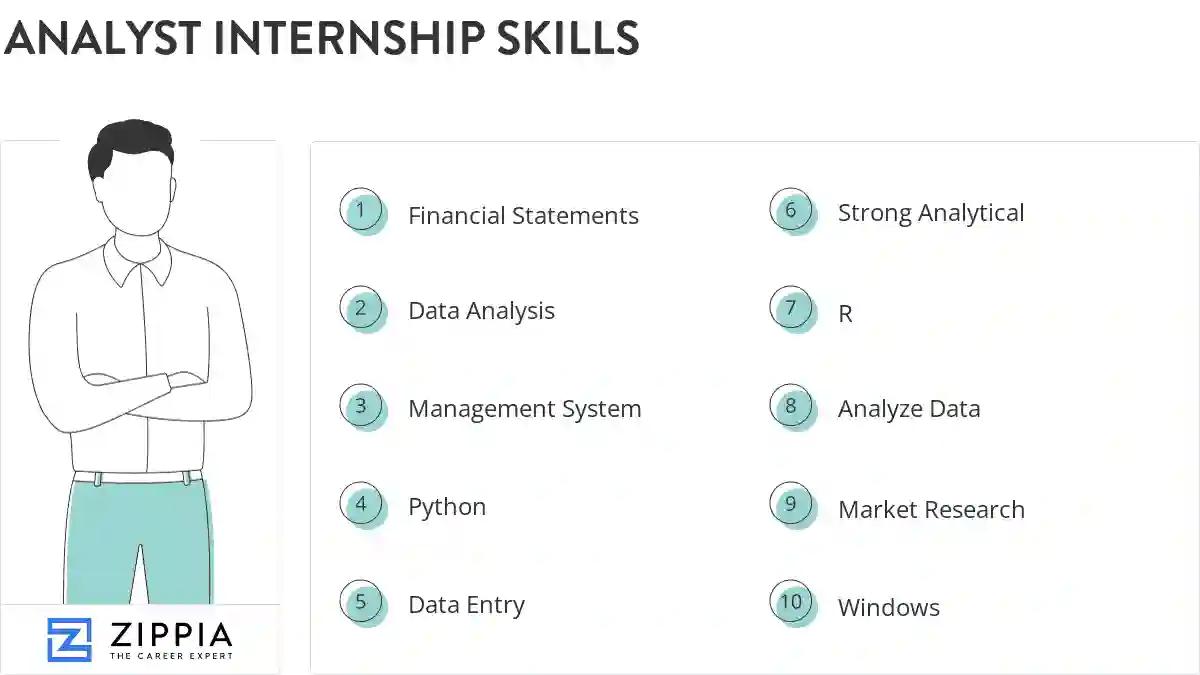
The most important skills for an analyst internship resume and required skills for an analyst internship to have include:
- Financial Statements
- Data Analysis
- Management System
- Python
- Data Entry
- Strong Analytical
- R
- Analyze Data
- Market Research
- Windows
- Client Portfolios
- Data Collection
- Due Diligence
- SQL Server
- VBA
- Real Estate
- SAS
- Salesforce
- Statistical Analysis
- Private Equity
- Financial Models
- HR
- Pivot Tables
- Financial Analysis
- SharePoint
- ERP
- Strategic Sourcing
- Business Processes
- Financial Data
- MATLAB
- Market Analysis
- Asset Allocation
- Quantitative Analysis
- Linux
- JavaScript
- HTML
- Test Cases
- Market Trends
- Google Analytics
- Research Reports
- GIS
- Financial Reports
- Equities
- SPSS
- DCF
- Discounted Cash Flow
- Fundamental Analysis
Updated January 8, 2025
