What does an assembler & quality control do?
Assembler & quality control responsibilities
Here are examples of responsibilities from real assembler & quality control resumes:
- Serve as an internal ISO auditor.
- Adhere to all ISO procedures and departmental for safety and hazardous material.
- Read and interpret blueprints and check critical dimensions by using measuring instruments including micrometers, calipers and indicators.
- Perform QC tests on products including HPLC, UV, and melting point.
- Follow schematic attach on the BOM and verify all parts are complete and ready to be assemble.
- Read and interpret drawings, schematics, BOM's and written work instructions require to complete assemblies.
- Provide quality control inspection according to final QC procedures.
Assembler & quality control skills and personality traits
We calculated that 30% of Assemblers & Quality Control are proficient in Part Numbers, Quality Checks, and Assembly Line. They’re also known for soft skills such as Dexterity, Math skills, and Mechanical skills.
We break down the percentage of Assemblers & Quality Control that have these skills listed on their resume here:
- Part Numbers, 30%
Order parts and assign part numbers to new inventory as required.
- Quality Checks, 12%
Prepared daily quality check reports to supervisors and provide monthly quality control analysis.
- Assembly Line, 11%
Performed labor along an assembly line building automotive parts, verifying component accuracy and providing accurate component placement against blueprints.
- Safety Guidelines, 4%
Inspected finished products to ensure meeting the company and federal quality & safety guidelines.
- Control Panels, 3%
Assembled and wired electrical control panels and explosion proof enclosures to customer's schematics Worked from schematics and customer's wiring diagrams
- R, 3%
Assisted with R and D projects, developed jig process, troubleshooting.
Most assemblers & quality control use their skills in "part numbers," "quality checks," and "assembly line" to do their jobs. You can find more detail on essential assembler & quality control responsibilities here:
Math skills. Another essential skill to perform assembler & quality control duties is math skills. Assemblers & quality control responsibilities require that "knowledge of basic math is important for measuring, calibrating, and calculating specifications in quality control testing." Assemblers & quality control also use math skills in their role according to a real resume snippet: "specialize in fs100 controller platform and stem (science, technology, engineering, math) robotic education cells. "
Mechanical skills. Another skill that relates to the job responsibilities of assemblers & quality control is mechanical skills. This skill is critical to many everyday assembler & quality control duties, as "quality control inspectors use tools and machinery when testing products." This example from a resume shows how this skill is used: "applied my skills in mechanical drawing and electrical schematics to produce high quality control panels. "
Physical stamina. A big part of what assemblers & quality control do relies on "physical stamina." You can see how essential it is to assembler & quality control responsibilities because "some quality control inspectors must stand for long periods on the job." Here's an example of how this skill is used from a resume that represents typical assembler & quality control tasks: "butcher - concentration, dexterity, customer service and stamina"
Physical strength. A commonly-found skill in assembler & quality control job descriptions, "physical strength" is essential to what assemblers & quality control do. Assembler & quality control responsibilities rely on this skill because "quality control inspectors may be required to lift or maneuver heavy production materials or finished products." You can also see how assembler & quality control duties rely on physical strength in this resume example: "used excellent work ethic and physical coordination to quickly and effectively meet production demands on a daily basis. "
Technical skills. Another skill commonly found on assembler & quality control job descriptions is "technical skills." It can come up quite often in assembler & quality control duties, since "to ensure that products and parts meet quality standards, inspectors must understand the relevant blueprints, technical documents, and manuals." Here's an example from a resume of how this skill fits into day-to-day assembler & quality control responsibilities: "hand build printed circuit boards its technical staffing battelle dublin, ohio machine operator. "
The three companies that hire the most assembler & quality controls are:
- Eaton9 assemblers & quality control jobs
- Express Employment Indy South5 assemblers & quality control jobs
- Parker Hannifin3 assemblers & quality control jobs
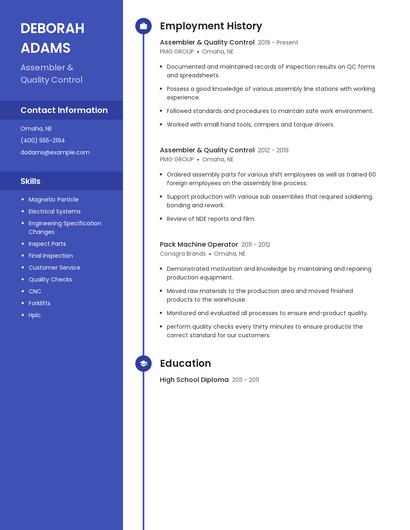
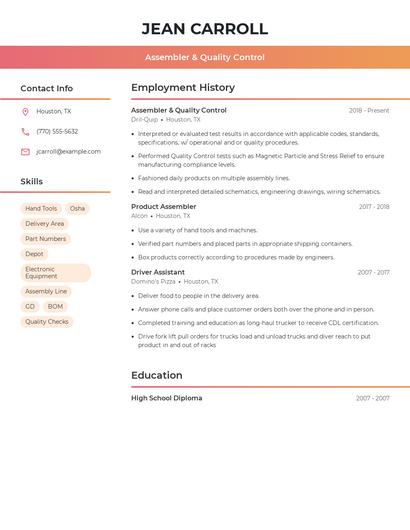
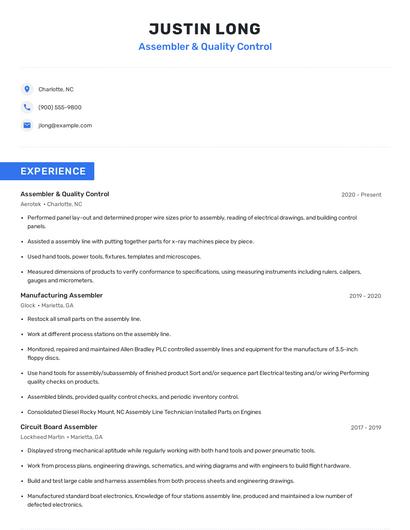
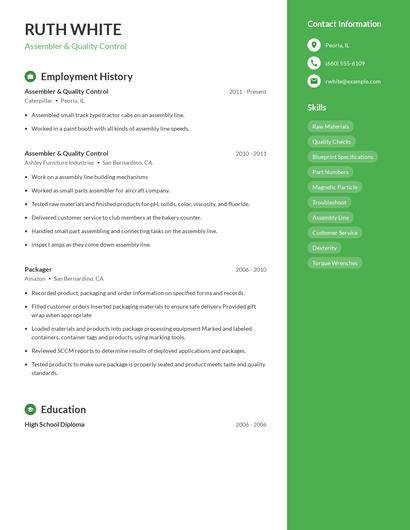
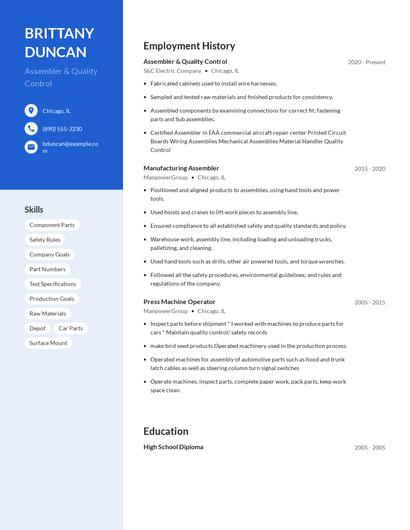
Choose from 10+ customizable assembler & quality control resume templates
Build a professional assembler & quality control resume in minutes. Our AI resume writing assistant will guide you through every step of the process, and you can choose from 10+ resume templates to create your assembler & quality control resume.



Compare different assemblers & quality control
Assembler & quality control vs. Final inspector
A manufacturing assembler is primarily responsible for assembling products according to technical guidelines and schematics, preparing them for public releases. Their responsibilities revolve around adhering to the directives of managers and supervisors, operating tools and devices, coordinating with quality-control officers and other manufacturing staff, and performing quick and efficient repairs on any materials or products. They must also ensure the cleanliness of their workspaces, keeping it free from any obstructions. Furthermore, as a manufacturing assembler, it is essential to uphold the company's safety policies and regulations.
There are some key differences in the responsibilities of each position. For example, assembler & quality control responsibilities require skills like "part numbers," "quality checks," "safety guidelines," and "control panels." Meanwhile a typical final inspector has skills in areas such as "micrometers," "calipers," "aerospace," and "in-process inspection." This difference in skills reveals the differences in what each career does.
Final inspectors really shine in the automotive industry with an average salary of $36,467. Comparatively, assemblers & quality control tend to make the most money in the automotive industry with an average salary of $34,668.final inspectors tend to reach similar levels of education than assemblers & quality control. In fact, final inspectors are 0.5% less likely to graduate with a Master's Degree and 0.2% more likely to have a Doctoral Degree.Assembler & quality control vs. Electrical mechanical assembler
Wire harness assemblers are tasked with binding wires to form wire harnesses, which are typically used in electrical systems and electronic equipment. They read electrical wiring schemes and binds wires together using sleeves, cable lacing, cable ties, and electrical conduits. They are expected to install wire harnesses, inspect them, and perform soldering as needed.
In addition to the difference in salary, there are some other key differences worth noting. For example, assembler & quality control responsibilities are more likely to require skills like "part numbers," "quality checks," "safety guidelines," and "r." Meanwhile, an electrical mechanical assembler has duties that require skills in areas such as "hand tools," "sub assemblies," "engineering drawings," and "electrical assembly." These differences highlight just how different the day-to-day in each role looks.
On average, electrical mechanical assemblers earn a higher salary than assemblers & quality control. Some industries support higher salaries in each profession. Interestingly enough, electrical mechanical assemblers earn the most pay in the finance industry with an average salary of $37,999. Whereas assemblers & quality control have higher pay in the automotive industry, with an average salary of $34,668.electrical mechanical assemblers earn similar levels of education than assemblers & quality control in general. They're 0.8% less likely to graduate with a Master's Degree and 0.2% less likely to earn a Doctoral Degree.Assembler & quality control vs. Manufacturing assembler
There are many key differences between these two careers, including some of the skills required to perform responsibilities within each role. For example, an assembler & quality control is likely to be skilled in "part numbers," "tape measure," "qa," and "plc," while a typical manufacturing assembler is skilled in "assembly operations," "basic math," "safety procedures," and "work ethic."
Manufacturing assemblers earn the highest salary when working in the automotive industry, where they receive an average salary of $32,563. Comparatively, assemblers & quality control have the highest earning potential in the automotive industry, with an average salary of $34,668.manufacturing assemblers typically earn similar educational levels compared to assemblers & quality control. Specifically, they're 0.1% less likely to graduate with a Master's Degree, and 0.1% less likely to earn a Doctoral Degree.Assembler & quality control vs. Wire harness assembler
Even though a few skill sets overlap between assemblers & quality control and wire harness assemblers, there are some differences that are important to note. For one, an assembler & quality control might have more use for skills like "part numbers," "safety guidelines," "r," and "quality inspection." Meanwhile, some responsibilities of wire harness assemblers require skills like "hand tools," "switches," "mechanical assembly," and "wire harness assembly. "
The finance industry tends to pay the highest salaries for wire harness assemblers, with average annual pay of $36,950. Comparatively, the highest assembler & quality control annual salary comes from the automotive industry.In general, wire harness assemblers hold similar degree levels compared to assemblers & quality control. Wire harness assemblers are 1.0% less likely to earn their Master's Degree and 0.0% less likely to graduate with a Doctoral Degree.Types of assembler & quality control
Updated January 8, 2025
