
Automatically apply for jobs with Zippia
Upload your resume to get started.
Assembly cleaner skills for your resume and career
15 assembly cleaner skills for your resume and career
1. Hand Tools
- Assembled prefabricated metal cabinets according to blueprint specifications, using hand tools, power tools and hoisting equipment.
- Assemble product following procedure book; used of hand tools and work with microscope view
2. Basic Math
- Complete basic mathematical calculations and follow standard work instructions.
- Input data into company spreadsheets and solved basic math problems.
3. Clean Room Environment
A cleanroom has a tidy and enclosed environment, which is free of all pollutants including aerosols and microbes. The pollutants are filtered out to keep the area as tidy as possible. Environmental variables such as temperature, humidity, and the flow of air are also controlled in a cleanroom environment.
- Assembled and tested electronic storage devices in ISO 6 Clean Room environment at state of art facility.
- Facilitated in the bonding of Teflon filters in a Clean Room environment.
4. Dexterity
- Perform a series of repetitive operations requiring manual dexterity and visual acuity.
- Exercise judgment at a high degree of manual dexterity to maintain close tolerance sealing as prescribed by blueprints and specifications.
5. Medical Devices
Medical devices refer to apparatus for use in medical procedures.
- Assemble medical devices per specification by following written manufacturing procedures and drawings.
- Assembled medical devices for vascular suturing.
6. Medical Products
A medical product is a general term for all products, devices, articles, methods, systems, or goods that are used to diagnose or treat patients. They are used primarily by healthcare professionals to diagnose, treat, or prevent illness or injury. This includes exam gloves, swabs, mattresses, lab products, protective clothing, drains, bandages, etc.
- Identified non-acceptable medical product components for discoloration and abnormalities.
- Read and understood manufacturing procedures and utilized the procedures to assemble / package medical products.
Choose from 10+ customizable assembly cleaner resume templates
Build a professional assembly cleaner resume in minutes. Our AI resume writing assistant will guide you through every step of the process, and you can choose from 10+ resume templates to create your assembly cleaner resume.7. Catheter
- Loaded catheters into the machines Inspect and checked the production qualify based with design Count and put all catheters into boxes
- Worked in a cleanroom environment Worked small parts of catheters.
8. Lean Manufacturing
- Helped to establish Lean manufacturing procedures, and 5S work environments.
- Cross-trained on production line as multifunctional team player in lean manufacturing.
9. Medical Equipment
Medical equipment refers to apparatus for use in medical procedures.
- Assemble trays and pack medical equipment properly for shipping Cross-trained in microscope assembly.
- Examine medical equipment or facility's structural environment and check for proper use of equipment to ensure compliance with safety regulations
10. Blueprint Specifications
Blueprints are layouts or designs about the construction of a building or structure. It consists of accurate engineering drawing on light-sensitive sheets allowing to create copies easily.
- Prepared work to be accomplished by following written and verbal instructions relating to blueprint specifications.
- Assemble parts together specific to instructions included and blueprint specifications.
11. ISO
- Trained in ISO Standards & Quality Assurance.
- Machine set up/self-test Completes all tasks within ISO guidelines.
12. Room Assembly
- Clean Room AssemblyReading schematics, reading blueprints, assembling high flow regulators for medical and industrial application.
- Clean Room assembly under a microscope.
13. Quality Checks
Quality checks are a component of quality control aimed at ensuring that quality requirements are met. Internally, quality checks provide assurance to managers, and externally, it provides assurance to clients, federal departments, authorities, and certifiers.
- Completed paperwork for quality checklist, and inspected placement of warning decals specific for each boat.
- Assembled harnesses, sanded, and finished wood Repaired gel, cracks, and other imperfections Conducted quality checks COMMUNITY INVOLVEMENT
14. FDA
The Food and Drug Administration (FDA) is a division of the US Department of Health and Human Services that regulates the production and sale of food, pharmaceutical products, medical equipment, and other consumer goods, as well as veterinary medicine. The FDA is now in charge of overseeing the manufacture of products like vaccines, allergy treatments, and beauty products.
- Followed manufacturing instructions according to engineering procedures defined by FDA.
- Constructed medical devices and provided necessary documentation according to FDA procedures.
15. Safety Policies
Safety policies are the rules and codes of conduct developed by an organization to ensure workplace safety.
- Follow all safety policies and procedures, and work in a safe manner when completing all tasks.
- Observed all safety policies and procedures Recognized and reported defective material and equipment to shift supervisor.
5 Assembly Cleaner resume examples
Build a professional assembly cleaner resume in minutes. Browse through our resume examples to identify the best way to word your resume. Then choose from 5+ resume templates to create your assembly cleaner resume.

What skills help Assembly Cleaners find jobs?
Tell us what job you are looking for, we’ll show you what skills employers want.
List of assembly cleaner skills to add to your resume
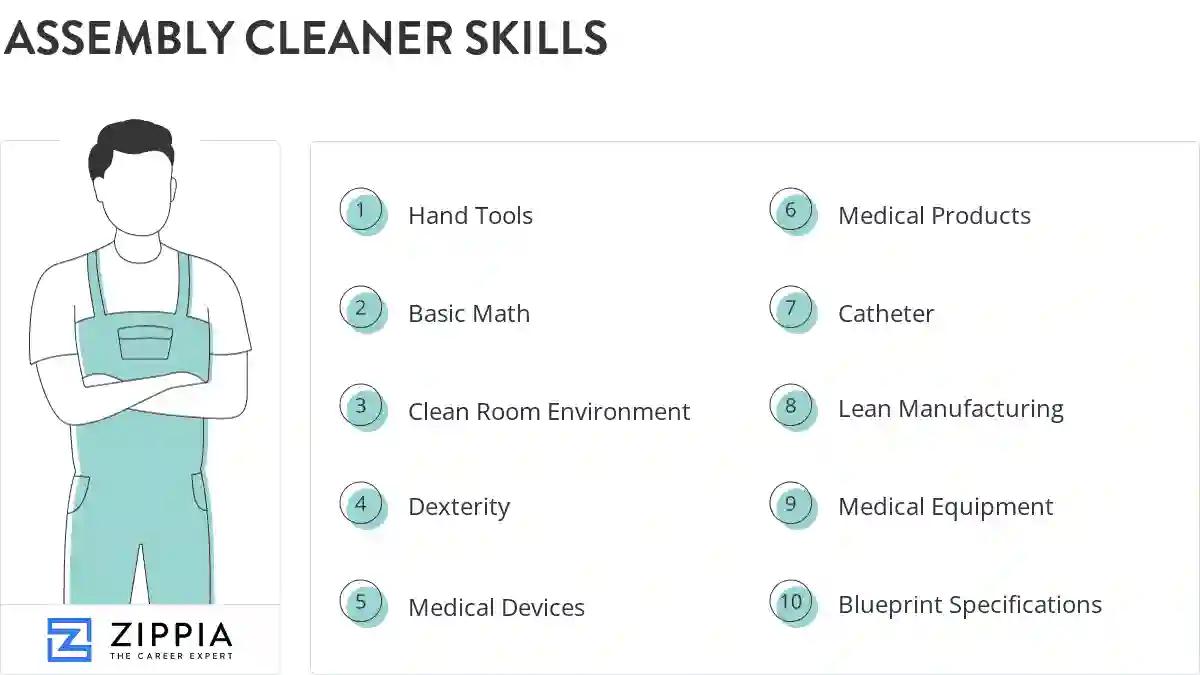
The most important skills for an assembly cleaner resume and required skills for an assembly cleaner to have include:
- Hand Tools
- Basic Math
- Clean Room Environment
- Dexterity
- Medical Devices
- Medical Products
- Catheter
- Lean Manufacturing
- Medical Equipment
- Blueprint Specifications
- ISO
- Room Assembly
- Quality Checks
- FDA
- Safety Policies
- Brazing
- Customer Specifications
- Medical Kits
- Hoists
- Medical Components
- Tweezers
- GMP
- Line Clearance
- Surgical Kits
- Syringes
- Medical Assembly
- Clean Rooms
- BOM
Updated January 8, 2025
