
Automatically apply for jobs with Zippia
Upload your resume to get started.
Assembly operator skills for your resume and career

15 assembly operator skills for your resume and career
1. Hand Tools
- Operated automatic compression/sonic weld machines and used various hand tools to assemble various components into finished product.
- Replaced defective or improperly functioning circuitry or electronics components, using hand tools or soldering iron.
2. Quality Checks
Quality checks are a component of quality control aimed at ensuring that quality requirements are met. Internally, quality checks provide assurance to managers, and externally, it provides assurance to clients, federal departments, authorities, and certifiers.
- Performed quality checks using calibrated measurement devices and visual inspection as required on the Quality Inspection Plan.
- Operated machines that produced aluminum under parts for Automobiles to include doing quality checks and packing
3. Basic Math
- Complete basic mathematical calculations and follow standard work instructions.
- Perform basic math functions (addition, subtraction, multiplication, division, and fractions).
4. Quality Standards
Quality standards are a specific level of standards of products that are set by the companies for the customers that have to be met and maintained throughout the process until the time of delivery. Quality standards are information that includes the customer's requirements, guidelines, and characteristics for the needed final product or service.
- Maintain quality standards by approving material at in-process inspection for all products verify conformance to specified dimensions.
- Exceeded all company manufacturing quotas while maintaining the highest possible quality standards.
5. Math
- Solve math equations quickly and accurately without calculator.
- Demonstrated mechanical abilities and shop math skills, used logic or a specific method to solve problem.
6. Troubleshoot
Troubleshooting is the process of analyzing and fixing any kind of problem in a system or a machine. Troubleshooting is the detailed yet quick search in the system for the main source of an issue and solving it.
- Assemble and build quality air conditioning units Operate and troubleshoot equipment effectively 5s and housekeeping Inventory management
- Understand how different automated machines are set up and be able to troubleshoot those machines including Test Cells for small engines.
Choose from 10+ customizable assembly operator resume templates
Build a professional assembly operator resume in minutes. Our AI resume writing assistant will guide you through every step of the process, and you can choose from 10+ resume templates to create your assembly operator resume.7. Assembly Line
Assembly line is a process used in industries to ensure the production of products in a cost effective manner by dividing up the responsibilities of each labor. Assembly lines enabled industries to hire more workers, therefore providing more employment opportunities to labors. This is possible because in this process the burden of all the tasks related to production are not laid on a single person, they are divided into small baby steps for each labor.
- Operated assembly line for industrial batteries and power supply for manufacturing distribution.
- Replenished parts to assembly lines to ensure constant availability of materials.
8. Assembly Operations
- Worked in manufacturing truck assembly performing various assembly operations to support manufacturing efforts.
- Performed assembly operations, in compliance with established policies and procedures.
9. Continuous Improvement
Continuous improvement is an ongoing process of improvement of products, services, and processes with the help of innovative ideas. It is an organized approach that helps an organization to find its weaknesses and improve them.
- Total commitment to continuous improvement and operator's self-operating procedure awareness, training and skills enhancement.
- Worked with team members to maximize productivity, efficiency and continuous improvements.
10. Dexterity
- Performed various assembly, sub-assembly, and or packaging operation in a production area requiring general physical dexterity.
- Perform a series of repetitive operations requiring manual dexterity and visual acuity.
11. Assembly Process
- Provide complete documentation of complete assembly process and production.
- Assisted individual assembly operators with various assembly processes.
12. Safety Procedures
Safety procedures are a set of standardized procedures, that ensures minimal to no risk to people, resources, and the work environment. A company follows the step-by-step safety procedures as it they not only keep the customers and the employees safe, but also help in avoiding legal claims.
- Gained experience in an industrial environment, mass production, manufacturing equipment, and safety procedures
- Machine Operator * Operated 10 ft. Poly Band Saw * Maintained all safety procedures of the operations of machinery.
13. Safety Policies
Safety policies are the rules and codes of conduct developed by an organization to ensure workplace safety.
- Followed company safety policies and procedures.
- Follow all safety policies & procedures, and maintain good housekeeping practices in their work area and all common areas.
14. Calipers
- Measured completed work to verify conformance to specifications using micrometers and calipers.
- Measured parts to determine tolerances, using precision measurement instruments, such as micrometers, calipers, and verniers.
15. ISO
- Helped plant to achieve ISO 9000 Certification by following product specifications and performing in-process inspections.
- Maintained a safe and efficient workplace in a factory environment, compliant with current OSHA and ISO 9001 standards.
5 Assembly Operator resume examples
Build a professional assembly operator resume in minutes. Browse through our resume examples to identify the best way to word your resume. Then choose from 5+ resume templates to create your assembly operator resume.

What skills help Assembly Operators find jobs?
Tell us what job you are looking for, we’ll show you what skills employers want.
List of assembly operator skills to add to your resume
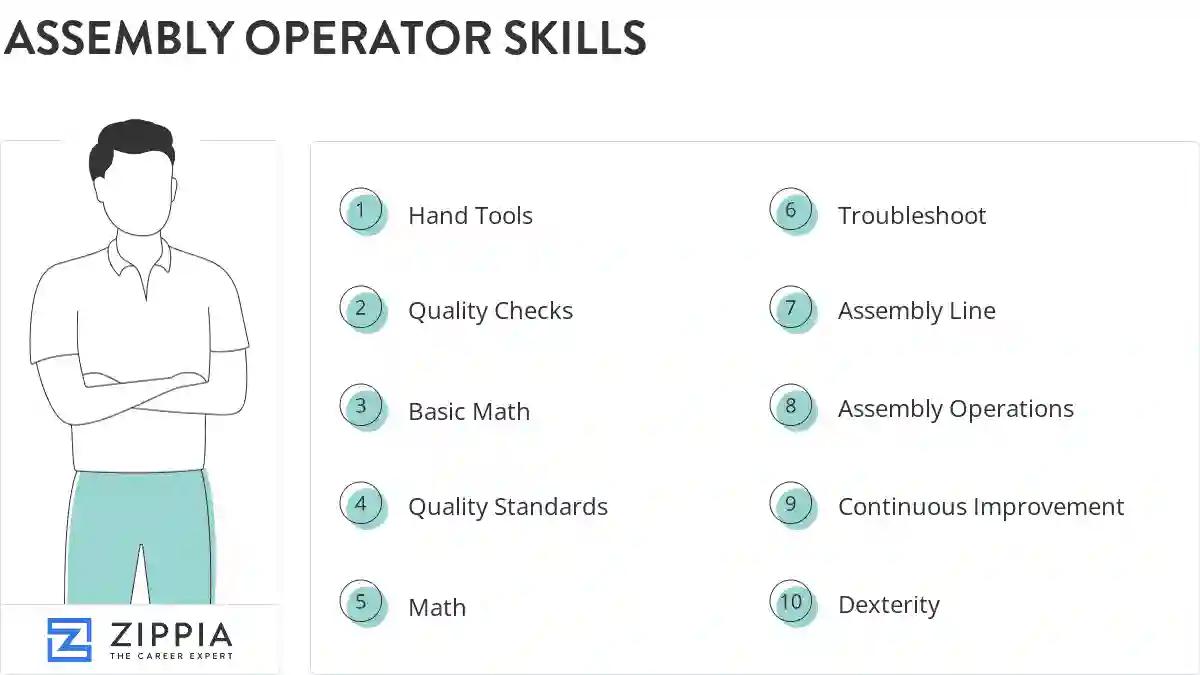
The most important skills for an assembly operator resume and required skills for an assembly operator to have include:
- Hand Tools
- Quality Checks
- Basic Math
- Quality Standards
- Math
- Troubleshoot
- Assembly Line
- Assembly Operations
- Continuous Improvement
- Dexterity
- Assembly Process
- Safety Procedures
- Safety Policies
- Calipers
- ISO
- Assembly Equipment
- Safety Standards
- Safety Regulations
- Lean Manufacturing
- Catheter
- Etching
- Test Equipment
- Quality Inspection
- Medical Devices
- Jigs
- Production Equipment
- Assembly Machines
- Quality Specifications
- Production Schedules
- FDA
- Tweezers
- Quality Products
- GMP
- Production Reports
- Quality Issues
- Blueprint Specifications
- Clean Room Environment
- SPC
- Extrusion
- Pallet Jack
- Spot Welding
- Electrical Components
- Machine Operation
- CNC
- Circuit Boards
- Customer Specifications
- Defective Materials
- Hoists
- Preventive Maintenance
Updated January 8, 2025
