What does an asset management analyst do?
Asset management specialists are employees who oversee all of the company's assets. They ensure that all assets are in proper condition. Asset management specialists handle the asset management plan of the company. They organize capital investments, asset acquisitions, asset dispositions. They ensure that all paperwork involved is properly filed. They also ensure that all agreements made would be beneficial to the company. This would help them ensure the company's longevity in the business. Asset management specialists also develop recommendations on the company's existing assets and how the company can expand its asset portfolio.
Asset management analyst responsibilities
Here are examples of responsibilities from real asset management analyst resumes:
- Modify and test data models design for remedy database used to manage inventory of hardware and software.
- Manage all areas of PC physical inventory including remote site visits to audit for compliance with procedures and policies.
- Manage SharePoint library and request accurately.
- Prepare and post journal entries (re-classes, accruals, accrual reversals) and provide support documentation for month-end close.
- Perform general accounting functions, including preparation of journal entries, account analysis and balance sheet reconciliations.
- Analyze CIP and review capital asset supporting documents.
- Conduct data and process mapping according to ITIL standards.
- Develop macro enable spreadsheet for FAS13 test (op-lease test).
- Assist in the mapping of relationships and dependencies of CIs in the CMDB.
- Integrate a major division of the company into the main corporate ITAM database.
- Analyze and manipulate SQL data to provide financial modeling for upper management and clients.
- Monitor actual CAPEX spend against budget and aware when a project needs additional approvals.
- Increase accountability across departments to ensure compliance to the ITAM policies and increase cost effectiveness.
- Identify budget increase opportunity by allocating current year expenses to prior year base on accruals.
- Conduct consistent macro and micro market research in order to foresee trouble assets due to market conditions.
Asset management analyst skills and personality traits
We calculated that 17% of Asset Management Analysts are proficient in Asset Management, Portfolio, and Real Estate. They’re also known for soft skills such as Interpersonal skills, Time-management skills, and Problem-solving skills.
We break down the percentage of Asset Management Analysts that have these skills listed on their resume here:
- Asset Management, 17%
Trained team members and various internal groups in the proper internal procedures, organizational roles and responsibilities pertaining to asset management.
- Portfolio, 8%
Conducted sensitivity analysis on potential impact of deposit outflows on Key's portfolio and established measures of financial stability.
- Real Estate, 6%
Developed new business relationship through sales of our real estate lines of credit to real estate developers and flippers.
- PowerPoint, 5%
Designed and maintained reports utilizing Excel and PowerPoint for informational and metric accountability purposes.
- Customer Service, 4%
Contacted customer daily to advise status update of equipment to ensure great customer service delivery practices.
- Property Management, 4%
Initiated property management activities that included payment processing and ensuring that continual maintenance was performed and that property inventory/utility was maintained.
Most asset management analysts use their skills in "asset management," "portfolio," and "real estate" to do their jobs. You can find more detail on essential asset management analyst responsibilities here:
Interpersonal skills. To carry out their duties, the most important skill for an asset management analyst to have is interpersonal skills. Their role and responsibilities require that "management analysts work with managers and other employees of the organizations for which they provide consulting services." Asset management analysts often use interpersonal skills in their day-to-day job, as shown by this real resume: "applied interpersonal, analytical and computer skills to troubleshoot incoming problems and disbursed cases to the appropriate information systems team members. "
Time-management skills. Another soft skill that's essential for fulfilling asset management analyst duties is time-management skills. The role rewards competence in this skill because "management analysts often work under tight deadlines and must use their time efficiently to complete projects on schedule." According to an asset management analyst resume, here's how asset management analysts can utilize time-management skills in their job responsibilities: "opened asset management checking and savings accounts under strict deadlines. "
Problem-solving skills. Another skill that relates to the job responsibilities of asset management analysts is problem-solving skills. This skill is critical to many everyday asset management analyst duties, as "management analysts must be able to think creatively to solve clients’ problems." This example from a resume shows how this skill is used: "identified and facilitate the resolution of the differences between machines reporting in asset management and discovery tool. "
Analytical skills. For certain asset management analyst responsibilities to be completed, the job requires competence in "analytical skills." The day-to-day duties of an asset management analyst rely on this skill, as "management analysts must be able to interpret information and use their findings to make proposals." For example, this snippet was taken directly from a resume about how this skill applies to what asset management analysts do: "monitored data integrity of the asset management system by conducting physical stockroom inventories ensuring accuracy of stockroom counts. "
Communication skills. Another common skill required for asset management analyst responsibilities is "communication skills." This skill comes up in the duties of asset management analysts all the time, as "management analysts must be able to convey information clearly in both writing and speaking." An excerpt from a real asset management analyst resume shows how this skill is central to what an asset management analyst does: "worked directly with the project management office to coordinate metrics tracking, audits, status reports, and project communications. "
The three companies that hire the most asset management analysts are:
- JPMorgan Chase & Co.26 asset management analysts jobs
- JLL11 asset management analysts jobs
- Northrop Grumman11 asset management analysts jobs
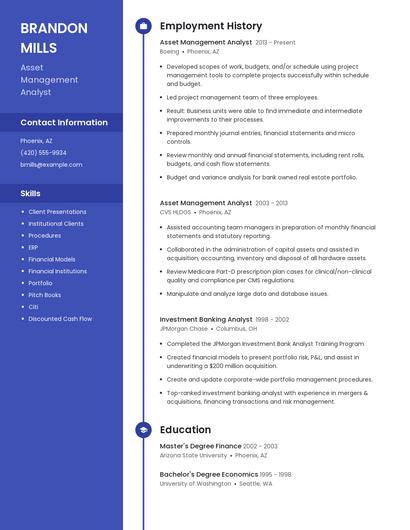
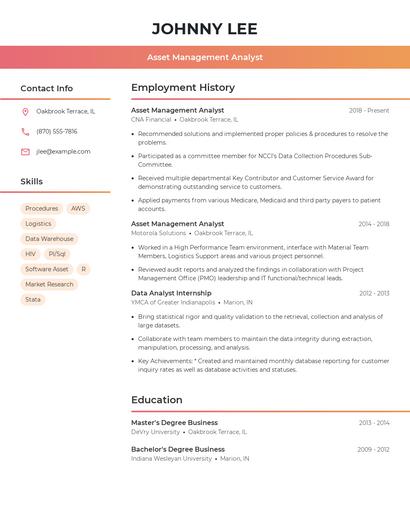
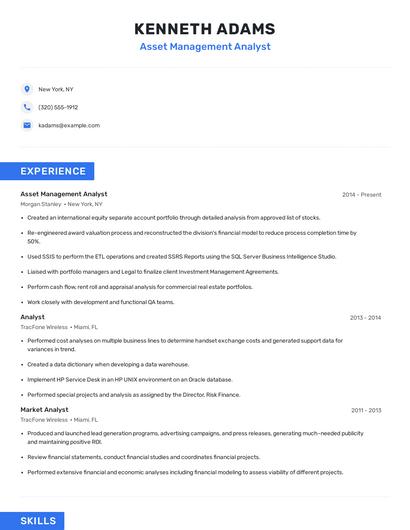
Choose from 10+ customizable asset management analyst resume templates
Build a professional asset management analyst resume in minutes. Our AI resume writing assistant will guide you through every step of the process, and you can choose from 10+ resume templates to create your asset management analyst resume.



Compare different asset management analysts
Asset management analyst vs. Junior business analyst
Junior business analysts work with senior business analysts and project teams to ensure the applications or products in development comply with end-user needs. Their primary responsibility is data analysis, in which they report the findings to the senior business analysts as well as the developers. Other duties and responsibilities include analyzing the impact of projects on business outcomes, collecting systems information, and giving feedback to developers who work on the deliverables. Junior business analysts are also expected to contribute to the development of test scripts and test plans.
There are some key differences in the responsibilities of each position. For example, asset management analyst responsibilities require skills like "asset management," "portfolio," "real estate," and "customer service." Meanwhile a typical junior business analyst has skills in areas such as "user stories," "test cases," "sdlc," and "jira." This difference in skills reveals the differences in what each career does.
Junior business analysts really shine in the finance industry with an average salary of $73,417. Comparatively, asset management analysts tend to make the most money in the finance industry with an average salary of $82,385.junior business analysts tend to reach higher levels of education than asset management analysts. In fact, junior business analysts are 6.1% more likely to graduate with a Master's Degree and 0.4% less likely to have a Doctoral Degree.Asset management analyst vs. Junior is analyst
A junior IS analyst takes responsibility in making sure that databases are constructed appropriately and with access limits. IS analysts improve trading strategy with intermediaries through compensation information analysis. They handle financial claims payment as well as provider directory processes. Also, they develop dictionaries and provide technical support. They even perform due diligence for investment opportunities. The skills they need to have include management, information technology, and financial management.
While some skills are similar in these professions, other skills aren't so similar. For example, resumes show us that asset management analyst responsibilities requires skills like "asset management," "customer service," "property management," and "software asset." But a junior is analyst might use other skills in their typical duties, such as, "dod," "data entry," "pivot tables," and "logistics."
Junior is analysts earn a lower average salary than asset management analysts. But junior is analysts earn the highest pay in the finance industry, with an average salary of $83,781. Additionally, asset management analysts earn the highest salaries in the finance with average pay of $82,385 annually.In general, junior is analysts achieve similar levels of education than asset management analysts. They're 4.3% less likely to obtain a Master's Degree while being 0.4% more likely to earn a Doctoral Degree.Asset management analyst vs. Treasury analyst
A treasury analyst is an individual who manages and analyses the financial activities of an organization that can include cash flows, liability obligations, and assets. Treasury analysts are required to execute the daily cash management of the organization such as cash forecasting, investing of excess cash, and running a hedging program in interest rates. They must present monthly reports and daily briefings on cash flows to senior management and provide advice on the financial operations of the movement of cash. Treasury analysts also update treasury policies and procedures for the organization to comply.
The required skills of the two careers differ considerably. For example, asset management analysts are more likely to have skills like "asset management," "portfolio," "real estate," and "powerpoint." But a treasury analyst is more likely to have skills like "treasury," "cash management," "ach," and "treasury operations."
Treasury analysts make a very good living in the automotive industry with an average annual salary of $87,077. On the other hand, asset management analysts are paid the highest salary in the finance industry, with average annual pay of $82,385.Most treasury analysts achieve a similar degree level compared to asset management analysts. For example, they're 0.7% more likely to graduate with a Master's Degree, and 0.1% more likely to earn a Doctoral Degree.Asset management analyst vs. Analyst
Analysts are employees or individual contributors with a vast experience in a particular field that help the organization address challenges. They help the organization improve processes, policies, and other operations protocol by studying the current processes in place and determining the effectiveness of those processes. They also research industry trends and data to make sound inferences and recommendations on what the company should do to improve their numbers. Analysts recommend business solutions and often help the organization roll out these solutions. They ensure that the proposed action plans are effective and produce the desired results.
Types of asset management analyst
Updated January 8, 2025
