What does an assistant-at-surgery do?
An assistant at surgery is a medical professional who assists surgeons and nurses during surgical operations and other procedures. They are responsible for setting up and maintaining the cleanliness of operating rooms, preparing and sanitizing tools and equipment, understanding the operations' course, and preparing the patients pre-surgery through interviews and assessments. During the surgery, they provide direct assistance to the surgeon by handing the correct tools, monitoring the patients' vital signs, attaching tubes, and even closing wounds. Moreover, as an assistant at surgery, it is essential to be proactive and have a clear mind presence.
Assistant-at-surgery responsibilities
Here are examples of responsibilities from real assistant-at-surgery resumes:
- Submit requests for authorization for surgical procedures and office appointments from patients' insurance carriers.
- Perform EKGs and phlebotomy as needed.
- Assist doctors with procedures, patient triage/telephone triage.
- Participate in hospital triage with medical and surgical cases.
- Make calls to pharmacies and other medical offices to give or obtain patient information in accordance with HIPAA.
- Perform clinical tasks such as taking and recording vitals, operating EKG machine, performing finger sticks, and patient preparation.
- Prepare charts for record requests while ensuring the rights and privacy of customers as it pertains to HIPAA and state laws.
- Administer injections, venipuncture, and laboratory tests.
- Change dressings, perform urinalysis testing and minor laboratory procedures.
- Perform phlebotomy, Foley catheterizations, and blood sugar monitoring.
- Perform venipuncture, injections and various diagnostic procedures and ancillary test.
- Facilitate surgery scheduling, from contacting patients to reserving and supplying operating rooms.
- Perform urinalysis and pregnancy test, dispose of contaminate supplies, sterilize medical instruments.
- Perform risk reduction counseling, HIV counseling and testing, STI awareness, and education and testing.
- Perform all protocol specific regulatory duties from initial submission to IRB to final study close-out.
Assistant-at-surgery skills and personality traits
We calculated that 39% of Assistants-At Surgery are proficient in Patients, Surgical Procedures, and HIPAA. They’re also known for soft skills such as Analytical skills, Technical skills, and Detail oriented.
We break down the percentage of Assistants-At Surgery that have these skills listed on their resume here:
- Patients, 39%
Submitted requests for authorization for surgical procedures and office appointments from patients' insurance carriers.
- Surgical Procedures, 7%
Perform surgical procedures to simulate injuries and treatment using micro-encapsulated antibiotics and anesthetics for non terminal surgeries.
- HIPAA, 4%
Demonstrated knowledge of HIPAA Privacy and Security Regulations by appropriately handling patient information Read and recorded temperature, pulse and respiration.
- CPR, 4%
Maintained current CPR and emergencies preparation certification and was responsible for accurate EKG interpretations.
- Direct Patient Care, 4%
Assisted in Psychiatric ward- Direct Patient Care, Groups.
- Vital Signs, 3%
Monitored vital signs, such as blood pressure and Oxygen.
Most assistants-at surgery use their skills in "patients," "surgical procedures," and "hipaa" to do their jobs. You can find more detail on essential assistant-at-surgery responsibilities here:
Analytical skills. The most essential soft skill for an assistant-at-surgery to carry out their responsibilities is analytical skills. This skill is important for the role because "medical assistants must be able to understand and follow medical charts and diagnoses." Additionally, an assistant-at-surgery resume shows how their duties depend on analytical skills: "created and maintained database of cardiac surgery patients. "
Technical skills. Another soft skill that's essential for fulfilling assistant-at-surgery duties is technical skills. The role rewards competence in this skill because "medical assistants should be able to use basic clinical instruments so they can take a patient’s vital signs, such as heart rate and blood pressure." According to an assistant-at-surgery resume, here's how assistants-at surgery can utilize technical skills in their job responsibilities: "provided technical assistance to medical providers during in-house medical procedures. "
Detail oriented. assistants-at surgery are also known for detail oriented, which are critical to their duties. You can see how this skill relates to assistant-at-surgery responsibilities, because "medical assistants need to be precise when taking vital signs or recording patient information." An assistant-at-surgery resume example shows how detail oriented is used in the workplace: "roomed patients and interviewed patient to know further details about their previous medical history. "
Interpersonal skills. For certain assistant-at-surgery responsibilities to be completed, the job requires competence in "interpersonal skills." The day-to-day duties of an assistant-at-surgery rely on this skill, as "medical assistants need to be able to discuss patient information with other medical personnel, such as physicians." For example, this snippet was taken directly from a resume about how this skill applies to what assistants-at surgery do: "utilized interpersonal communication skills with very nervous patients. "
The three companies that hire the most assistant-at-surgerys are:
- Norman Regional Health System10 assistants-at surgery jobs
- Brigham and Women's Hospital6 assistants-at surgery jobs
- Memorial Healthcare System4 assistants-at surgery jobs
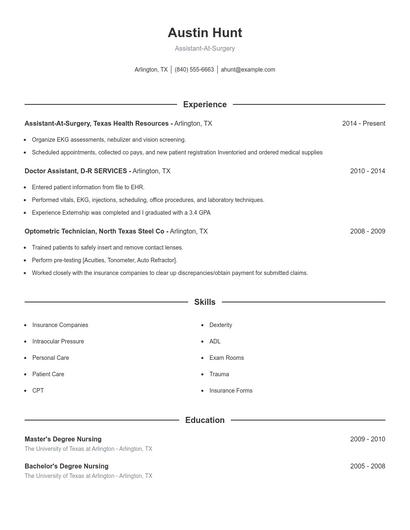
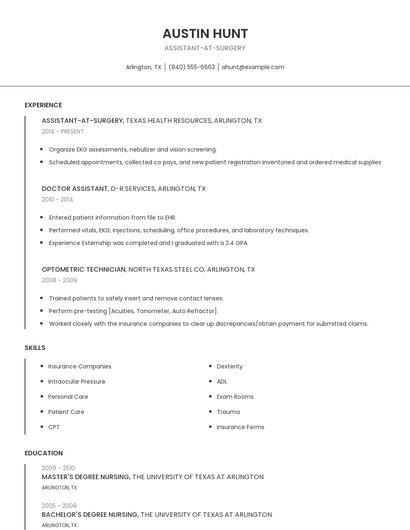
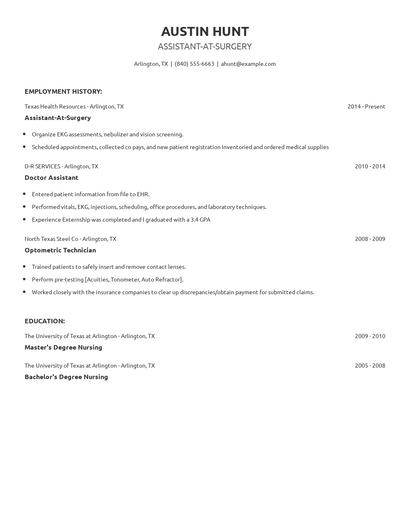
Choose from 10+ customizable assistant-at-surgery resume templates
Build a professional assistant-at-surgery resume in minutes. Our AI resume writing assistant will guide you through every step of the process, and you can choose from 10+ resume templates to create your assistant-at-surgery resume.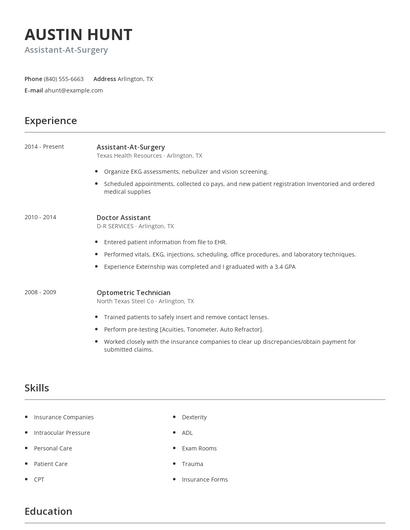
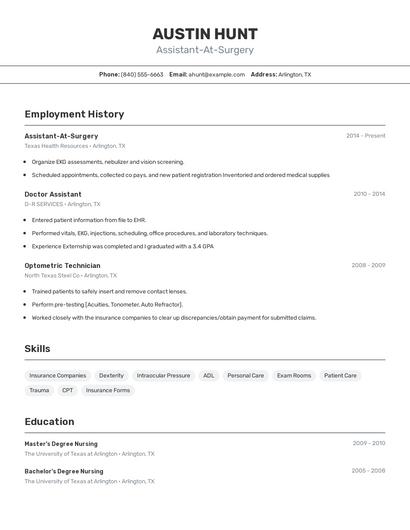


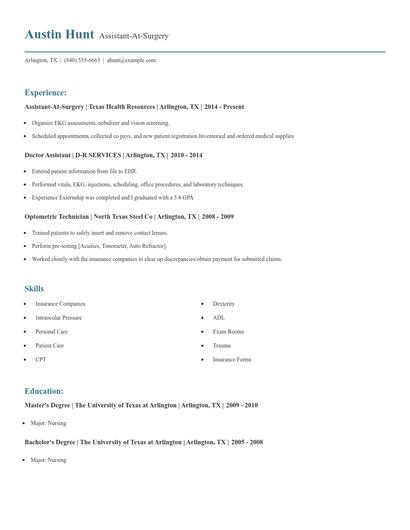
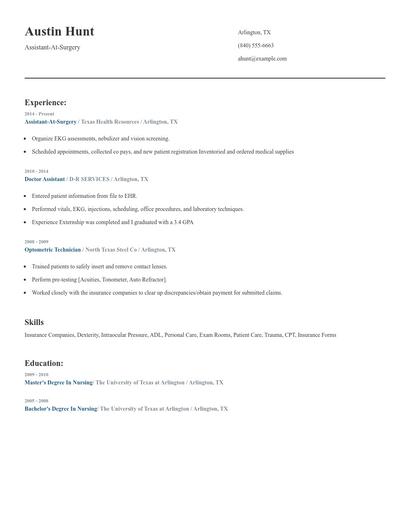
Compare different assistants-at surgery
Assistant-at-surgery vs. Registered medical assistant
The primary job of registered medical assistants is to perform clinical and administrative tasks in a healthcare setting. They offer support services to physicians, so the latter have plenty of time to care for patients. They carry out varied administrative, clerical, and clinical tasks that include taking vital signs, filing records, and scheduling patient appointments. Other responsibilities include discussing treatment procedures to patients, interacting with patients, and collecting laboratory specimens such as tissue and blood. Ideal characteristics to become a registered medical assistant include being compassionate, can work well with people, and adaptable.
There are some key differences in the responsibilities of each position. For example, assistant-at-surgery responsibilities require skills like "direct patient care," "infection control," "dr," and "scheduling appointments." Meanwhile a typical registered medical assistant has skills in areas such as "customer service," "phlebotomy," "phone calls," and "rma." This difference in skills reveals the differences in what each career does.
Registered medical assistants tend to reach similar levels of education than assistants-at surgery. In fact, registered medical assistants are 3.7% less likely to graduate with a Master's Degree and 7.2% less likely to have a Doctoral Degree.Assistant-at-surgery vs. Medical laboratory assistant
A medical laboratory assistant is in charge of performing support tasks while under the supervision and directives of a more experienced medical technician or scientist. Their responsibilities typically revolve around collecting samples such as blood and tissues, preparing slides, running tests using machines and equipment, and maintaining records of all procedures and results. Furthermore, a medical laboratory assistant must also keep the cleanliness of the laboratory, organize and monitor inventories, procure supplies, and implement the laboratory's policies and regulations.
Each career also uses different skills, according to real assistant-at-surgery resumes. While assistant-at-surgery responsibilities can utilize skills like "surgical procedures," "direct patient care," "infection control," and "dr," medical laboratory assistants use skills like "customer service," "data entry," "lab equipment," and "patient care."
Average education levels between the two professions vary. Medical laboratory assistants tend to reach similar levels of education than assistants-at surgery. In fact, they're 2.1% less likely to graduate with a Master's Degree and 7.2% less likely to earn a Doctoral Degree.Assistant-at-surgery vs. Clinical medical assistant
A clinical medical assistant specializes in performing administrative and clinical tasks in a hospital or similar setting. Their responsibilities revolve around gathering a patient's information, medical history, test results, and other essential documentation, and updating patient medical records. Other tasks include reaching out to patients' families and guardians, assisting health workers with room preparation and patient care, and preparing medications and other treatments, all in adherence to a physician's directives. Furthermore, a clinical medical assistant may conduct inspections to ensure that the hospital complies with government regulations.
The required skills of the two careers differ considerably. For example, assistants-at surgery are more likely to have skills like "direct patient care," "infection control," "dr," and "scheduling appointments." But a clinical medical assistant is more likely to have skills like "patient care," "customer service," "medical assistants," and "phlebotomy."
When it comes to education, clinical medical assistants tend to earn similar degree levels compared to assistants-at surgery. In fact, they're 2.8% less likely to earn a Master's Degree, and 6.8% less likely to graduate with a Doctoral Degree.Assistant-at-surgery vs. Medical research assistant
A medical research assistant is primarily in charge of performing support tasks in a laboratory or similar environment. Their responsibilities include gathering and organizing samples, preparing the laboratories and other facilities, compiling and managing data, updating databases, and conducting examinations and analysis, all while adhering to the laboratory's policies and regulations. They may also liaise with clients, answering inquiries as necessary. Furthermore, it is vital to maintain an active line with researchers, coordinating with them every step of the way to ensure an efficient workflow.
Even though a few skill sets overlap between assistants-at surgery and medical research assistants, there are some differences that are important to note. For one, an assistant-at-surgery might have more use for skills like "cpr," "direct patient care," "infection control," and "scheduling appointments." Meanwhile, some responsibilities of medical research assistants require skills like "patient care," "medical terminology," "phlebotomy," and "surgery. "
In general, medical research assistants hold similar degree levels compared to assistants-at surgery. Medical research assistants are 1.7% more likely to earn their Master's Degree and 4.2% less likely to graduate with a Doctoral Degree.Updated January 8, 2025
