Explore jobs
Find specific jobs
Explore careers
Explore professions
Best companies
Explore companies
Job outlook for assistant technology coordinators in the United States
Assistant technology coordinator job growth summary. After extensive research, interviews, and analysis, Zippia's data science team found that:
The projected assistant technology coordinator job growth rate is 12% from 2018-2028.
About 52,400 new jobs for assistant technology coordinators are projected over the next decade.
Assistant technology coordinator salaries have increased 13% for assistant technology coordinators in the last 5 years.
There are over 14,249 assistant technology coordinators currently employed in the United States.
There are 118,510 active assistant technology coordinator job openings in the US.
The average assistant technology coordinator salary is $39,762.
Are assistant technology coordinator jobs in demand?
Assistant technology coordinator job and salary trends over time
Assistant technology coordinator jobs over time
Assistant technology coordinator job growth rate over time
| Year | # of jobs | % of population |
|---|---|---|
| 2021 | 14,249 | 0.00% |
| 2020 | 14,409 | 0.00% |
| 2019 | 15,582 | 0.00% |
| 2018 | 16,252 | 0.00% |
| 2017 | 16,727 | 0.01% |
Average assistant technology coordinator salary over time
Assistant technology coordinator salary by year
| Year | Avg. salary | Hourly rate | % Change |
|---|---|---|---|
| 2025 | $39,762 | $19.12 | +2.6% |
| 2024 | $38,767 | $18.64 | +3.9% |
| 2023 | $37,319 | $17.94 | +1.9% |
| 2022 | $36,622 | $17.61 | +4.1% |
| 2021 | $35,173 | $16.91 | +3.2% |
Assistant technology coordinator jobs by state
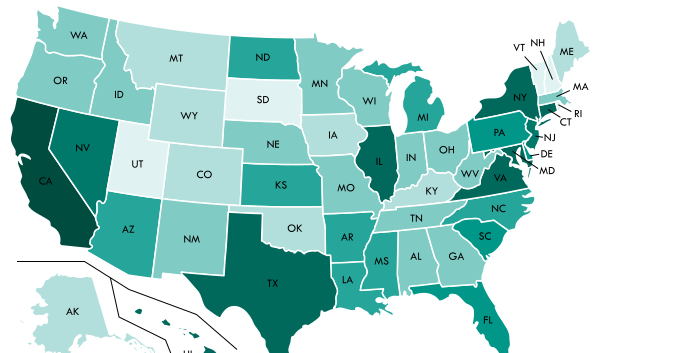
Most common states for assistant technology coordinators
| Rank | State | Population | # of jobs | Employment/ 1000ppl |
|---|---|---|---|---|
| 1 | Vermont | 623,657 | 228 | 37% |
| 2 | Rhode Island | 1,059,639 | 326 | 31% |
| 3 | Wyoming | 579,315 | 180 | 31% |
| 4 | North Dakota | 755,393 | 225 | 30% |
| 5 | Delaware | 961,939 | 283 | 29% |
| 6 | South Dakota | 869,666 | 245 | 28% |
| 7 | Massachusetts | 6,859,819 | 1,629 | 24% |
| 8 | Minnesota | 5,576,606 | 1,311 | 24% |
| 9 | District of Columbia | 693,972 | 165 | 24% |
| 10 | West Virginia | 1,815,857 | 414 | 23% |
| 11 | Maine | 1,335,907 | 300 | 22% |
| 12 | New Hampshire | 1,342,795 | 294 | 22% |
| 13 | Alaska | 739,795 | 165 | 22% |
| 14 | New Mexico | 2,088,070 | 438 | 21% |
| 15 | Idaho | 1,716,943 | 364 | 21% |
| 16 | Hawaii | 1,427,538 | 265 | 19% |
| 17 | Colorado | 5,607,154 | 983 | 18% |
| 18 | Virginia | 8,470,020 | 1,452 | 17% |
| 19 | Maryland | 6,052,177 | 1,034 | 17% |
| 20 | Alabama | 4,874,747 | 851 | 17% |
Most common cities for assistant technology coordinators
| Rank | City | # of jobs | Employment/ 1000ppl | Avg. salary |
|---|---|---|---|---|
| 1 | Bangor | 1 | 3% | $33,927 |
| 2 | Baltimore | 1 | 0% | $51,778 |
| 3 | Phoenix | 1 | 0% | $39,412 |
Assistant Technology Coordinator job outlook: Expert opinions
Our panel of assistant technology coordinator experts
Heidelberg University

Wichita State University
College of Charleston
Meredith College
Paige Atterholt
Adjunct ProfessorHeidelberg University
Will there be an enduring impact of the coronavirus pandemic on Assistant Technology Coordinators?
Paige Atterholt: I think now, being in year 2 of the pandemic, I think if anything there will be more jobs for graduates. Just looking through the jobs online, there are many opportunities for graduates to get a job. I think the older community retired when things got bad, which opened the door for the younger generation.
Sonja Armbruster
Health Sciences EducatorWichita State University
Department of Public Health Sciences
What technical skills for an Assistant Technology Coordinator stand out to employers?
Sonja Armbruster: The technology of this moment may change in the next moment. The capacity to quickly learn new systems and processes is a critical skill. In large-part, this requires a willingness to say yes, and perhaps a willingness to make mistakes and try again. Successful new-graduates are coachable. None of us is as smart as all of us. New grads need to seek coaching and feedback from others. Older co-workers may have wisdom to share, or they may be missing a perspective or skill needed - and either way, new grads can learn so much by watching and paying attention. One of the most valuable skills one can hone is the approach to the work. New responsibilities are an opportunity to grow in the job, not a burden. While you likely won't see this on a normal "technical skills" list, stand-out employees have a healthy willingness to "go-figure-it-out" and then consult with one's supervisor or team rather than waiting to be told what to do or having a narrowly defined "job-jar". GFIO.
What experience really stands out on Assistant Technology Coordinator resumes?
Jacob Craig Ph.D.: I believe strongly in dexterity and a language of expertise. That means that if a student can show they can adapt to new demands by learning a new way of working, learning about a new audience, learning how to address a new purpose, learning a new genre or style, and learning a new technology, that employee attractive. Especially at the entry-level, the ability to learn and adapt is valuable. Being able to talk about their experience using a persuasive vocabulary is often useful. For instance, if students can describe their approach to communication without using cliches (short and sweet, clear) and something along the lines of purpose, audience, situation, genre, medium--that's persuasive.
What type of skills will young Assistant Technology Coordinators need?
Angela Robbins Ph.D.: History majors are in high demand in government, business, and non-profits because of the knowledge and skills they gain in the classroom. History majors, in particular, are especially good at contextualizing-that is, explaining how an event or discussion fits within the big picture. This includes how things that are going on today-such as the Capitol riot on January 6-connects to the Constitution, the balance of powers, the way democracy works, and related issues such as the implications of propaganda and misinformation. This goes well beyond merely expressing an opinion or debating two sides of an issue. Students of history do their research and practice skills of analysis, collecting and scrutinizing evidence rather than taking something at face value or only relying on a single source. We take sources apart to evaluate the credentials of their creators and search for bias. We examine sources from various creators so we take into account multiple experiences and points of view. Then we synthesize-or bring the sources together-in order to communicate what it all means. These skills are desired by employers and translate well into many careers and work environments. Seeking good evidence to answer questions and solve problems, whether that's in the classroom today or working with clients later, is a skill that employers highly value.
Students are practicing other skills that are necessary to success in the workplace, whether that will be in person or online. Time management, seeing a project through from start to finish, hosting and contributing to meetings, working on a team-whether it's two people or ten-and creating appropriate types of presentations to communicate ideas are all things our students can tell their employers they will come in with so they can hit the ground running. In addition, our majors develop self-awareness, empathy, and an appreciation of diverse opinions and approaches to problems through investigation of the life experiences of historical figures and their classroom discussions with classmates. Certainly, every employer wants you to learn the specifics within their sector, but these skills are fairly universal and will benefit majors as they move from the classroom to career.