What does a batch mixer do?
Batch mixer responsibilities
Here are examples of responsibilities from real batch mixer resumes:
- Follow all regulations such as; GMP, FDA, and OSHA requirements.
- Work in appropriate personal protective equipment (PPE).
- Verify and document calculations perform by other batch mixers.
- Have excellent math skills to gatherrequir ingredients to set specifications.
- Produce a quality product in a clean and safe environment within the standards and practices set forth by employer and USDA.
- Fill batch tanks with powder and liquid materials to be transfer to the spray dryer feed line.
Batch mixer skills and personality traits
We calculated that 32% of Batch Mixers are proficient in Quality Standards, GMP, and Processing Equipment. They’re also known for soft skills such as Detail oriented, Physical strength, and Math skills.
We break down the percentage of Batch Mixers that have these skills listed on their resume here:
- Quality Standards, 32%
Gained a thorough understanding of required policies, procedures, quality standards, good manufacturing practices and safety environmental regulations.
- GMP, 19%
Pick and Pack Familiar with HACCP and GMP's and SOP'S Forklift certified , machine operator
- Processing Equipment, 12%
Adjust mixers and other equipment needed to accommodate differences in processing equipment.
- Mixers, 12%
Supervised and trained employees in pizza crust factory-operated mixers
- PPE, 10%
Followed and reviewed instructions, and measured and mixed ingredients while wearing the proper PPE for batches of medicine.
- QC, 7%
Assisted QC with known product errors.
Most batch mixers use their skills in "quality standards," "gmp," and "processing equipment" to do their jobs. You can find more detail on essential batch mixer responsibilities here:
Detail oriented. To carry out their duties, the most important skill for a batch mixer to have is detail oriented. Their role and responsibilities require that "workers must be able to detect small changes in the quality or quantity of food products." Batch mixers often use detail oriented in their day-to-day job, as shown by this real resume: "prepare and mix chemicals, additives as detailed in batching recipes. "
Physical strength. Many batch mixer duties rely on physical strength. "food processing equipment workers must be able to lift or move heavy boxes of ingredients, which may weigh up to 50 pounds.," so a batch mixer will need this skill often in their role. This resume example is just one of many ways batch mixer responsibilities rely on physical strength: "produced batches by precisely entering or physically loading, formula ingredients per batch ticket via pod system or scale weigh-in. "
Math skills. This is an important skill for batch mixers to perform their duties. For an example of how batch mixer responsibilities depend on this skill, consider that "workers may need math skills in order to accurately mix specific quantities of ingredients." This excerpt from a resume also shows how vital it is to everyday roles and responsibilities of a batch mixer: "general labor accomplishments zero product control failures skills used general labor, mathematics".
The three companies that hire the most batch mixers are:
- ICP3 batch mixers jobs
- The Rogers Company2 batch mixers jobs
- Kelly Services1 batch mixers jobs
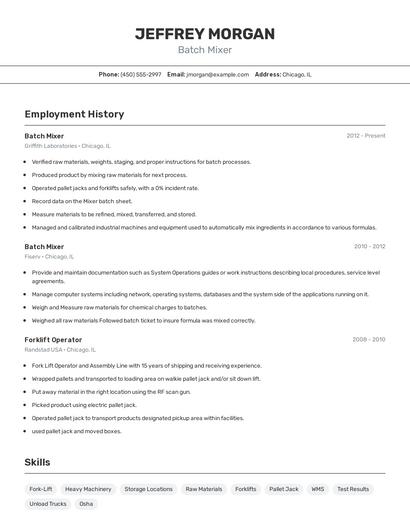
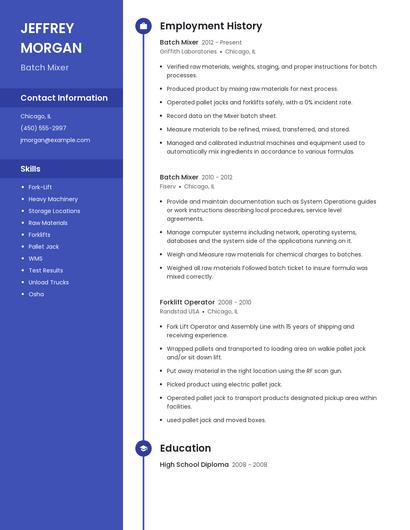
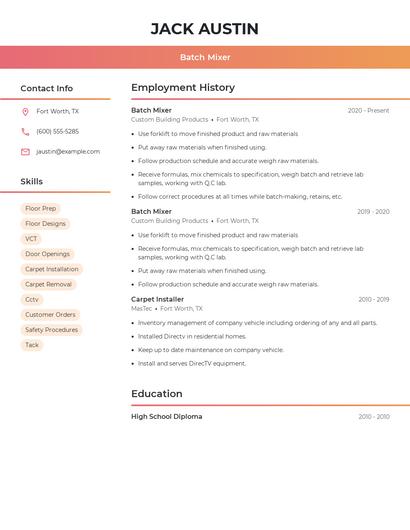
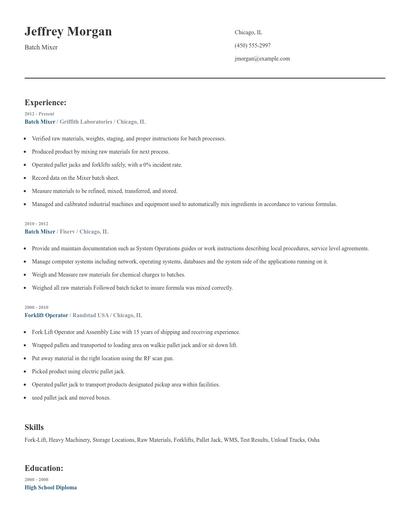
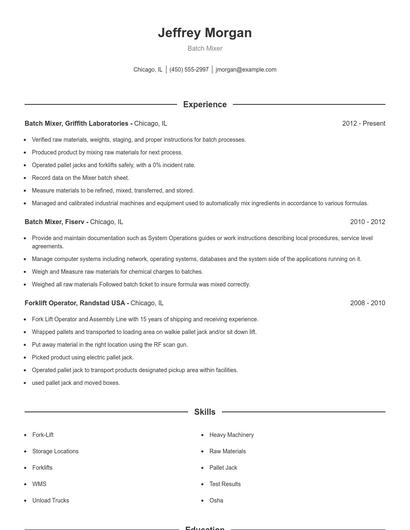
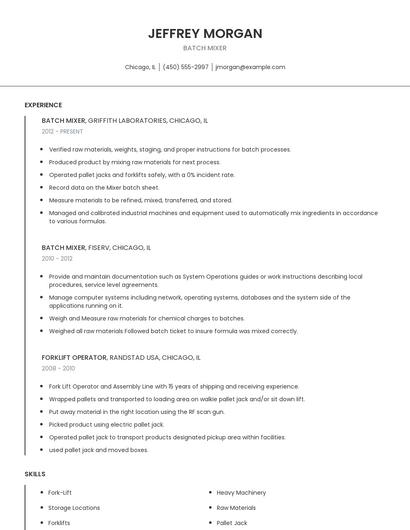
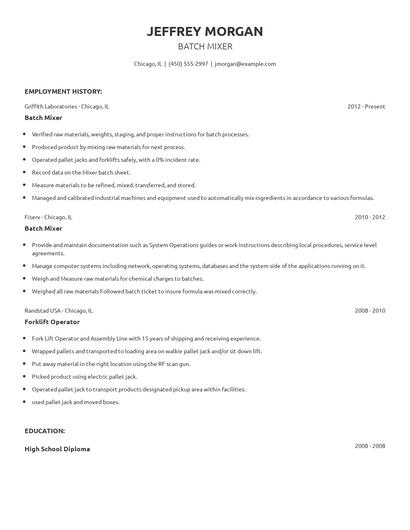
Choose from 10+ customizable batch mixer resume templates
Build a professional batch mixer resume in minutes. Our AI resume writing assistant will guide you through every step of the process, and you can choose from 10+ resume templates to create your batch mixer resume.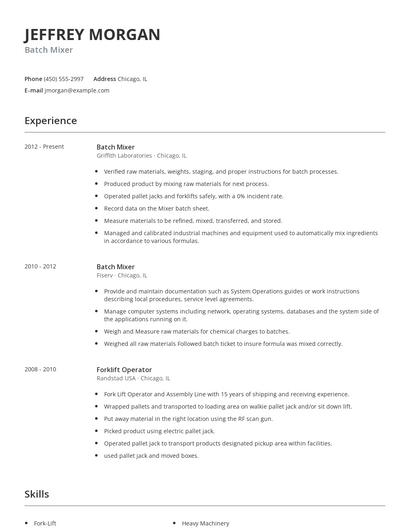
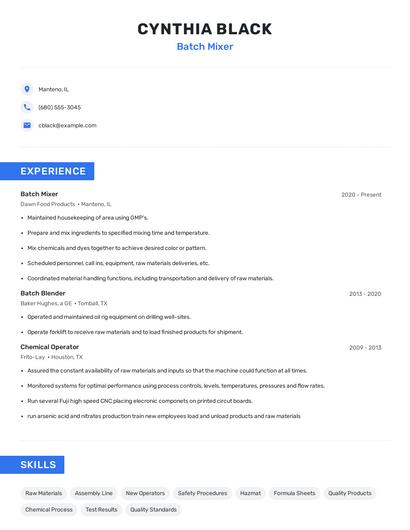
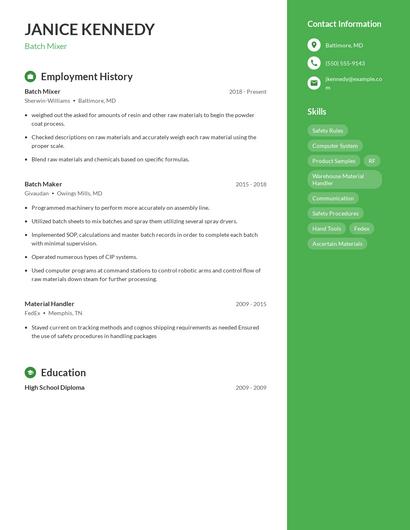
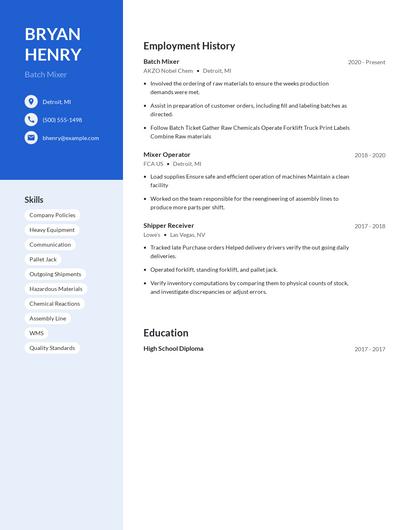
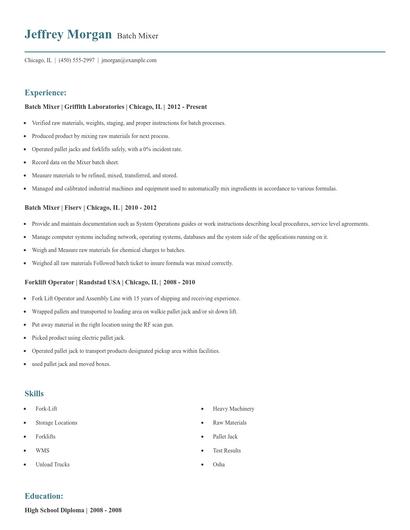
Compare different batch mixers
Batch mixer vs. Solutions operator
While similarities exist, there are also some differences between batch mixers and solutions operator. For instance, batch mixer responsibilities require skills such as "quality standards," "processing equipment," "mixers," and "ppe." Whereas a solutions operator is skilled in "sql," "quality checks," "chemical solutions," and "web forms." This is part of what separates the two careers.
Solutions operators tend to reach similar levels of education than batch mixers. In fact, solutions operators are 1.9% more likely to graduate with a Master's Degree and 0.0% less likely to have a Doctoral Degree.Batch mixer vs. Blending machine operator
In addition to the difference in salary, there are some other key differences worth noting. For example, batch mixer responsibilities are more likely to require skills like "processing equipment," "mixers," "ppe," and "qc." Meanwhile, a blending machine operator has duties that require skills in areas such as "pallets," "safety regulations," "machine operation," and "departmental procedures." These differences highlight just how different the day-to-day in each role looks.
On average, blending machine operators earn a lower salary than batch mixers. Some industries support higher salaries in each profession. Interestingly enough, blending machine operators earn the most pay in the agriculture industry with an average salary of $40,400. Whereas batch mixers have higher pay in the manufacturing industry, with an average salary of $40,356.blending machine operators earn similar levels of education than batch mixers in general. They're 3.2% less likely to graduate with a Master's Degree and 0.0% less likely to earn a Doctoral Degree.Batch mixer vs. Bulk plant operator
There are many key differences between these two careers, including some of the skills required to perform responsibilities within each role. For example, a batch mixer is likely to be skilled in "quality standards," "gmp," "processing equipment," and "mixers," while a typical bulk plant operator is skilled in "math," "cdl," "basic math," and "pallets."
Most bulk plant operators achieve a similar degree level compared to batch mixers. For example, they're 1.8% less likely to graduate with a Master's Degree, and 0.0% less likely to earn a Doctoral Degree.Batch mixer vs. Composition worker
Even though a few skill sets overlap between batch mixers and composition workers, there are some differences that are important to note. For one, a batch mixer might have more use for skills like "quality standards," "gmp," "processing equipment," and "mixers." Meanwhile, some responsibilities of composition workers require skills like "hand tools," "machine tools," "vacuum bag," and "composite materials. "
Composition workers reach similar levels of education compared to batch mixers, in general. The difference is that they're 3.6% more likely to earn a Master's Degree, and 0.0% less likely to graduate with a Doctoral Degree.Types of batch mixer
Updated January 8, 2025
