What does a behavior interventionist do?
A behavior interventionist, or sometimes called behavior intervention specialist (BIS), is an individual who provides support and training for students with behavioral challenges through behavior management techniques and coping skills. Behavior interventionists must assist in implementing Behavioral Intervention Plans (BIP) or Individual Education Programs (IEP) to students who have difficulties in learning and advancing with their class. They are required to travel between different schools to attend case review meetings and meet with teachers who need assistance for managing problems in their classrooms. Behavior interventionists also consult with both medical and psychological professionals to develop and implement BIPs.
Behavior interventionist responsibilities
Here are examples of responsibilities from real behavior interventionist resumes:
- Manage and target behaviors using the ESDM, ABA, PRT and SCERTS model.
- Complete all require documentations including collecting data, graphing, IEP, and quarterly notes.
- Focus on improving behavior and communication in children with autism and developmental disabilities by providing in home behavioral services.
- Implement behavior programs design as directed for children with autism spectrum disorders, and children with other developmental disabilities.
- Report infractions to the district as information to better understand the needs of at-risk kids.
- Implement behavioral therapy programs design specifically for a client's needs under the supervision of a BCBA.
- Hold conferences with parents about recent behavior of the kids and how they may be approving daily.
- Modify academic, social, and self-help tasks to a more developmentally appropriate level for the client.
- Collaborate with staff on individual educational plans (IEP) design to promote education, physical and social development.
- Prepare and present data summaries and recommendations as needed for clinics, monthly progress meetings, and official IEP meetings.
- Assist with the improvement of client's communication, social, motor, self-help, school readiness, and self-management skills.
- Communicate with parents/caregivers, BCBA, and lead behavior interventionists about clients
- Maintain CPR certification/training, participate in monthly behavioral program meetings and communicate client progress with supervisor on a weekly basis.
- Maintain client confidentiality per company and HIPPA policy.
- Maintain client confidentiality and keeping up with HIPPA guidelines.
Behavior interventionist skills and personality traits
We calculated that 19% of Behavior Interventionists are proficient in Applied Behavior Analysis, Autism, and Behavior Analysis. They’re also known for soft skills such as Listening skills, Speaking skills, and Interpersonal skills.
We break down the percentage of Behavior Interventionists that have these skills listed on their resume here:
- Applied Behavior Analysis, 19%
Implement individualized Applied Behavior Analysis programs and in-home behavioral intervention for children diagnosed with Autism Spectrum Disorder.
- Autism, 18%
Implement behavior programs designed as directed for children with autism spectrum disorders, and children with other developmental disabilities.
- Behavior Analysis, 9%
Apply Behavior Analysis (ABA) to children displaying a spectrum of developmental delays such as autistic and Down Syndrome.
- Developmental Disabilities, 8%
Provided one-to-one behavioral based instruction to children with developmental disabilities in school, home and/or community settings.
- ABA, 7%
Provided basic parent education of correct implementation of ABA principles.
- Autism Spectrum Disorder, 5%
Provide behavior therapy to children and young adults diagnosed with Autism Spectrum Disorder and related developmental delays in their natural setting.
Common skills that a behavior interventionist uses to do their job include "applied behavior analysis," "autism," and "behavior analysis." You can find details on the most important behavior interventionist responsibilities below.
Listening skills. To carry out their duties, the most important skill for a behavior interventionist to have is listening skills. Their role and responsibilities require that "marriage and family therapists need to give their full attention to their clients to understand their problems, values, and goals." Behavior interventionists often use listening skills in their day-to-day job, as shown by this real resume: "attended iep (individual education program) and communicated changes in program to other significant staff members and teachers. "
Speaking skills. Many behavior interventionist duties rely on speaking skills. "marriage and family therapists need to be able to communicate with clients effectively," so a behavior interventionist will need this skill often in their role. This resume example is just one of many ways behavior interventionist responsibilities rely on speaking skills: "prepared and presented data summaries and recommendations as needed for clinics, monthly progress meetings, and official iep meetings. "
Interpersonal skills. Another skill that relates to the job responsibilities of behavior interventionists is interpersonal skills. This skill is critical to many everyday behavior interventionist duties, as "marriage and family therapists work with different types of people." This example from a resume shows how this skill is used: "incorporated aba and prt interventions for individuals diagnosed with autism to improve their social skills and interpersonal relationships. "
The three companies that hire the most behavior interventionists are:
- Intercare Therapy131 behavior interventionists jobs
- Cortica26 behavior interventionists jobs
- Centria Healthcare10 behavior interventionists jobs
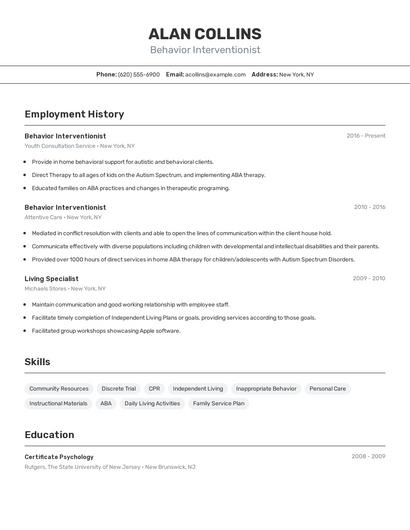
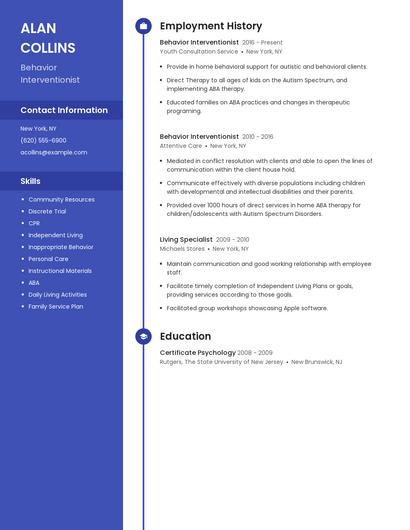
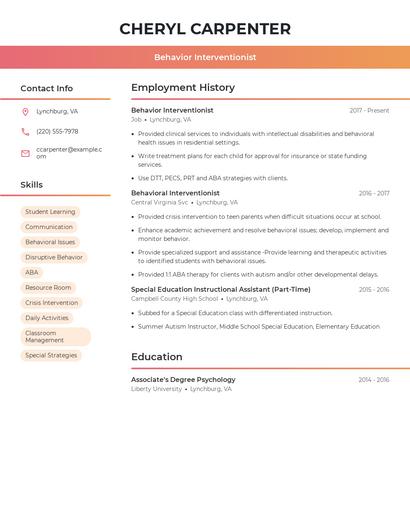
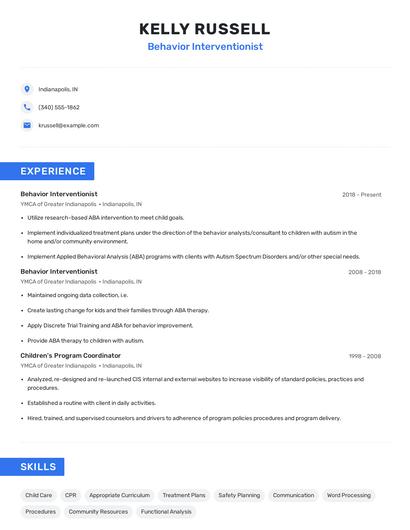
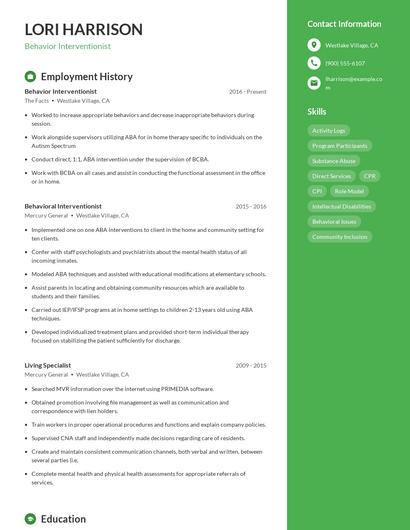
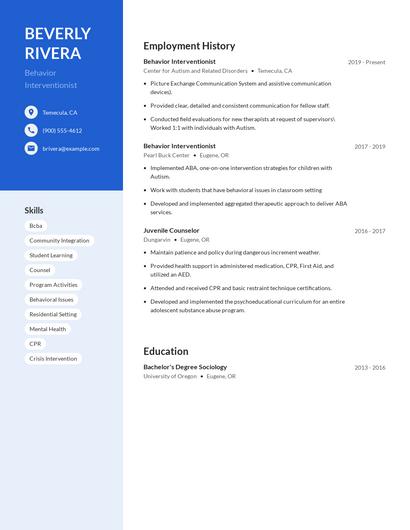
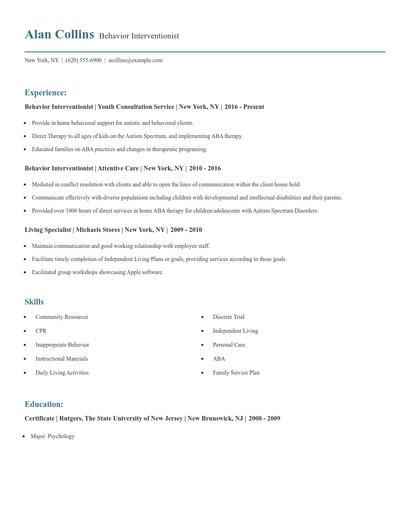
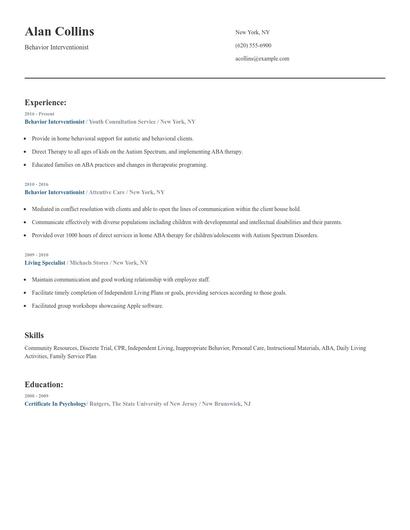
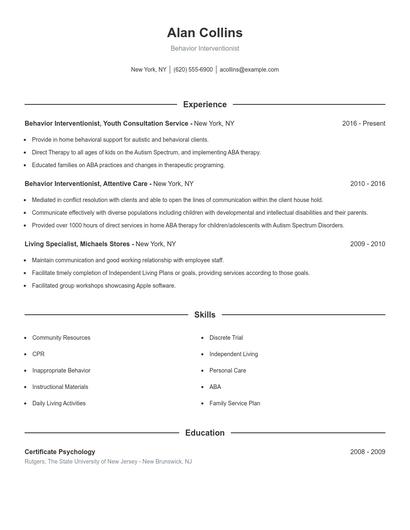
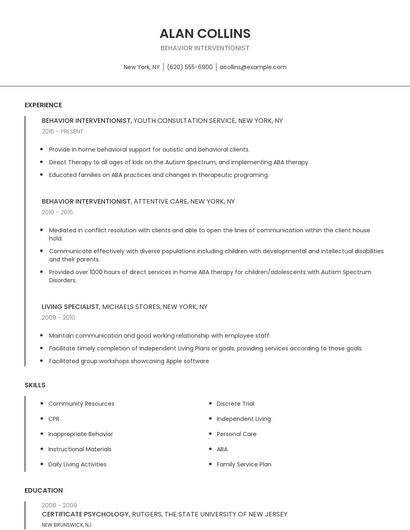
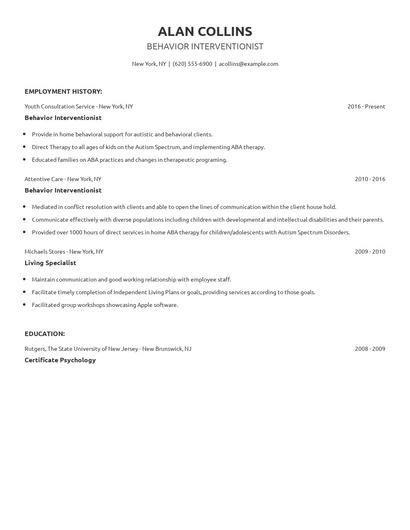
Choose from 10+ customizable behavior interventionist resume templates
Build a professional behavior interventionist resume in minutes. Our AI resume writing assistant will guide you through every step of the process, and you can choose from 10+ resume templates to create your behavior interventionist resume.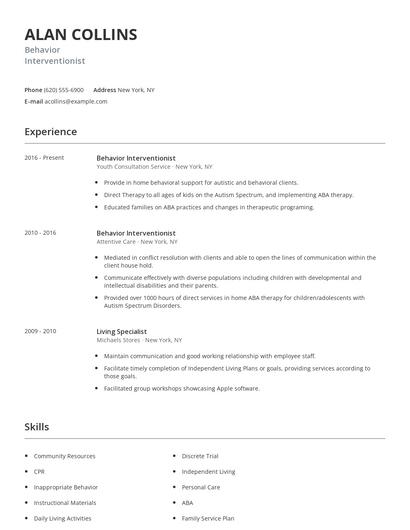
Compare different behavior interventionists
Behavior interventionist vs. Child care counselor
Child care counselors monitor the progress of children who have behavioral, physical, and mental issues in between counseling appointments. These counselors create daily schedules for children that include field trips, play dates, and learning plans to ensure that children get the most out of their days. They use their critical thinking skills, organizational skills, and interpersonal skills to deal with children diagnosed with psychological issues and to coordinate with their patients' families. Most of the cases they handle are the abuse, bullying, and past traumas of children.
While similarities exist, there are also some differences between behavior interventionists and child care counselor. For instance, behavior interventionist responsibilities require skills such as "applied behavior analysis," "autism," "behavior analysis," and "developmental disabilities." Whereas a child care counselor is skilled in "child care," "behavioral issues," "crisis intervention techniques," and "direct supervision." This is part of what separates the two careers.
Child care counselors earn the highest salaries when working in the finance industry, with an average yearly salary of $41,472. On the other hand, behavior interventionists are paid more in the education industry with an average salary of $41,611.The education levels that child care counselors earn slightly differ from behavior interventionists. In particular, child care counselors are 3.3% less likely to graduate with a Master's Degree than a behavior interventionist. Additionally, they're 0.1% less likely to earn a Doctoral Degree.Behavior interventionist vs. Mental health worker
A mental health worker is an individual who provides basic care and therapy to patients who are inflicted with mental disabilities or developmental disabilities. Mental health workers assist patients with their daily activities, monitor their conditions, and administer therapeutic care. They may be directly supervised by a registered nurse and can work in facilities such as psychiatric hospitals and residential mental health facilities. They may also help develop treatment plans and strategies with other staff members to best meet patient needs.
In addition to the difference in salary, there are some other key differences worth noting. For example, behavior interventionist responsibilities are more likely to require skills like "applied behavior analysis," "autism," "behavior analysis," and "aba." Meanwhile, a mental health worker has duties that require skills in areas such as "patients," "vital signs," "mental illness," and "direct supervision." These differences highlight just how different the day-to-day in each role looks.
Mental health workers earn a higher average salary than behavior interventionists. But mental health workers earn the highest pay in the professional industry, with an average salary of $39,268. Additionally, behavior interventionists earn the highest salaries in the education with average pay of $41,611 annually.In general, mental health workers achieve similar levels of education than behavior interventionists. They're 0.2% more likely to obtain a Master's Degree while being 0.1% less likely to earn a Doctoral Degree.What technology do you think will become more important and prevalent for behavior interventionists in the next 3-5 years?
Lesley Casarez Ph.D.
Director, Quality Enhancement Plan Program Coordinator, M.S. Professional School Counseling Associate Professor, Curriculum and Instruction, Angelo State University
Behavior interventionist vs. Youth advocate
Youth advocates are individuals who responsible for maintaining the human rights of youth while assisting them in developing their skills in all areas of life, such as education, health, employment, and relationships. These advocates are required to discuss youth development and involvement with various leaders in the community. They must provide crisis interventions by performing one-on-one and group meetings with young adults. Youth advocates must also work with mental health professionals within the community so that they can guide teenagers with drug or alcohol problems and mental health issues.
There are many key differences between these two careers, including some of the skills required to perform responsibilities within each role. For example, a behavior interventionist is likely to be skilled in "applied behavior analysis," "autism," "behavior analysis," and "developmental disabilities," while a typical youth advocate is skilled in "foster care," "community resources," "youth development," and "social services."
Youth advocates earn the best pay in the automotive industry, where they command an average salary of $31,171. Behavior interventionists earn the highest pay from the education industry, with an average salary of $41,611.When it comes to education, youth advocates tend to earn similar degree levels compared to behavior interventionists. In fact, they're 0.5% less likely to earn a Master's Degree, and 0.1% less likely to graduate with a Doctoral Degree.Behavior interventionist vs. Mental health associate
As a mental health associate, you will assist the medical team members in diagnosing and treating individuals with mental, developmental, and behavioral conditions. You may be tasked to facilitate individual and group therapy sessions, help patients with their day-to-day activities such as self-care and hygiene, and assist in administering medications prescribed by physicians. Other duties include planning and leading program activities, attending treatment rounds, and assisting with the physical care of patients. The qualifications and skills required for this role include a bachelor's degree in social science or psychology, previous work experience, and certification on basic life support.
Even though a few skill sets overlap between behavior interventionists and mental health associates, there are some differences that are important to note. For one, a behavior interventionist might have more use for skills like "behavior analysis," "developmental disabilities," "aba," and "autism spectrum disorder." Meanwhile, some responsibilities of mental health associates require skills like "patients," "customer service," "vital signs," and "safety checks. "
The professional industry tends to pay the highest salaries for mental health associates, with average annual pay of $37,746. Comparatively, the highest behavior interventionist annual salary comes from the education industry.The average resume of mental health associates showed that they earn similar levels of education compared to behavior interventionists. So much so that theyacirc;euro;trade;re 0.9% more likely to earn a Master's Degree and more likely to earn a Doctoral Degree by 0.3%.Types of behavior interventionist
Updated January 8, 2025
