
Automatically apply for jobs with Zippia
Upload your resume to get started.
Bereavement counselor skills for your resume and career
15 bereavement counselor skills for your resume and career
2. Patients
- Collaborated with an interdisciplinary team of health care professionals to provide counseling support for terminally ill patients and their families.
- Provided individual/family/group counseling and psycho-educational programs for a diverse population of hospice patients, families and couples.
3. Mental Health
Mental health is the state of wellbeing in which an individual can cope with the regular stresses and tensions of life, and can work productively without having any emotional or psychological breakdown. Mental health is essential for a person of any age and helps them make the right decisions in their life.
- Completed two-year internship to become Licensed Mental Health Counselor.
- Performed diagnostic evaluation and conducted mental health assessments.
4. Community Resources
Community resources are a set of resources that are used in the day to day life of people which improves their lifestyle in some way. People, sites or houses, and population assistance can come under the services offered by community resources.
- Identified support systems available to reduce stress and facilitate coping; identified community resources and assisted with utilization.
- Conducted assessments and developed individualized treatment plans and discharge planning; prepared thorough documentation and established communication with other community resources.
5. Medicare
Medicare is a federal government insurance program that offers health care coverage to people who are 65 and above. In some cases, younger people with disabilities whose status is identified by the SSA can also avail the insurance program. Medicare covers the health expenses of people who are not able to afford it plus it protects the payee from rising health care costs.
- Provided referrals and assisted with Medicaid and Medicare issues.
- Trained Administrative Assistant and Community Liaison Computed figures for end of year Medicare survey
6. Bereavement Services
- Extended telephone outreach to hospice families referred for bereavement services.
- Collaborated with hospice and bereavement team to provide general bereavement services via groups, workshops, and community outreach.
Choose from 10+ customizable bereavement counselor resume templates
Build a professional bereavement counselor resume in minutes. Our AI resume writing assistant will guide you through every step of the process, and you can choose from 10+ resume templates to create your bereavement counselor resume.7. Family Therapy
- Direct provision of individual, group, and family therapy with children and adults.
- Performed individual and family therapy for both pre and post bereaved through telemedicine and in person sessions.
8. Spiritual Care
Spiritual care is a facet of healthcare that deals with the spiritual and religious needs caused by an injury or illness.
- Assisted the Interdisciplinary Team in identifying patient/family units appropriate for spiritual care services.
- Develop and deliver staff and volunteer training programs on spiritual care, bereavement and grief, self-care, boundaries, more.
9. Loss Issues
- Provide education and training for hospice staff related to grief and loss issues.
- Provide community consultant services regarding grief and loss issues.
10. Emotional Support
At its core, emotional support involves providing support, reassurance, acceptance, love, and encouragement. It is especially important in a time of stress/sadness as it stabilizes an individual and provides a positive foundation for trust. Honing this skill is important for individuals who want to pursue the career of caregivers and emotional support nurses. Their job includes monitoring mental health and helping patients to handle any mental challenge.
- Provide comfort and emotional support to clients dealing with grief or terminal illness of a family member or friend.
- Provided emotional support for those in a variety of grief stricken situations
11. Clinical Supervision
Clinical supervision refers to how practicing nurses get professional and moral support from their experienced colleagues. The practice aims to promote their ability to make a concrete decision that values the patient's well-being.
- Provided clinical supervision to MSW student interns and LSW staff.
- Performed Utilization Reviews/Quality Assurance, reviewed clinical files, conducted case management meetings, monitored counselor proficiency and provided clinical supervision.
12. Community Organizations
Community organizations refers to a form of social or volunteer work that focuses on bettering a community. This may be a community defined by geographic boundaries or by a person's racial or sexual identity. These organizations are often nonprofits that help groups of people affected by natural disasters or hate crimes.
- Provided emergency crisis intervention, debriefing and trauma counseling to schools and community organizations.
- Presented educational training's to hospice professionals, community organizations and agencies, and counseling professionals.
13. Memorial Services
- Conducted Celebration of Life Services as well as funerals/memorial services.
- Planned and facilitated individual and group memorial services.
14. Group Therapy
Group psychotherapy or group therapy is the practice of treating a group of clients together in one sitting throughout multiple sessions. This practice allows people to receive encouragement and support from their peers who are taking the same group therapy.
- Worked with individuals of all ages, their families, as well as group therapy.
- Provide group therapy for students who have experienced a loss in school-based setting.
15. Community Outreach
- Participated in community outreach for children dealing with grief.
- Provided individual crisis counseling, community outreach, public education and referral services to hurricane Wilma survivors in Martin County.
5 Bereavement Counselor resume examples
Build a professional bereavement counselor resume in minutes. Browse through our resume examples to identify the best way to word your resume. Then choose from 5+ resume templates to create your bereavement counselor resume.

What skills help Bereavement Counselors find jobs?
Tell us what job you are looking for, we’ll show you what skills employers want.
What skills stand out on bereavement counselor resumes?
Treniece Lewis Harris Ph.D.
Associate Professor of the Practice, Program Director, Master's Program in Mental Health Counseling, Boston College
What soft skills should all bereavement counselors possess?
Treniece Lewis Harris Ph.D.
Associate Professor of the Practice, Program Director, Master's Program in Mental Health Counseling, Boston College
-active listening
-perspective-taking
-open-mindedness and respect for differences
-humility
-curiosity and critical observation
-problem recognition and analytical thinking
-creativity and flexibility
-presentation skills
What hard/technical skills are most important for bereavement counselors?
Treniece Lewis Harris Ph.D.
Associate Professor of the Practice, Program Director, Master's Program in Mental Health Counseling, Boston College
-Knowledge and application of developmental and personality theory to human behavior.
-Experience in using multiple evidence-based psychotherapy models
-Psychological assessment, especially in neuropsychological testing
-Research design and implementation to study
-Program development
-Curriculum design and teaching skills
What bereavement counselor skills would you recommend for someone trying to advance their career?
Samantha Bates PhD, LISW-S
Assistant Professor, LiFEsports Director of Research, Ohio State University
What type of skills will young bereavement counselors need?
Dr. Thomas Dearden Ph.D.
Assistant Professor of Sociology, Virginia Polytechnic Institute and State University
List of bereavement counselor skills to add to your resume
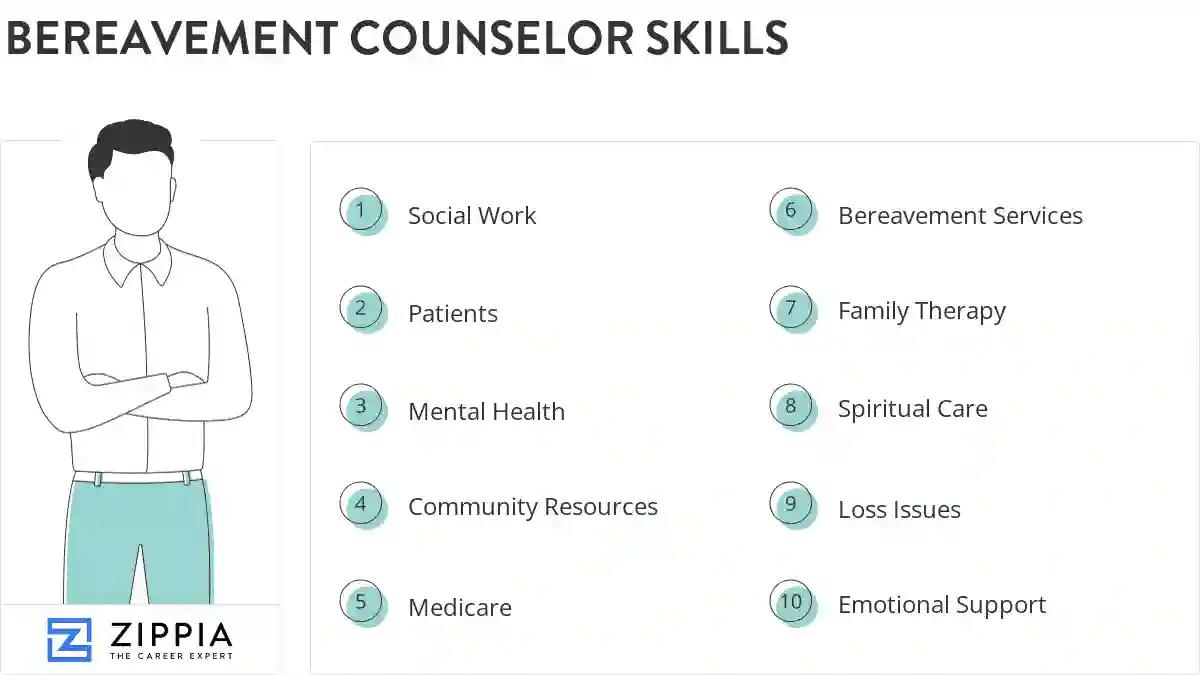
The most important skills for a bereavement counselor resume and required skills for a bereavement counselor to have include:
- Social Work
- Patients
- Mental Health
- Community Resources
- Medicare
- Bereavement Services
- Family Therapy
- Spiritual Care
- Loss Issues
- Emotional Support
- Clinical Supervision
- Community Organizations
- Memorial Services
- Group Therapy
- Community Outreach
- Public Speaking
- IDG
- Program Development
- Terminal Illness
- Community Agencies
- Crisis Intervention
- IDT
- Art Therapy
- Spiritual Support
- Pastoral Care
- Suicide Prevention
- Anticipatory Grief
- Support Services
- Community Programs
- Community Education
- Children Ages
- HIPAA
- Direct Care
- Clinical Documentation
- Therapeutic Relationships
- Community Events
- Educational Programs
Updated January 8, 2025

1. Social Work