What does a buildings and grounds superintendent do?
Buildings and grounds superintendent responsibilities
Here are examples of responsibilities from real buildings and grounds superintendent resumes:
- Manage sales, run machinary, complete wekly inventory, run forklift, deliver orders, and keep financial records
- Help maintain cleanliness of buildings and grounds on properties
- Operate equipment such as chainsaws, gas operate trimmers, mowers and blowers.
- Preserve the physical appearance of company grounds by mowing, raking, planting, fertilizing, trimming, and watering.
- Perform plumbing, electrical, carpentry, HVAC, painting, and landscaping work necessary to maintain a historical mansion and museum
- Operate heavy equipment, riding mowers, chainsaws, leaf blowers, weed whackers, wood chippers, wood-splitters and lifts.
- Maintain and operate mechanical equipment, electrical, plumbing.
- Clean and polish windows and chairs.
- Adjust hvac to maintain proper temperature in building
- Clean shelters and repair broken glass in windows.
- Water community gardens, mow lawn, weed and prune.
- Designate asbestos and mold abatement person for the school district.
- Cut and hang strip curtains around building, maintain HVAC filtration units.
- Fix broken equipment, company truck, lawn mowers and office furniture.
- Monitor CMMS work system, and ensure quality work performance and efficiency.
Buildings and grounds superintendent skills and personality traits
We calculated that 11% of Buildings And Grounds Superintendents are proficient in Plumbing, GRASS, and Mowing. They’re also known for soft skills such as Dexterity, Customer-service skills, and Leadership skills.
We break down the percentage of Buildings And Grounds Superintendents that have these skills listed on their resume here:
- Plumbing, 11%
Maintained and operated mechanical equipment, electrical, plumbing.
- GRASS, 10%
Supervised all chemical and fertilizer applications, irrigation system repairs and turf grass cultural practices.
- Mowing, 9%
Maintained Grounds and facilities cleaning, mowing, trimming grounds for recreation and maintaining campsites picking up garbage and debris.
- Grounds Maintenance, 8%
Job Duties: Light building and grounds maintenance including design and installation of drip irrigation systems.
- Cleanliness, 8%
Maintain cleanliness and operations of district vehicles, other duties as requested by the school district.
- HVAC, 6%
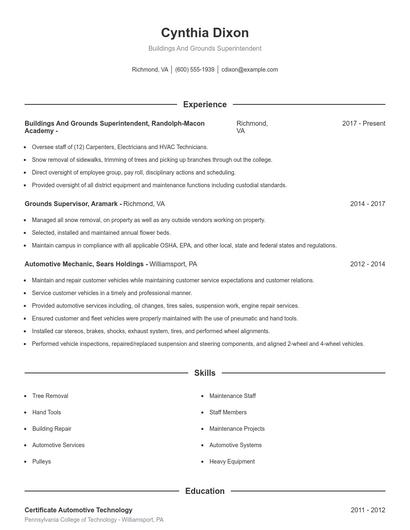
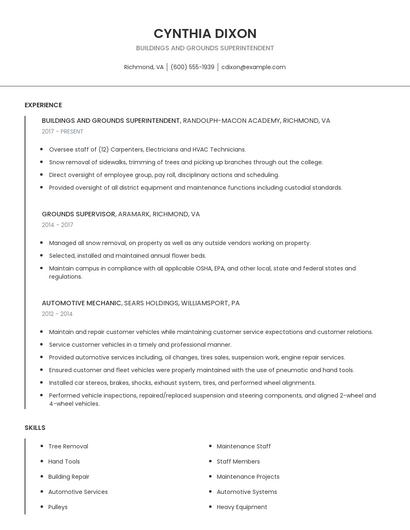
Oversee staff of (12) Carpenters, Electricians and HVAC Technicians.
Most buildings and grounds superintendents use their skills in "plumbing," "grass," and "mowing" to do their jobs. You can find more detail on essential buildings and grounds superintendent responsibilities here:
Dexterity. To carry out their duties, the most important skill for a buildings and grounds superintendent to have is dexterity. Their role and responsibilities require that "many repair and maintenance tasks, such as repairing small devices, connecting or attaching components, and using hand tools, require a steady hand and good hand–eye coordination." Buildings and grounds superintendents often use dexterity in their day-to-day job, as shown by this real resume: "run loader water truck, bobcat ,sweeper truck forklift, sharpen and changed chipper knife. "
Customer-service skills. Another soft skill that's essential for fulfilling buildings and grounds superintendent duties is customer-service skills. The role rewards competence in this skill because "these workers interact with customers on a regular basis." According to a buildings and grounds superintendent resume, here's how buildings and grounds superintendents can utilize customer-service skills in their job responsibilities: "maintained office records, assured cleanliness of base camp and assisted customers"
The three companies that hire the most buildings and grounds superintendents are:
- Kelly Services1 buildings and grounds superintendents jobs
- Endura Products
1 buildings and grounds superintendents jobs
- University of Nevada, Reno1 buildings and grounds superintendents jobs
Choose from 10+ customizable buildings and grounds superintendent resume templates
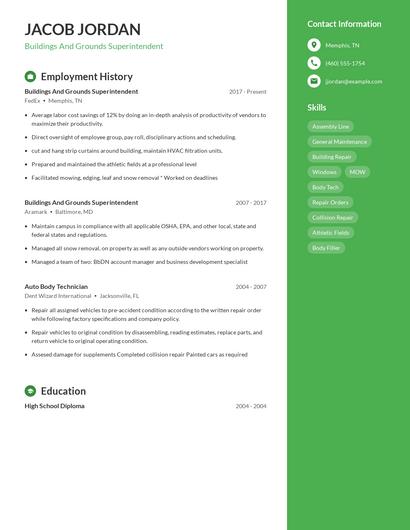
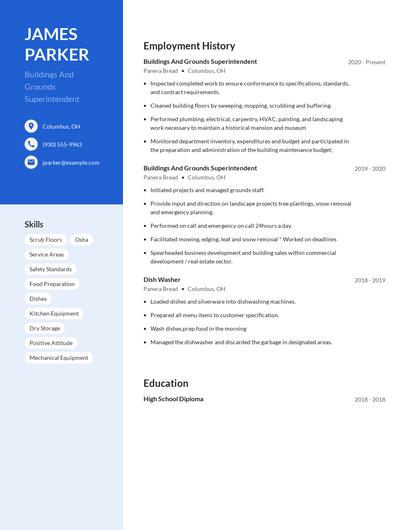
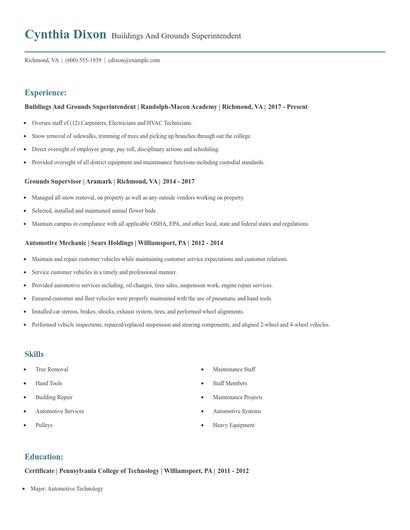
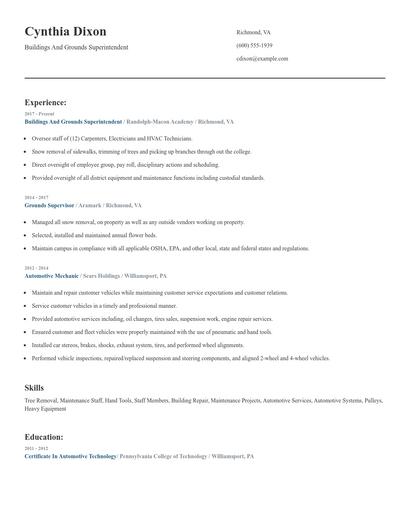
Build a professional buildings and grounds superintendent resume in minutes. Our AI resume writing assistant will guide you through every step of the process, and you can choose from 10+ resume templates to create your buildings and grounds superintendent resume.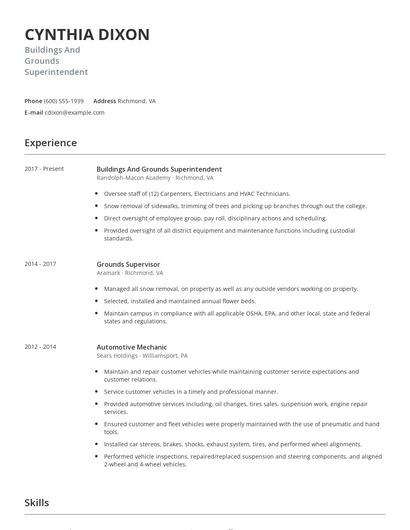
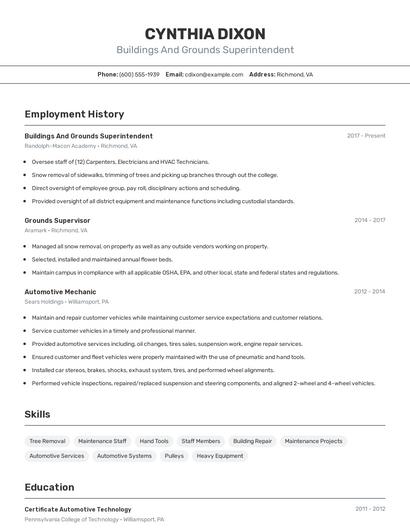
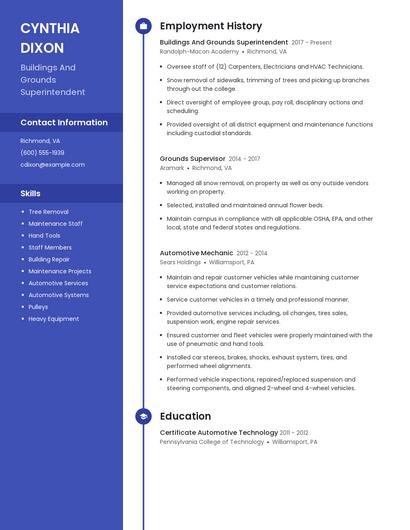
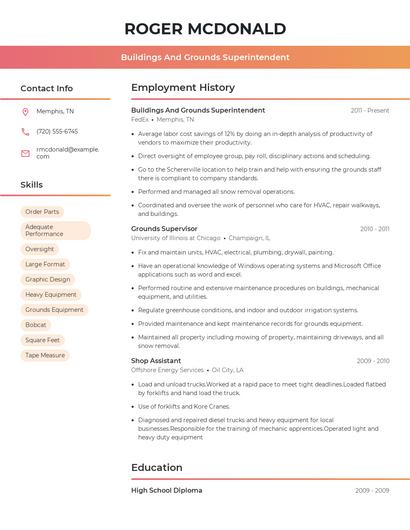


Compare different buildings and grounds superintendents
Buildings and grounds superintendent vs. Repair technician
A repair technician's role focuses on assessing the problem or damage of a device and implementing solutions for it to function again. Although the extent of a technician's tasks will depend on the device or industry of employment, most of it revolves around troubleshooting, providing technical support, installing and writing programs, detaching and re-attaching wirings, welding, and even thoroughly discussing problems and solutions to clients. Furthermore, there are instances when a repair technician must work in a team setting that requires coordination and communication.
These skill sets are where the common ground ends though. The responsibilities of a buildings and grounds superintendent are more likely to require skills like "grass," "mowing," "grounds maintenance," and "cleanliness." On the other hand, a job as a repair technician requires skills like "customer service," "hand tools," "customer satisfaction," and "preventative maintenance." As you can see, what employees do in each career varies considerably.
Repair technicians tend to make the most money working in the manufacturing industry, where they earn an average salary of $49,974. In contrast, buildings and grounds superintendents make the biggest average salary, $45,203, in the education industry.repair technicians tend to reach similar levels of education than buildings and grounds superintendents. In fact, repair technicians are 0.8% less likely to graduate with a Master's Degree and 0.1% more likely to have a Doctoral Degree.Buildings and grounds superintendent vs. Handyman
A handyman can perform various repair and maintenance tasks involving electricity, carpentry, plumbing, and even appliance installation. Most handymen work independently, but they can also choose to be part of a company. Furthermore, a handyman must also discuss the extent of repairs to clients, even sharing insights on maintaining facilities in good condition. There are instances when a handyman may be required to work in a group setting, which requires an active line of communication and coordination.
Each career also uses different skills, according to real buildings and grounds superintendent resumes. While buildings and grounds superintendent responsibilities can utilize skills like "grass," "grounds maintenance," "cleanliness," and "mechanical equipment," handymen use skills like "customer service," "drywall repair," "general maintenance," and "caulking."
On average, handymen earn a higher salary than buildings and grounds superintendents. Some industries support higher salaries in each profession. Interestingly enough, handymen earn the most pay in the construction industry with an average salary of $51,528. Whereas buildings and grounds superintendents have higher pay in the education industry, with an average salary of $45,203.In general, handymen achieve similar levels of education than buildings and grounds superintendents. They're 1.1% less likely to obtain a Master's Degree while being 0.1% more likely to earn a Doctoral Degree.Buildings and grounds superintendent vs. Maintainer
A maintainer serves as a time tracker that oversees and monitors the tasks of employees. They are the one who facilitates and reviews all the work, ensuring it is done according to specifications. Depending on what industry they work in, their function is to troubleshoot, repair, test, document, and review data that is needed.
Some important key differences between the two careers include a few of the skills necessary to fulfill the responsibilities of each. Some examples from buildings and grounds superintendent resumes include skills like "grass," "grounds maintenance," "cleanliness," and "construction projects," whereas a maintainer is more likely to list skills in "hydraulic systems," "suspension systems," "test equipment," and "electrical systems. "
Maintainers earn the highest salary when working in the technology industry, where they receive an average salary of $70,079. Comparatively, buildings and grounds superintendents have the highest earning potential in the education industry, with an average salary of $45,203.When it comes to education, maintainers tend to earn similar degree levels compared to buildings and grounds superintendents. In fact, they're 0.1% less likely to earn a Master's Degree, and 0.0% less likely to graduate with a Doctoral Degree.Buildings and grounds superintendent vs. Maintenance worker
Maintenance workers are employees assigned to oversee the equipment, furniture, and fixtures in the office. They ensure that these items work correctly by doing routine check-ups, identifying any problems, anticipating challenges, sourcing for spare parts, and repairing problems. They also ensure that all the equipment, furniture, and fixtures are clean and always ready for use. They should be familiar with all the official instructions and procedures to ensure that they can adequately care for these items. They may also handle the installation of any new equipment.
Updated January 8, 2025
