
Automatically apply for jobs with Zippia
Upload your resume to get started.
Cell operator skills for your resume and career

15 cell operator skills for your resume and career
1. Hand Tools
- Operate overhead cranes-Used various hand tools to produce aluminum-Worked in extreme environmental conditions
- Used hand tools to grind metal sand blast or shave specific parts off to make parts in accordance to specifics.
2. Math
- Produced and maintained accurate documentation for production reports using math and computer skills.
- Job required a variety of skills including general math and communication with management.
3. Quality Standards
Quality standards are a specific level of standards of products that are set by the companies for the customers that have to be met and maintained throughout the process until the time of delivery. Quality standards are information that includes the customer's requirements, guidelines, and characteristics for the needed final product or service.
- Ensured customer quality standards are achieved.
- Finished part dimensions were verified with a micrometer and microscope to ensure they adhere to strict quality standards and dimensional tolerances.
4. CNC
CNC stands for Computer Numerical Control. It is a subtractive manufacturing technique that usually uses computerized controls and machine tools to strip layers of material from a stock piece.
- Serve as an Interior Doors Special Assemblies Builder, CNC Operator, Door Finisher and Packaging Specialist.
- Pressed out airplane parts, CNC the parts, followed by sandblasting.
5. Calipers
- Check parts with various calipers and other measuring tools as they came out of machine.
- Use of calipers and also responsible for keeping work area clean.
6. Micrometers
A micrometer is a measuring instrument used in various laboratories to measure even the tiniest components in-depth with great precision and accuracy and to make precise linear measurements of dimensions such as diameters, thicknesses, and lengths of solid bodies. They are essential measuring instruments used by mechanical engineers, machinists, and workers in other technical professions. They allow workers to take extremely precise measurements, which can be viewed either in imperial or metric format. Most micrometers are designed to measure within one-thousandth of an inch! It's a snug fit. Accurate measurements like this are needed when even the smallest distance between objects can cause problems or difficulties.
- Used Calipers/Micrometers to gauge parts Preformed set ups and tear downs of machines
- Inspect or measure finished work pieces to determine conformance to specifications, using measuring instruments such as gauges or micrometers.
Choose from 10+ customizable cell operator resume templates
Build a professional cell operator resume in minutes. Our AI resume writing assistant will guide you through every step of the process, and you can choose from 10+ resume templates to create your cell operator resume.7. Safety Procedures
Safety procedures are a set of standardized procedures, that ensures minimal to no risk to people, resources, and the work environment. A company follows the step-by-step safety procedures as it they not only keep the customers and the employees safe, but also help in avoiding legal claims.
- Prevented accidents by wearing personal protective equipment, maintaining a clean environment and following safety procedures.
- Trained new hires on safety procedures, OSHA standards, and the operation of the machines.
8. Lean Manufacturing
- Trained in and committed to 5S, lean manufacturing, first in first out, total preventative maintenance, forklift certified.
- Team memberships include Emergency Response Team, HAZMAT team (spill control and containment), and lean manufacturing initiatives.
9. Light Fixtures
Light fixtures are electric devices that provide electricity to light bulbs. They can be lamps, sconces, canned or recessed lighting, fan lighting, etc.
- Function as a manufacturing assembly operator putting together light fixtures
- Assemble light fixtures in a cell with 8 other people
10. Safety Regulations
- Adhere to all safety regulations and procedures.
- Developed machine-operating procedures utilizing OSHA Safety Regulations.
11. Jigs
- Positioned and clamped work pieces together or assembled them in a jig fixture.
- load parts into jig for welding-unload and inspect finished assemblies against spec.-repair any minor defects-major defects sent to re-work
12. Cell Culture
- Directed the operations of four mammalian cell culture production teams, a purchasing team, and a warehousing/distribution team.
- Assisted in the development of roller bottle, suspension and micro carrier processes for the propagation of cell cultures.
13. Test Results
- Analyze test results in relation to design or rated specifications and test objectives, modify or adjust equipment to meet specifications.
- Test hydraulic pumps to ensure they meet industry standards * Provide test results to team leads, management and engineering
14. Machine Operation
- Measure products with template to determine accuracy of machine operations.
- Observed meters, gauges and machine operations.
15. NDT
Non-Destructive Testing, NDT, is a combination of different test techniques used individually or collectively to evaluate the integrity and properties of a material, component, system, or structure without permanently altering it. NDT is important for safe operation, as well as for quality control and lifetime evaluation of the system. It is used in industries such as aerospace, oil, and gas, nuclear, power generation, medical, rail, general manufacturing, etc.
- Processed parts for fluorescent penetrant inspection (FPI/ NDT), part of the Quality Control.
- Processed parts for fluorescent penetrant inspection (FPI/ NDT).
5 Cell Operator resume examples
Build a professional cell operator resume in minutes. Browse through our resume examples to identify the best way to word your resume. Then choose from 5+ resume templates to create your cell operator resume.

What skills help Cell Operators find jobs?
Tell us what job you are looking for, we’ll show you what skills employers want.
List of cell operator skills to add to your resume
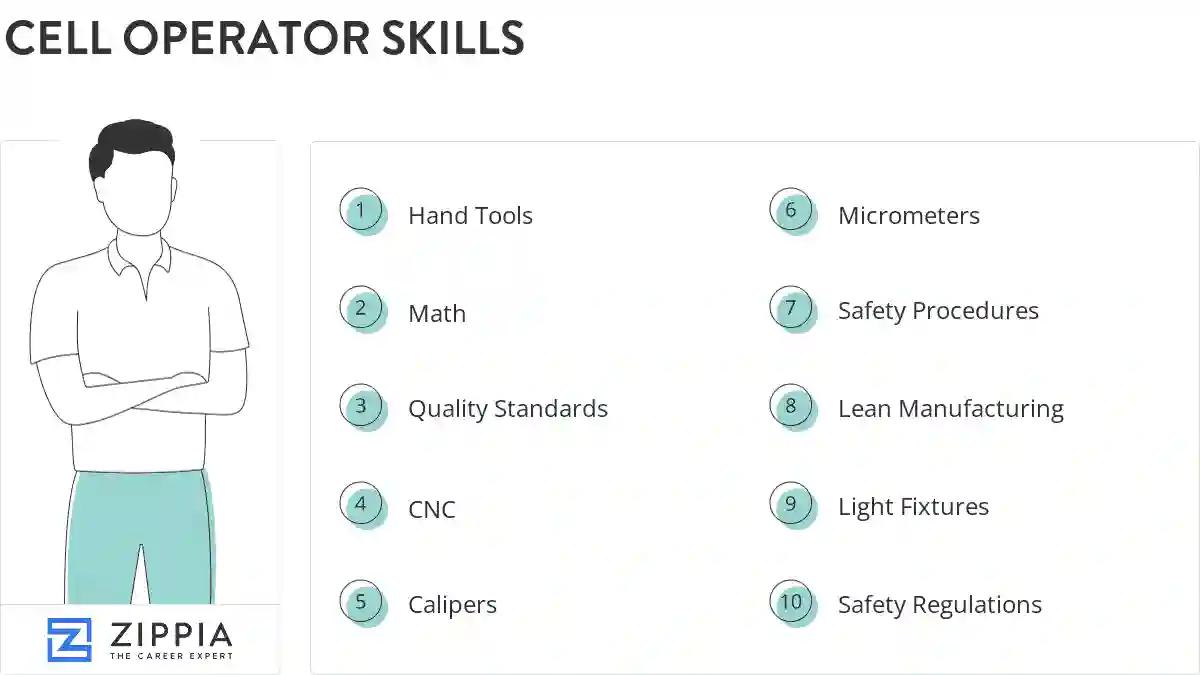
The most important skills for a cell operator resume and required skills for a cell operator to have include:
- Hand Tools
- Math
- Quality Standards
- CNC
- Calipers
- Micrometers
- Safety Procedures
- Lean Manufacturing
- Light Fixtures
- Safety Regulations
- Jigs
- Cell Culture
- Test Results
- Machine Operation
- NDT
- Customer Specifications
- Production Equipment
- Hoists
- PC
- Test Equipment
- CMM
- Assembly Line
- Product Quality
- Assembly Operations
- Quality Checks
- SPC
- Test Cell
- CIP
- Aluminum
- ISO
- MIG
- Sops
- Safety Equipment
- PLC
- FPI
- Etching
- Visual Inspections
- Grinding Tools
- Drill Press
- Quality Inspection
- GMP
- Aircraft Engines
- Office Furniture
- Assembly Machines
- Extrusion
- Fork Trucks
- Hydraulic Presses
Updated January 8, 2025
