
Automatically apply for jobs with Zippia
Upload your resume to get started.
Chemical processor skills for your resume and career
15 chemical processor skills for your resume and career
1. Hazardous Materials
Any substance or good that is harmful to human health as well as the environment are called hazardous materials. Such materials must be handled carefully to avoid any mishaps. Harmful gases. chemicals, strong medicines or drugs, radioactive elements required for radiation purposes, a human blood sample that carries germs, all of these are considered hazardous materials.
- Assisted the safety department in conducting Hazardous Materials training for supervisory and hourly employees in operational and technician levels.
- Experience conducting the daily operations of a laboratory to include analyzing hazardous materials, maintaining and troubleshooting equipment.
2. Safety Procedures
Safety procedures are a set of standardized procedures, that ensures minimal to no risk to people, resources, and the work environment. A company follows the step-by-step safety procedures as it they not only keep the customers and the employees safe, but also help in avoiding legal claims.
- General knowledge in SOP, CGMP and safety procedures.
- Authored procedures and documentation for compliance as hazardous waste generator and trained staff on hazards and safety procedures regarding chemical hazards.
3. OSHA
- Completed multiple safety training programs: PAPR, LOTO,OSHA Certified in Forklift Operation (sit-down/side-saddle).
- Maintained lab safety regulations and MSDS reference materials for compliance with Federal State OSHA regulations
4. Etching
- Managed daily production schedule, monitored machine operation, addressed any etching machinery problems.
5. PPE
Personal protective equipment is an item of protective clothing such as goggles, helmets, or other garments meant to protect the body from injury.
- Train and certify other chemical process technicians Set up and operate production equipment in a controlled environment, use proper PPE.
- Practiced safe laboratory procedures prescribed by employer including proper PPE, safe chemical handling, attended safety meetings and training.
6. Hazardous Waste
- Documented, labeled and packed the hazardous waste into DOT approved containers.
- Coordinate pickup of hazardous waste.
Choose from 10+ customizable chemical processor resume templates
Build a professional chemical processor resume in minutes. Our AI resume writing assistant will guide you through every step of the process, and you can choose from 10+ resume templates to create your chemical processor resume.7. Processing Equipment
Processing Equipment refers to any form of machinery or equipment used in the manufacturing of goods or in processing raw materials used in later goods. Equipment for food processing, for example, may include meat saws and other knives and packaging materials, while equipment used in water or oil treatment may involve more complex machinery and chemical procedures.
- Prepare, operate, clean and sanitize chemical processing equipment, pipes, pumps and tanks.
- Load materials and products into package processing equipment.
8. Safety Guidelines
Safety guidelines are regulations or rules governing procedures, actions, or devices with the aim of reducing the occurrence or risk of loss, injury, and danger to properties, individuals, or the environment. To adhere to the safety guidelines and be able to make the best possible decisions to ensure everyone at the workplace is safe, you should possess a wide range of skills.
- Followed necessary cleaning and safety guidelines which were implemented for this position.
- Ensured that all health and safety guidelines were followed.
9. R
R is a free software environment and a language used by programmers for statistical computing. The R programming language is famously used for data analysis by data scientists.
- Produced Form R, Form TR II, and Hazardous Waste Reports for City of Detroit and MDEQ.
- Operated and maintained Polysilicon Synthesis, distillation and Reactor processes for R and D development.
10. Distillation
- Trained in vacuum distillation, Filter presses, Centerfuge filtration.
- Supervised and trained two process operators in daily operation and in meeting daily production goals for cryogenic distillation air separation process.
11. Consumer Products
- Manufactured consumer products according to the process instructions to exact specifications.
- Control or operate equipment in which chemical changes or reactions take place during the processing of industrial or consumer products.
12. Customer Specifications
A Customer Specification is a document that describes the general requirement of an expected service from a contractor. It outlines the key requirements of the customer. Customer specifications should be written in simple and general language so that the contractor clearly understands the expectations of the customer. It is also known as a User Specification.
- Worked in chemical processing room mixing raw chemicals to customer specifications.
- Inspected finished products for quality and adherence to customer specifications.
13. Batch Sheets
- Weigh out and measure proper chemical from a batch sheet manifest to be produced into cosmetic products.
- Set up raw materials required to manufacture product, and manufactured mixes based on batch sheet instructions.
14. Troubleshoot
Troubleshooting is the process of analyzing and fixing any kind of problem in a system or a machine. Troubleshooting is the detailed yet quick search in the system for the main source of an issue and solving it.
- Operate, maintain and troubleshoot instruments/equipment authorized within the Anatomical Pathology Department.
- Make 20 ton batches of shampoo and conditioner, Troubleshoot machinery, give daily update reports.
15. GMP
GMP stands for Good Manufacturing Practice. It is a system that ensures that all products like food, beverages, and medicinal drugs that are produced comply with the quality standards. It helps in minimizing the risks and hazards that cannot be eliminated after the testing of final products.
- Handled all aspects required for batch production of household cleaning products using GMP's and following SOP's.
- Utilize GMP to mix and process chemicals for various pharmaceutical products - Operate various in-house machinery to process chemicals
5 Chemical Processor resume examples
Build a professional chemical processor resume in minutes. Browse through our resume examples to identify the best way to word your resume. Then choose from 5+ resume templates to create your chemical processor resume.

What skills help Chemical Processors find jobs?
Tell us what job you are looking for, we’ll show you what skills employers want.
List of chemical processor skills to add to your resume
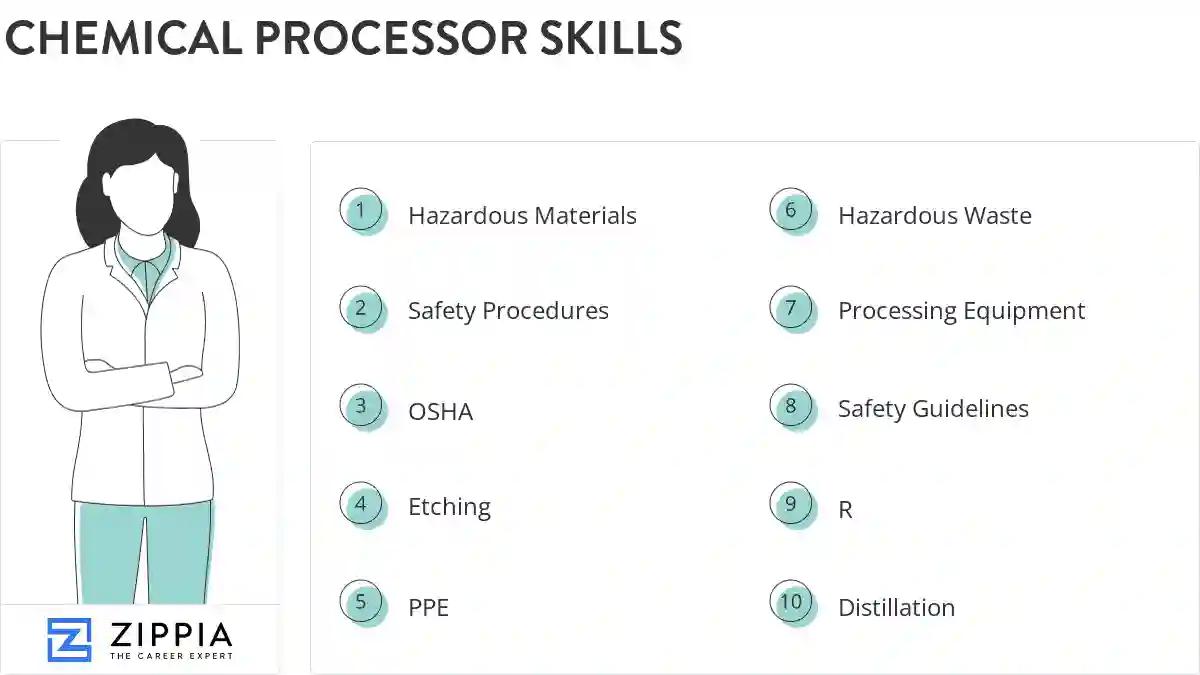
The most important skills for a chemical processor resume and required skills for a chemical processor to have include:
- Hazardous Materials
- Safety Procedures
- OSHA
- Etching
- PPE
- Hazardous Waste
- Processing Equipment
- Safety Guidelines
- R
- Distillation
- Consumer Products
- Customer Specifications
- Batch Sheets
- Troubleshoot
- GMP
- Test Results
- Quality Control Analysis
- Chemical Changes
- FDA
- HMI
- Centrifuges
- Production Lines
- Production Schedules
- Sops
- PLC
- DOT
- Production Equipment
- Flow Meters
- ISO
- Clean Rooms
- Control Software
- Clean Tanks
- Agitators
- Production Processes
- EPA
- Storage Tanks
- Dryers
- Inventory Control
- DI
- CNC
Updated January 8, 2025
