
Automatically apply for jobs with Zippia
Upload your resume to get started.
Chief of internal medicine skills for your resume and career

15 chief of internal medicine skills for your resume and career
1. Patients
- Greeted 30-45 patients daily upon arrival * Collected co-payments * Entered ICD-9 codes into system COMPUTER SKILLS Microsoft Office Suite 60-75 WPM
- Greet patients on a regular basis and provide excellent patient care; check patients in and out.
2. Patient Care
Patient care entails the diagnosis, recovery, and control of sickness as well as the maintenance of physical and emotional well-being through the use of healthcare providers' services. Patient care is described as services provided to patients by health practitioners or non-professionals under guidance.
- Monitored quality and appropriateness of patient care.
- Administered office activities for group of six physicians, managing personnel and processes in the delivery of patient care.
3. Pediatrics
Pediatrics is that branch of medicine that deals specifically with the well-being and health matters relating to infants, children, and teenagers entering into adulthood. People under the age of 18 are recommended to be under the care of a pediatrician instead of a normal doctor. However, this age limit is subject to vary in different countries. A professional of this medical branch is known as a pediatrician.
- Developed an ambulatory pediatrics curriculum for family medicine residents
- Completed rotations in Internal Medicine, General Surgery, Emergency Medicine, ENT, Pediatrics, OB/GYN, and Ambulatory Care.
4. Diagnosis
- Perform physical exam; acquire all necessary information to establish accurate medical diagnosis.
- Formulated differential diagnosis and discussed treatment plan with medical staff.
5. Medical Care
- Bring emergency medical cares for patient in critical medical condition
- Demonstrated expert knowledge of policies, procedures, ethical standards and laws regarding delivery of medical care.
6. Epic
Epic is a private healthcare company which developed and continues to provide a software intended for healthcare professionals and the organization and management of medical records. It is by far one of the largest in its field, with over 50% of patients having a medical record present in their system. Patients, as well as clinics and various medical professionals and facilities are all able to use this system to keep medical history and information safe and easy to reach, alter, and share with the necessary people.
- Documented patient medical records in the Epic electronic medical record system.
- Initiated recommendations for work flow and EPIC electronic templates to improve patient outcomes.
Choose from 10+ customizable chief of internal medicine resume templates
Build a professional chief of internal medicine resume in minutes. Our AI resume writing assistant will guide you through every step of the process, and you can choose from 10+ resume templates to create your chief of internal medicine resume.7. Family Practice
A family practice is a specialization that constitutes those comprehensive medical services provided to people corresponding to all age groups and genders. It includes healthcare coverage for all diseases whether chronic or acute. Apart from the clinical cures, the practice also includes therapy treatments. Family practice is delivered by physicians who are commonly referred to as family doctors.
- Provided medical services in a fully accredited Family practice program which emphasized a multidisciplinary approach to urban family medicine.
- Delivered direct patient care in a family practice setting
8. IV
- Performed procedures such as IV's, Incision and drainage, aspiration of synovial fluids, intubations and phlebotomy.
- Sutured lacerations, splinted fractures and sprains, and placed IV lines.
9. Physical Examinations
- Performed, documented and presented history and physical examinations and participated in emergency codes.
- Train medical students in basic history taking/physical examination techniques and problem based clinical decision making.
10. ICU
ICU means intensive care units. It also has a name known as the critical care unit or intensive therapy unit. The ICU handles patients experiencing acute diseases or severe injuries that need specialized treatment procedures by specific professionals.
- Managed inpatients in ICU, Respiratory Care Unit, and in outpatient sleep clinic.
- Participated in 2 months of ICU rotations.
11. Grand Rounds
- Participate in Grand Rounds along with the medical team.
12. Financial Statements
A financial statement is a report of an individual or a company that includes all the information about the declared assets, the use of money, income, and also the contribution of shareholders over a certain period.
- Prepare reports, invoices, financial statements, letters, case histories and medical records.
13. EKG
- Assisted Medical Assistant on EKG's and Urine Tests for lab.
- Back Office: Vitals, Vein punctures, EKG's, and assisting with minor procedures.
14. Internal Audit
Internal audit is an evaluation process that ensures that a company's risk management, governing body, and other internal processes are running effectively. People who perform internal audits must be highly qualified, have experience, and knowledge to work accordingly with the international standards and the code of ethics.
- Established and directed the Internal Audit Dept.
- Conducted internal audits in conjunction with outside auditing firms to assure expenditures met with DOD funding requirements and find possible efficiencies.
15. Medical History
- Utilized electronic medical records to gain a better understanding of a patient s medical history.
- Acquired skills in obtaining medical history from patients to be used regarding IONM.
5 Chief Of Internal Medicine resume examples
Build a professional chief of internal medicine resume in minutes. Browse through our resume examples to identify the best way to word your resume. Then choose from 5+ resume templates to create your chief of internal medicine resume.

What skills help Chiefs Of Internal Medicine find jobs?
Tell us what job you are looking for, we’ll show you what skills employers want.
List of chief of internal medicine skills to add to your resume
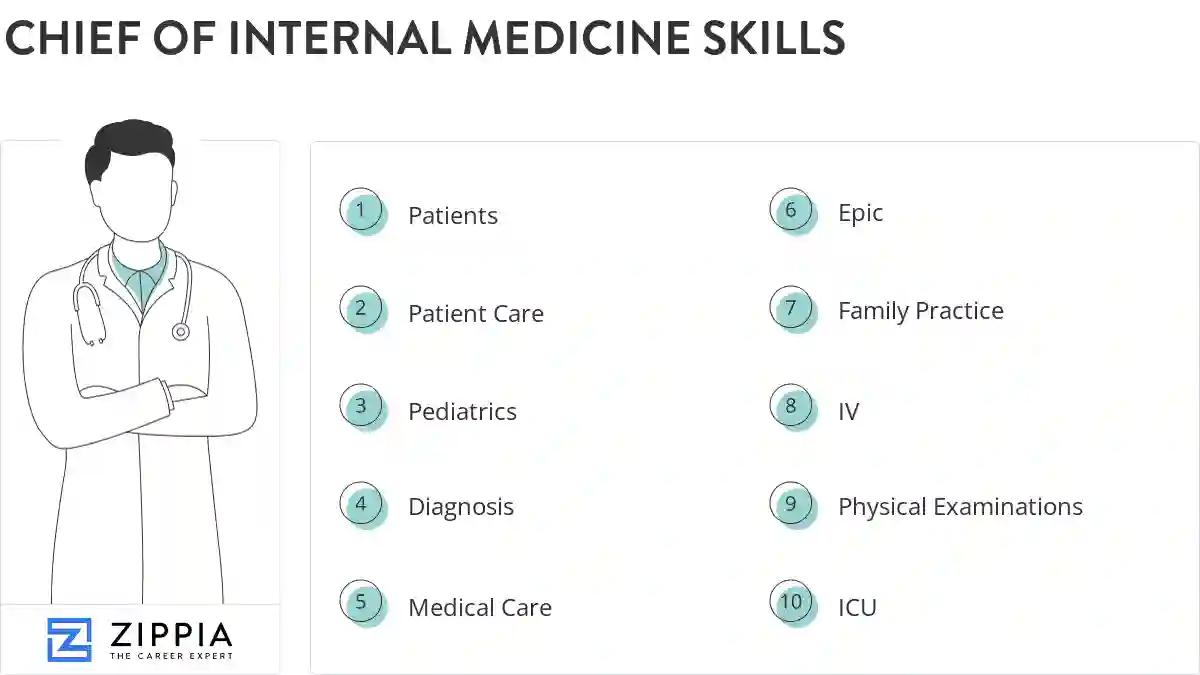
The most important skills for a chief of internal medicine resume and required skills for a chief of internal medicine to have include:
- Patients
- Patient Care
- Pediatrics
- Diagnosis
- Medical Care
- Epic
- Family Practice
- IV
- Physical Examinations
- ICU
- Grand Rounds
- Financial Statements
- EKG
- Internal Audit
- Medical History
- Internal Review
- Audit Reports
- Patient Education
Updated January 8, 2025
