Explore jobs
Find specific jobs
Explore careers
Explore professions
Best companies
Explore companies
Job outlook for children's program coordinators in the United States
Children's program coordinator job growth summary. After extensive research, interviews, and analysis, Zippia's data science team found that:
The projected children's program coordinator job growth rate is 12% from 2018-2028.
About 52,400 new jobs for children's program coordinators are projected over the next decade.
Children's program coordinator salaries have increased 13% for children's program coordinators in the last 5 years.
There are over 17,306 children's program coordinators currently employed in the United States.
There are 113,250 active children's program coordinator job openings in the US.
The average children's program coordinator salary is $40,825.
Are children's program coordinator jobs in demand?
Children's program coordinator job and salary trends over time
Children's program coordinator jobs over time
Children's program coordinator job growth rate over time
| Year | # of jobs | % of population |
|---|---|---|
| 2021 | 17,306 | 0.01% |
| 2020 | 17,373 | 0.01% |
| 2019 | 17,570 | 0.01% |
| 2018 | 17,042 | 0.01% |
| 2017 | 16,685 | 0.01% |
Average children's program coordinator salary over time
Children's program coordinator salary by year
| Year | Avg. salary | Hourly rate | % Change |
|---|---|---|---|
| 2025 | $40,825 | $19.63 | +2.6% |
| 2024 | $39,803 | $19.14 | +3.9% |
| 2023 | $38,316 | $18.42 | +1.9% |
| 2022 | $37,601 | $18.08 | +4.1% |
| 2021 | $36,113 | $17.36 | +3.2% |
Children's program coordinator jobs by state
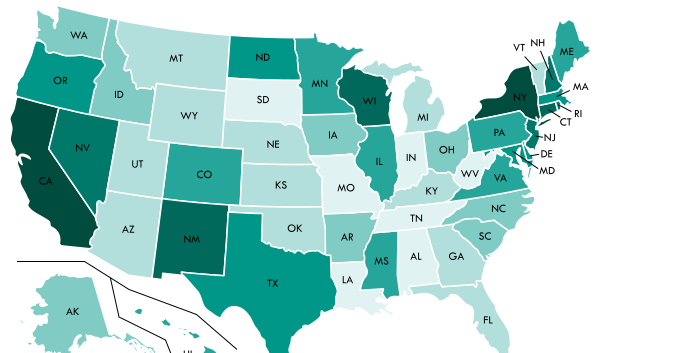
Most common states for children's program coordinators
| Rank | State | Population | # of jobs | Employment/ 1000ppl |
|---|---|---|---|---|
| 1 | North Dakota | 755,393 | 315 | 42% |
| 2 | Delaware | 961,939 | 360 | 37% |
| 3 | South Dakota | 869,666 | 258 | 30% |
| 4 | Kansas | 2,913,123 | 812 | 28% |
| 5 | District of Columbia | 693,972 | 188 | 27% |
| 6 | Arkansas | 3,004,279 | 779 | 26% |
| 7 | New Mexico | 2,088,070 | 553 | 26% |
| 8 | Idaho | 1,716,943 | 451 | 26% |
| 9 | New Hampshire | 1,342,795 | 334 | 25% |
| 10 | Montana | 1,050,493 | 259 | 25% |
| 11 | Rhode Island | 1,059,639 | 254 | 24% |
| 12 | Minnesota | 5,576,606 | 1,178 | 21% |
| 13 | Alabama | 4,874,747 | 1,010 | 21% |
| 14 | Nebraska | 1,920,076 | 406 | 21% |
| 15 | Colorado | 5,607,154 | 1,114 | 20% |
| 16 | Oklahoma | 3,930,864 | 778 | 20% |
| 17 | Massachusetts | 6,859,819 | 1,300 | 19% |
| 18 | Oregon | 4,142,776 | 781 | 19% |
| 19 | Connecticut | 3,588,184 | 664 | 19% |
| 20 | Alaska | 739,795 | 137 | 19% |
Most common cities for children's program coordinators
| Rank | City | # of jobs | Employment/ 1000ppl | Avg. salary |
|---|---|---|---|---|
| 1 | Escondido | 1 | 1% | $47,810 |
| 2 | Mobile | 1 | 1% | $32,369 |
| 3 | Pembroke Pines | 1 | 1% | $35,563 |
| 4 | San Diego | 1 | 0% | $47,792 |
Children's Program Coordinator job outlook: Expert opinions
Our panel of children's program coordinator experts
Seattle University

Seattle University

East Tennessee State University
Pacific Lutheran University

Hartwick College

Boston University

ASCP - Associated Skin Care Professionals
Muhlenberg College
American University

Pace University

Frostburg State University
Dr. Rashmi Chordiya Ph.D.
Assistant ProfessorSeattle University
Institute of Public Service
What soft skills should all Children's Program Coordinators possess?
Dr. Rashmi Chordiya Ph.D.: Empathy, cultural intelligence, emotional intelligence, self-awareness, ability to practice calm and loving-kindness with clients.
What skills will help Children's Program Coordinators earn the most?
Dr. Rashmi Chordiya Ph.D.: Skills to work with client groups of diverse backgrounds, having a deep understanding and practice of trauma-informed social work, and adaptive leadership skills to adapt to the needs of diverse clients and evolving social and organizational contexts.
Theresa Earenfight Ph.D.
Professor of History, Director, Women, Gender, and Sexuality Studies ProgramSeattle University
History Department
Will there be an enduring impact of the coronavirus pandemic on Children's Program Coordinators?
Theresa Earenfight Ph.D.: As a historian of the European Middle Ages, I'm struck by how students this past year have acquired something scarce: historical empathy. The past can seem so remote, so very different from our lived experiences today, and this can make history seem irrelevant. But this fall, I was teaching a section on the bubonic plague, which historians of medicine now know was a global pandemic, not just an epidemic in Europe. Usually, students are fascinated by the gruesome medical details, but not this group.
They did not need or want to look death in the eyes. They wanted to know how did people react? How did they get back to normal? When we ticked off the list of reactions--fear, distrust of science (such as it was in 1348), xenophobia, scapegoating, economic collapse, hoarding supplies, turn to religion, gallows humor about worms crawling about corpses--they got it. When we talked about the aftermath--eat, drink, be merry, and protest the inequality--they got it. That is historical empathy, and I'm sad that this was how it had to be learned, but it will give them broader compassion that can encompass people alive today.
What type of skills will young Children's Program Coordinators need?
Theresa Earenfight Ph.D.: Science. They will need to learn and trust scientific knowledge-social work. We have a lot of work to do to repair the social fabric. Art. We need to know to express our pain in creative ways.
Will there be an enduring impact of the coronavirus pandemic on Children's Program Coordinators?
Dr. Frederick Gordon Ph.D.: Graduate students will need to refocus on the changing institutional role, being both remote and in-person, and impacting agency goals and performance.
What type of skills will young Children's Program Coordinators need?
Dr. Frederick Gordon Ph.D.: Budgeting skills are essential, as well as apparent, logical written ability.
Jordan Levy Ph.D.
Associate Professor of AnthropologyPacific Lutheran University
Anthropology Department
What Children's Program Coordinator skills would you recommend for someone trying to advance their career?
Jordan Levy Ph.D.: Some students enter college having taken a "gap year" between high school and university. Any kind of volunteer or work experience that further develops their interpersonal communication skills is beneficial for the range of discussion and small group work that university-level classes require. Some students do service projects in other countries, which is great because they also gain international experiences that contribute to their overall formation as informed global citizens. These experiences can then tell what kinds of classes they take in university and can remain a source of inspiration for what careers they pursue.
Namita Sugandhi Ph.D.
Assistant Professor of AnthropologyHartwick College
Anthropology Department
What technology do you think will become more important and prevalent for Children's Program Coordinators in the next 3-5 years?
Namita Sugandhi Ph.D.: Documentation and public engagement will remain crucial parts of Anthropological work, and technology that allows us to record, analyze, and share data will continue to be necessary. Over the next several years, it will be essential to find new and innovative ways of connecting virtually to audiences' broader network. This will require the ability to think out-of-the-box and adapt to unique circumstances and new technologies. Technologies that allow people to build relationships across space will continue to transform how we experience social life. Those who are new to the job market will have to master these new virtual strategies of communication and self-promotion and need to understand and navigate the impact of this pandemic on the non-virtual world.
What type of skills will young Children's Program Coordinators need?
John Marston: Critical thinking, the ability to communicate in writing, and problem-solving skills are essential in archaeology.
Emily Morgan
Associated Skin Care Professionals (ASCP)ASCP - Associated Skin Care Professionals
What type of skills will young Children's Program Coordinators need?
Emily Morgan: Standards are elevating in the skincare industry, and this is a good thing! However, esthetic graduates may find that the basics needed to pass their state board exams may not cut it for gainful employment. Estheticians looking for a new job should be prepared to show that they have a strong knowledge of sanitation and safety protocols, treatment techniques, and ingredients. Certifications in more advanced esthetic services will improve the chances of gainful employment. This demonstrates to potential employers that the esthetician is eager to learn, grow, and offer a new means of income. Belonging to an association such as Associated Skin Care Professionals (ASCP) also shows an impressive level of professionalism and maturity, and shows that the esthetician is serious about protecting and flourishing in their new career, which will be very attractive to employers.
Dr. Steven Coutinho
ProfessorMuhlenberg College
Department of Philosophy
Will there be an increase or decrease in demand for Children's Program Coordinators in the next 5 years?
Dr. Steven Coutinho: This depends on how the field responds to current changes. If Philosophy Departments focus on training graduates for successful careers outside of academia, especially training in applied ethics, politics, and other areas of contemporary concern, I would predict an increase in demand for graduates, given the reasons stated in 1. above.
How do you envision technology impacting Children's Program Coordinators in the next 5 years?
Dr. Adelaide Kelly-Massoud: Well, every teacher and teacher candidate was thrust into distance learning. Misguided attempts to foster understanding often leaned our adult distant learning pedagogy. Teachers, and those who prepare teachers, found their job to research, define, design, and implement meaningful teaching and learning using a virtual platform. Words such as synchronous and asynchronous are now a part of our everyday vernacular. But there is a much more optimistic change on the horizon that we can thank coronavirus for.
Communication and collaboration have been forced to change. Parents and Teachers are more connected and have been put in a position to leverage technology to build networks of support and consistent dialog. I urge teachers to leverage this in their future as we work to reopening schools; we should learn from this experience to leverage technology to keep us connected.
Dr. Sheying Chen Ph.D.
Professor of Public Administration/Social PolicyPace University
Department of Public Administration
What technology do you think will become more important and prevalent for Children's Program Coordinators in the next 3-5 years?
Dr. Sheying Chen Ph.D.: The economy will eventually recover, though its structure and job composition may be quite different. Public administration has to adapt to those fundamental changes with retraining, renovation, etc. with more muscular accountability control, particularly for new entrants to the labor force. Experts suggest that the pandemic's primary consequence is to accelerate the timeline of automation and artificial intelligence (AI) we had already anticipated. Policymakers should push for investments in institutions that closely tie worker skills to employers' needs, as the economy recovers after COVID-19.
Jamelyn Tobery-Nystrom
Coordinator of M.Ed. Special EducationFrostburg State University
Educational Professions
What type of skills will young Children's Program Coordinators need?
Jamelyn Tobery-Nystrom: Special education needs are wide and varying, depending on position and state/jurisdiction needs. In general, knowledge and experience in the Autism Spectrum is a high need area. Knowledge and skills in behavioral/mental health are also in demand. Indeed, due to the COVID-19 pandemic, the ability to adapt instruction online is a new skill area for special education teachers.