
Automatically apply for jobs with Zippia
Upload your resume to get started.
Cisco network engineer skills for your resume and career
15 cisco network engineer skills for your resume and career
1. Switches
- Configured and troubleshoot Cisco Routers and Switches on Physical layer and network layer issues and try to diagnose the issue.
- Installed a complete rack and patch panel wiring to installing switches and routers for the new Cisco sells office building.
2. Firewall
- Designed perimeter security policy by Implementing Firewall ACL's Allowed access to specified services.
- Updated firewall rule based on Checkpoint FW-1/VPN-1, as well as implemented NAT on WAN applications.
3. CCNA
- Configured labs and provided Cisco CCNA training to classes of up to 12 IT professionals.
- Obtained CCNA Certification, worked with Cisco IP Telephony as well.
4. Troubleshoot
Troubleshooting is the process of analyzing and fixing any kind of problem in a system or a machine. Troubleshooting is the detailed yet quick search in the system for the main source of an issue and solving it.
- Provide technology support services: Troubleshoot, maintain, upgrade, and provide solutions to complex hardware/software problems.
- Worked with a small team to troubleshoot ISDN/IP-VPN connections using all current troubleshooting techniques and standards.
5. VoIP
- Designed & Developed VoIP network using Cisco Unified Communications Manager.
- Integrate Cisco IP Telephony applications into Enterprise VoIP infrastructure.
6. Network Infrastructure
- Design and implemented network infrastructure and configured all the network Infrastructure devices including Network Printers and Registers
- Created a Cisco lab for students to experiment with LAN/WAN scenarios and duplicate real world network infrastructures.
Choose from 10+ customizable cisco network engineer resume templates
Build a professional cisco network engineer resume in minutes. Our AI resume writing assistant will guide you through every step of the process, and you can choose from 10+ resume templates to create your cisco network engineer resume.7. BGP
The Border Gateway Protocol (BGP) is a procedure that facilitates the exchange of routing information among different networks connected through the internet. It also refers to the electronic language used among internet routers, to determine how a piece of information is sent from one router to the other over the network. This process is extremely quick that occurs within mini-seconds, enabling the internet to function properly.
- Configured VLAN s, STP, VTP, Port Security, BGP, MPLS protocols and implemented QoS mechanisms.
- Configured network using routing protocols such as OSPF, BGP and troubleshooting L2/L3 Issues 3.
8. Lan Wan
- Supported and administered existing LAN WAN Infrastructure.
- Work on different networking concepts and routing protocols like OSPF and other LAN WAN technologies.
9. OSPF
- Act as Tier II for APN/Managed Service Group supporting large-scale private networks utilizing OSPF.
- WAN Infrastructure running OSPF as core routing protocol.
10. VPN
A Virtual Private Network, VPN encrypts a device's internet access, activity, and identity through a secure server, making data theft and third-party traceability more difficult, and increasing the privacy and security of public and private networks, the internet, and Wi-Fi hotspots. The VPN is designed to protect one's system and network from being compromised.
- Configured site-to-site VPN setup and remote desktop applications.
- Installed and configured WPA2/WPA Cisco 4200 Series Wireless VPN Service Routers, and Cisco TACACS for Cisco device management.
11. Nexus
Nexus acts as a storage location for packages of software that allows the user to develop complex programs while collaborating with other users. Constructing a software requires a great deal of external sources and codes, which can then be stored internally with Nexus's storage system or repository.
- Assist with completing the migration of the remaining equipment connected to the Cisco 6509 switch to the Nexus 7008 core switch.
- Experience with converting 6500 to Cisco Nexus in the data center environment.
12. VMware
- Design VLANS for Avaya Phone, Lenel Security, VMWare, and Citrix Solutions Implement QOS for Avaya Voice trunks.
- Install, setup, template various Windows server OS utilizing VMWARE Control Center.
13. Lan
- Use of a LAN fluke analyzer in order to analyze and confirm physical layer network anomalies.
- Provided support for all Cisco routers and addressing various LAN and WAN issues.
14. IOS
iOS stands for "iPhone operating system," which is the operating system used in Apple phones and other mobile devices. This system, along with the software development kit Apple released, allows app developers to design new applications specifically for Apple devices. Because of the specific operating system, many applications designed using iOS are not compatible with devices that use a different system.
- Experience with Cisco's Catalyst (set-based) OS version 6.3 and above and IOS 12.0 and above.
- Work with Cisco TAC on isolating troubles due to possible IOS bugs, configuration and/or hardware problems.
15. QoS
- Configured and tuned Cisco IP/TV and IP/VC devices for real-time access aligned with QoS requirements.
- Configure and maintain SRST, QoS, voice routing protocols and voice gateways.
5 Cisco Network Engineer resume examples
Build a professional cisco network engineer resume in minutes. Browse through our resume examples to identify the best way to word your resume. Then choose from 5+ resume templates to create your cisco network engineer resume.

What skills help Cisco Network Engineers find jobs?
Tell us what job you are looking for, we’ll show you what skills employers want.
What cisco network engineer skills would you recommend for someone trying to advance their career?
Dr. Bobby Roohparvar Ph.D.
Professor of Computer Science and Computer Engineering, California State University - East Bay
*Variety: Each day presents new challenges and opportunities for problem-solving.*
*Demand: The field offers strong job growth and stability.*
*Impact: Your work ensures businesses and organizations remain connected and operational.*
*Learning: There's always something new to learn with emerging technologies.*
*Dislike:*
*Troubleshooting: Issues can be complex and take a lot of time to resolve.*
*On-call: Network problems can occur at any time, requiring on-call availability.*
*Pressure: Maintaining network uptime can be stressful, especially during critical periods.*
*Keeping Up-to-Date: Rapid technological changes necessitate continuous learning.*
List of cisco network engineer skills to add to your resume
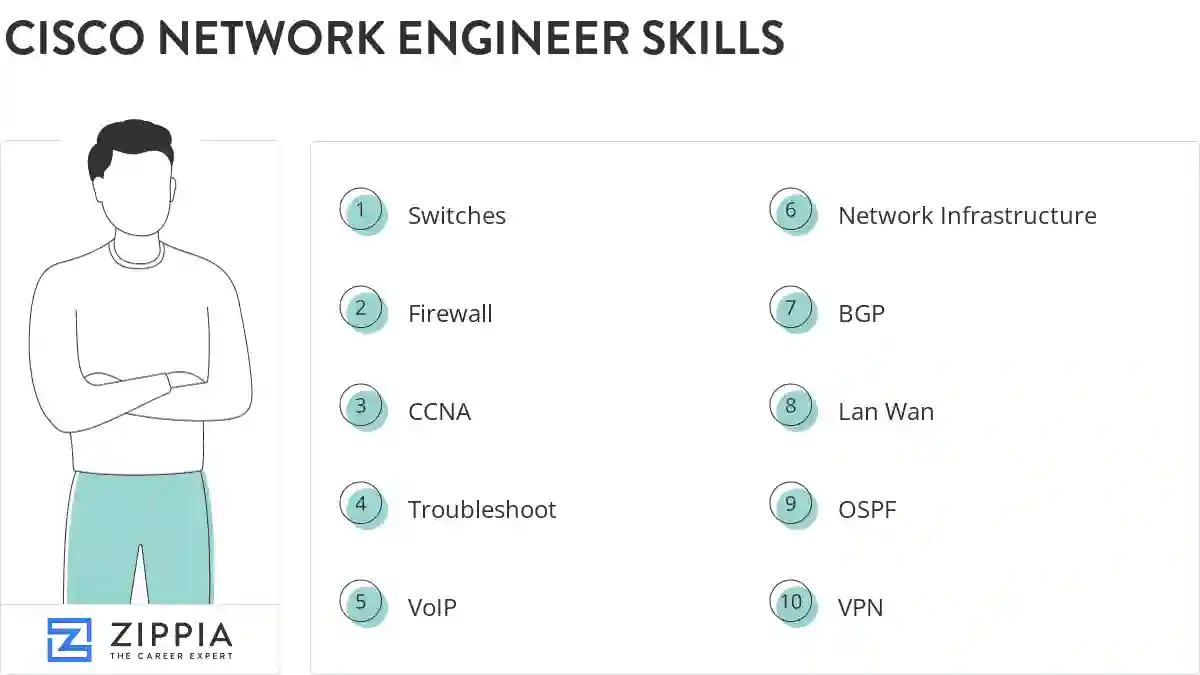
The most important skills for a cisco network engineer resume and required skills for a cisco network engineer to have include:
- Switches
- Firewall
- CCNA
- Troubleshoot
- VoIP
- Network Infrastructure
- BGP
- Lan Wan
- OSPF
- VPN
- Nexus
- VMware
- Lan
- IOS
- QoS
- EIGRP
- DNS
- Cisco Asa
- Unity
- F5
- Network Devices
- Unified Communications
- ASA
- DHCP
- TCP/IP
- MPLS
- Cisco Ios
- IPSEC
- CUCM
- Load Balancers
- UCCX
- Wireshark
- Catalyst
- Network Performance
- Ethernet
- HSRP
- DMVPN
- Visio
- SNMP
- SAN
- Technical Support
- Juniper
- Series Routers
- NAT
- Virtualization
- Network Issues
- Cisco Ucs
Updated January 8, 2025
