What does a cisco network engineer do?
A Cisco network engineer specializes in designing and developing networks using the Cisco systems. Their responsibilities include meeting with clients to identify their needs and preferences, installing and configuring networks, establishing security protocols, facilitating upgrades, creating test structures for speed and security, and performing software and hardware assessments. They may also conduct maintenance checks and repair networks, providing technical support to staff as needed. Moreover, a Cisco network engineer must oversee and encourage staff to reach goals, all while enforcing the company's policies and regulations.
Cisco network engineer responsibilities
Here are examples of responsibilities from real cisco network engineer resumes:
- Install, configure, design, troubleshoot, manage & maintain hardware & software that comprise the LAN/WAN infrastructure.
- Manage, operate and analyze results from Sourcefire detection systems.
- Support service provider DHCP & DNS products.
- Used Cisco IOS for troubleshooting sites for up and down time.
- Upgrade the remote access (VPN) and firewall environment for the entire organization.
- Configure routing protocol: EIGRP OSPF and redundant protocols like HSRP and some GLBP.iii.
- Experience in routing protocols like OSPF, BGP, and standby protocols like HSRP and VRRP application in the routers
- Configure protocols (TCP/IP, SNMP, SMTP, FTP, IPX/ SPX) to ensure network connectivity.
- Maintain DHCP scopes on domain controllers.
- Maintain Cisco TACACS server and VPN accesses.
- Experience with IPSec, SSL and EZVPN connections.
- Use SPLUNK enterprise for monitoring and analyzing the data.
- Provide technical knowledge and configurations for all Cisco VoIP systems.
- Modify existing ACL's, IPsec and preform network translations.
- Used SPLUNK tool to analyze the logs in the applications.
Cisco network engineer skills and personality traits
We calculated that 8% of Cisco Network Engineers are proficient in Switches, Firewall, and CCNA. They’re also known for soft skills such as Analytical skills, Communication skills, and Problem-solving skills.
We break down the percentage of Cisco Network Engineers that have these skills listed on their resume here:
- Switches, 8%
Configured and troubleshoot Cisco Routers and Switches on Physical layer and network layer issues and try to diagnose the issue.
- Firewall, 6%
Designed perimeter security policy by Implementing Firewall ACL's Allowed access to specified services.
- CCNA, 5%
Configured labs and provided Cisco CCNA training to classes of up to 12 IT professionals.
- Troubleshoot, 4%
Provide technology support services: Troubleshoot, maintain, upgrade, and provide solutions to complex hardware/software problems.
- VoIP, 4%
Designed & Developed VoIP network using Cisco Unified Communications Manager.
- Network Infrastructure, 4%
Design and implemented network infrastructure and configured all the network Infrastructure devices including Network Printers and Registers
Common skills that a cisco network engineer uses to do their job include "switches," "firewall," and "ccna." You can find details on the most important cisco network engineer responsibilities below.
Analytical skills. One of the key soft skills for a cisco network engineer to have is analytical skills. You can see how this relates to what cisco network engineers do because "administrators need to evaluate networks and systems to make sure that they perform reliably and to anticipate new requirements as customers’ needs change." Additionally, a cisco network engineer resume shows how cisco network engineers use analytical skills: "utilize analytical skills to isolate/identify problems related to lan/wan slow response, routing issues, spanning-tree, ios bugs, etc. "
Communication skills. Another essential skill to perform cisco network engineer duties is communication skills. Cisco network engineers responsibilities require that "administrators must describe problems and their solutions to non-it workers." Cisco network engineers also use communication skills in their role according to a real resume snippet: "configure, troubleshooting, maintain and support for cisco unified communications manager, unity. "
Problem-solving skills. This is an important skill for cisco network engineers to perform their duties. For an example of how cisco network engineer responsibilities depend on this skill, consider that "administrators must quickly resolve problems that arise with computer networks." This excerpt from a resume also shows how vital it is to everyday roles and responsibilities of a cisco network engineer: "designed ip telephony solutions for 200 users using cisco callmanager 4.x and unity 4.x implement sip trunk for toll by pass. ".
The three companies that hire the most cisco network engineers are:
- Motion Recruitment5 cisco network engineers jobs
- TWO95 International4 cisco network engineers jobs
- General Dynamics3 cisco network engineers jobs
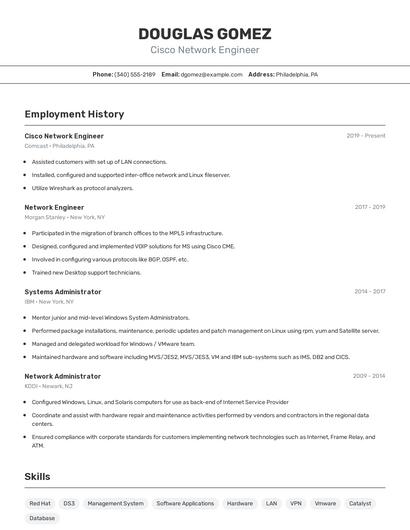
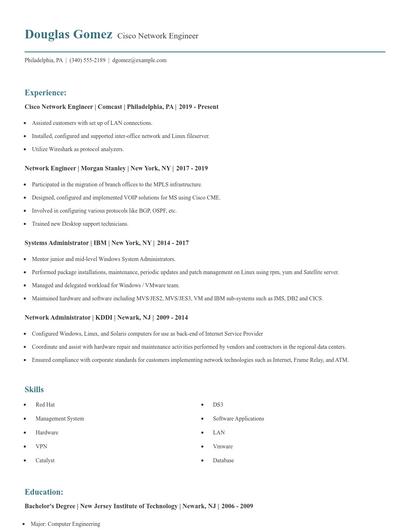
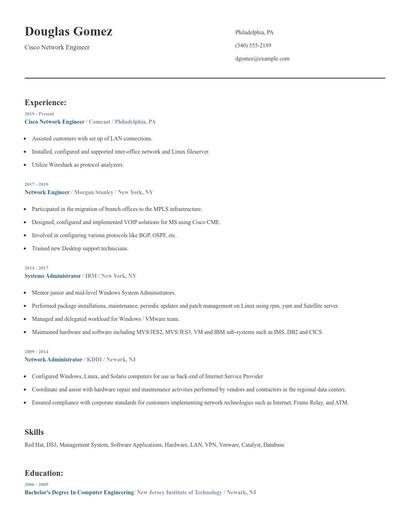
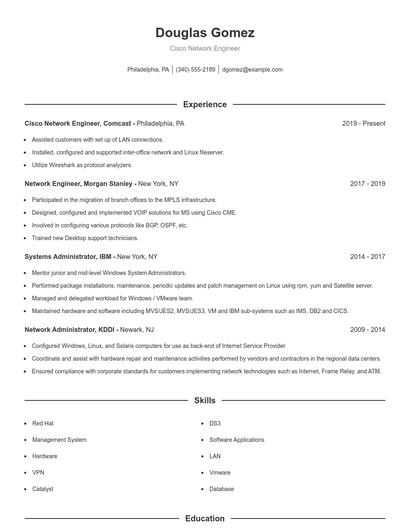
Choose from 10+ customizable cisco network engineer resume templates
Build a professional cisco network engineer resume in minutes. Our AI resume writing assistant will guide you through every step of the process, and you can choose from 10+ resume templates to create your cisco network engineer resume.




Compare different cisco network engineers
Cisco network engineer vs. Administrator
Administrators are administrative professionals who oversee the whole office or department. They manage office activities and supervise administrative functions in the office. They work the office calendar and oversee the appointment-setting process. They coordinate office events and ensure that all preparations are made and that there are no conflicting schedules. They also maintain a database of external providers of various office needs. Administrators also oversee office supplies and prepare purchase requisitions. They also manage janitorial services and other functions that are related to the maintenance of the physical office space. Administrators ensure that all fixtures and equipment in the office are functioning well and have no problems.
These skill sets are where the common ground ends though. The responsibilities of a cisco network engineer are more likely to require skills like "switches," "firewall," "ccna," and "voip." On the other hand, a job as an administrator requires skills like "customer service," "data entry," "payroll," and "financial reports." As you can see, what employees do in each career varies considerably.
Administrators earn the highest salaries when working in the manufacturing industry, with an average yearly salary of $78,798. On the other hand, cisco network engineers are paid more in the technology industry with an average salary of $100,431.On average, administrators reach similar levels of education than cisco network engineers. Administrators are 1.6% more likely to earn a Master's Degree and 1.2% more likely to graduate with a Doctoral Degree.Cisco network engineer vs. Network support analyst
Network support analysts are professionals who provide technical support as well as maintain various network components for an organization's network system. These analysts are responsible for installing and configuring local area networks (LANs), wide area networks (WANs), internet systems, and other components of network systems. They are required to monitor the performance of networks and systems and align network use and access by using master consoles. Network support analysts must also organize and deploy security measures for the network so that they can safeguard software, hardware, and data.
In addition to the difference in salary, there are some other key differences worth noting. For example, cisco network engineer responsibilities are more likely to require skills like "ccna," "nexus," "qos," and "unity." Meanwhile, a network support analyst has duties that require skills in areas such as "routers," "problem resolution," "windows server," and "network security." These differences highlight just how different the day-to-day in each role looks.
On average, network support analysts earn a lower salary than cisco network engineers. Some industries support higher salaries in each profession. Interestingly enough, network support analysts earn the most pay in the technology industry with an average salary of $98,644. Whereas cisco network engineers have higher pay in the technology industry, with an average salary of $100,431.In general, network support analysts achieve similar levels of education than cisco network engineers. They're 2.6% less likely to obtain a Master's Degree while being 1.2% more likely to earn a Doctoral Degree.Cisco network engineer vs. Network operation technician
A network operation technician is responsible for providing technical assistance with computer network issues. Network operation technicians repair and troubleshoot networks and routers, identifying the source of defects by listening to the customers and determining step-by-step guidelines for resolution. They also configure servers to optimize the network's performance and recommend strategies to improve the system's infrastructure. A network operation technician must have excellent organizational and technical skills, especially in explaining the network problems to the customers and addressing preventive maintenance.
The required skills of the two careers differ considerably. For example, cisco network engineers are more likely to have skills like "firewall," "ccna," "nexus," and "ios." But a network operation technician is more likely to have skills like "network operations," "customer service," "routers," and "trouble tickets."
Network operation technicians earn the best pay in the retail industry, where they command an average salary of $74,614. Cisco network engineers earn the highest pay from the technology industry, with an average salary of $100,431.When it comes to education, network operation technicians tend to earn similar degree levels compared to cisco network engineers. In fact, they're 4.6% less likely to earn a Master's Degree, and 0.2% less likely to graduate with a Doctoral Degree.Cisco network engineer vs. Network support technician
A network support technician specializes in optimizing a company's information technology (IT) networks for a smooth and efficient workflow. Their responsibilities revolve around addressing issues and concerns, troubleshooting, installing systems, executing upgrades, conducting diagnostic tests, and performing corrective measures as needed. They must also coordinate with staff in developing new IT systems, evaluate existing networks for areas needing improvement, and develop protocols while adhering to the company's policies and regulations. Furthermore, as a network support technician, it is essential to maintain regular network maintenance checks to ensure the security and safety of company data.
Even though a few skill sets overlap between cisco network engineers and network support technicians, there are some differences that are important to note. For one, a cisco network engineer might have more use for skills like "firewall," "ccna," "bgp," and "nexus." Meanwhile, some responsibilities of network support technicians require skills like "customer service," "provides technical support," "desk support," and "os. "
The technology industry tends to pay the highest salaries for network support technicians, with average annual pay of $48,633. Comparatively, the highest cisco network engineer annual salary comes from the technology industry.The average resume of network support technicians showed that they earn lower levels of education compared to cisco network engineers. So much so that theyacirc;euro;trade;re 6.3% less likely to earn a Master's Degree and more likely to earn a Doctoral Degree by 0.3%.Types of cisco network engineer
Updated January 8, 2025
