
Automatically apply for jobs with Zippia
Upload your resume to get started.
Classification counselor skills for your resume and career
13 classification counselor skills for your resume and career
1. Community Resources
Community resources are a set of resources that are used in the day to day life of people which improves their lifestyle in some way. People, sites or houses, and population assistance can come under the services offered by community resources.
- Collaborated with community resources and D.O.C staff to promote successful re-entry and transition of offenders to the community.
- Conducted assessments and developed individualized treatment plans and discharge planning; prepared thorough documentation and established communication with other community resources.
2. Incident Reports
An Incident Report, in a medical facility such as hospitals and nursing homes, is a type of paperwork filled out immediately after and in the case of an incident of some sort, with the goal of describing the incident and its consequences, as well as the measurements taken after or during the incident, as well as any other information relevant to said incident. Such an incident might be a patient acting out or a patient being injured.
- Write correspondence, infractions and incident reports.
- Analyzed written incident reports and disciplinary reports from Correctional Officers for accuracy regarding the nature of the offense and recommended sanctions.
3. Mental Health
Mental health is the state of wellbeing in which an individual can cope with the regular stresses and tensions of life, and can work productively without having any emotional or psychological breakdown. Mental health is essential for a person of any age and helps them make the right decisions in their life.
- Review infraction behavior, institutional adjustment and overall mental health for classification for lower levels of custody.
- Identified mental health, substance abuse, medical health and behaviors problems by interviewing, observing and documenting client's behavior.
4. Criminal Justice
- Participated in a eight week intensive criminal justice training as a condition of employment.
- Recommend treatment plan for clients to program manager and criminal justice officials.
5. Crisis Situations
- Provided suicide prevention counseling to callers experiencing crisis situations by demonstrating empathy, poise, and exceptional communication skills.
- Managed crisis situations using the least restrictive interventions, and implementing behavior management programs/techniques and appropriate intervention techniques.
6. Emergency Situations
- Work under pressure; respond effectively to emergency situations.
- Developed critical thinking skills in emergency situations.
7. Substance Abuse
- Developed and implemented an extra intensive out-patient program for individuals struggling with repeated relapses while in out-patient treatment for substance abuse.
- Facilitate individual and group substance abuse treatment and opiate specific treatment programs, completed individualized treatment plans and daily progress note.
8. Risk Assessments
The process of analyzing and identifying the acts or events that have the potential to negatively affect an individual, asset, or business is called risk assessment. Risk assessments are important because they form an integral part of an organization as well as occupational safety plans
- Completed security risk assessments and made referrals to medical or psychological services as appropriate.
9. NCIC
- Conducted National Crime Center Information Checks (NCIC) on visitors.
10. Adjustment Problems
- Provided individualcounseling to detainee on an informal basis regarding work and housing assignments, adjustment problems and family problems.
12. Background Checks
- Conducted criminal background checks to help determine supervision level.
13. Prea
- Provided orientation/ Prison Rape Elimination Act (PREA) classes to offenders as needed.
- Conducted new inmate orientation including serving as a PREA educator for the unit.

What skills help Classification Counselors find jobs?
Tell us what job you are looking for, we’ll show you what skills employers want.
What type of skills will young classification counselors need?
Dr. Thomas Dearden Ph.D.
Assistant Professor of Sociology, Virginia Polytechnic Institute and State University
What soft skills should all classification counselors possess?
Kacie Blalock Ph.D.
Associate Professor; Director, Master of Counseling, Louisiana State University at Shreveport
List of classification counselor skills to add to your resume
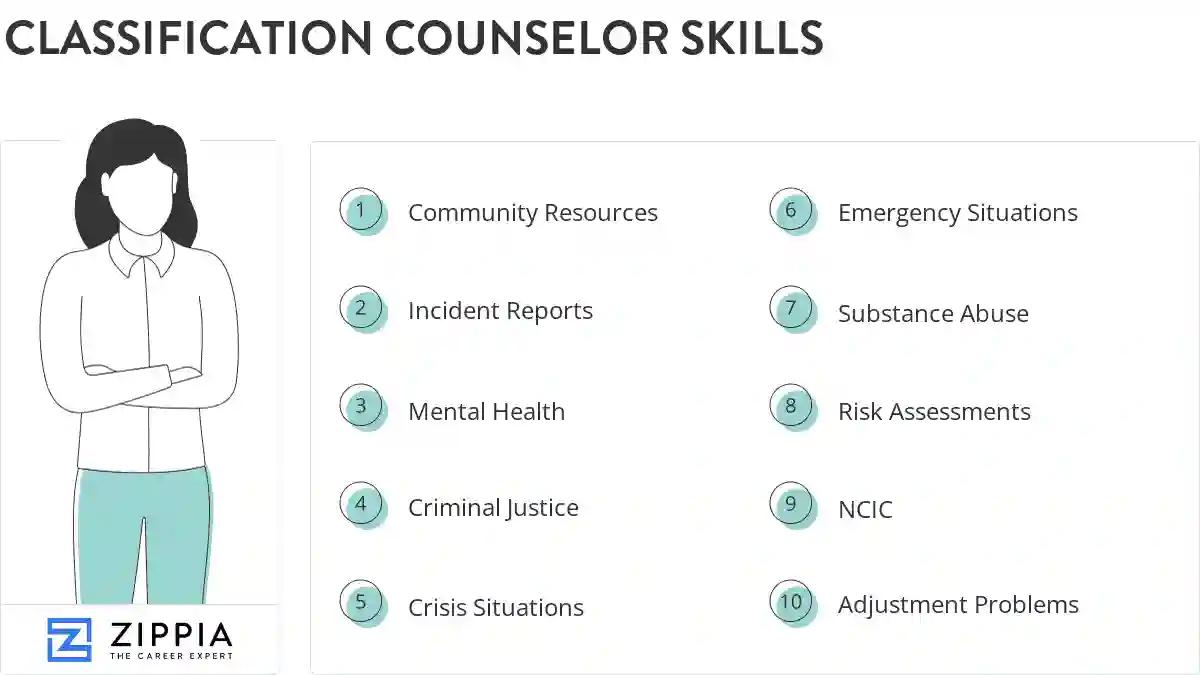
The most important skills for a classification counselor resume and required skills for a classification counselor to have include:
- Community Resources
- Incident Reports
- Mental Health
- Criminal Justice
- Crisis Situations
- Emergency Situations
- Substance Abuse
- Risk Assessments
- NCIC
- Adjustment Problems
- Social Behavior
- Background Checks
- Prea
Updated January 8, 2025

11. Social Behavior