
Automatically apply for jobs with Zippia
Upload your resume to get started.
Code clerk skills for your resume and career
15 code clerk skills for your resume and career
1. Patients
- Retrieved patients' information from internal system, distributed proper reports to physicians and other materials to corresponding departments.
- Ensured patients had referrals for physician reimbursements.
2. Data Entry
Data entry means entering data into a company's system with the help of a keyboard. A person responsible for entering data may also be asked to verify the authenticity of the data being entered. A person doing data entry must pay great attention to tiny details.
- Encoded criminal charges according to appropriate National Crime Information Center codes; performed data entry
- Trained company in Kingston Jamaica to do coding and data entry for Dun & Bradstreet.
3. CPT
CPT is a medical term that stands for Current Procedural Terminology. Whenever a procedure like surgery or diagnosis occurs or some other medical service is rendered to a patient, it is reported to the concerned physician, insurance company, or organization. The aforementioned practice is widely referred to as CPT.
- Enter hospital charges ensuring correct CPT and ICD9 codes.
- Code medical encounters using ICD-9 and CPT codes.
4. EMR
- Maintained medical records, which included, scanning documents into the EMR and prepare medical record requests.
- Entered and updated patient information into electronics medical records (EMR) database, prepared chart paperwork.
5. Medicaid
- Billed commercial insurance, Medicare, Medicaid and Workman's Compensation claims.
- Specialized in submission of Medicaid and Medicare claims to insurance.
6. Computer System
- Prepare all docs to be scanned and indexed into computer system.
- Input Codes on Computer System for individual client policies.
Choose from 10+ customizable code clerk resume templates
Build a professional code clerk resume in minutes. Our AI resume writing assistant will guide you through every step of the process, and you can choose from 10+ resume templates to create your code clerk resume.7. Scheduling Appointments
Scheduling appointments is the practice of finding a free slot with the person(s) you want to meet. The process of scheduling appointments involves finding mutually free time, negotiating follow-ups, sending reminders, and creating new appointments. Scheduling appointments is important to ensure that the timings of consecutive meetings do not clash with each other.
- Provided customer assistance by answering phones, scheduling appointments and product selection.
- Performed receptionist duties by answering telephones, scheduling appointments, typing, and filing; created an efficient filing system.
8. ICD-10
- Assured coding was accurate according to ICD-10 Standards and maintain industry standards of coding, billing, and payment posting.
- Worked closely with three psychologist in this field submitted CMS-1500 claims, frequently used ICD-10 CM transcribing records for doctors.
9. Medical Charts
- Prepped and organized medical charts according to hospital regulations.
- Operated the telephone system by taking requests for medical charts Delegated tasks to co-workers and coordinated workflow Scanned records into hospital database
10. Front Desk
- Assisted customers via phone and at the front desk with basic release of information.
- Coordinate front desk operations including verifying financial information and registration of patients.
11. EOB
EOB stands for explanation of benefits. This is a common outline provided as part of many health insurance plans to explain what services were completed, the co-pay required for each appointment, and how much of your payment is covered by health insurance. EOB is an indication that your insurance claim has already been processed.
- Posted all hospital charges, Worked all hospital billing EOB'S, Verified Insurance, Obtained referrals for studies/visits when required.
- Review all incoming Explanations of Benefits (EOB's) log and fax for posting of payments.
12. Insurance Policies
- Issue and mail insurance policies.
- Compiled records of insurance policies covering risks to property and equipment of industrial organization.
13. Diagnosis Codes
- Examined diagnosis codes for accuracy, completeness, specificity and appropriateness according to services rendered.
- Examined diagnosis codes for accuracy, completeness, specificity and appropriateness according to services rendered.
14. HIPAA
- Attended HIPAA and Medicare meetings.
- Demonstrated superb ability to work with confidential and sensitive information adhering to HIPAA privacy rules compliance and internal organizational policies.
15. Patient Accounts
Patient accounts are a part of a hospital information system that is used for storing financial data, keeping a record of healthcare costs, and providing information regarding patient billing. It deals with the financial aspects of the healthcare setting.
- Post all payments and charges to patient accounts.
- Researched AR reports for refunding overpayments on patient accounts.
5 Code Clerk resume examples
Build a professional code clerk resume in minutes. Browse through our resume examples to identify the best way to word your resume. Then choose from 5+ resume templates to create your code clerk resume.

What skills help Code Clerks find jobs?
Tell us what job you are looking for, we’ll show you what skills employers want.
List of code clerk skills to add to your resume
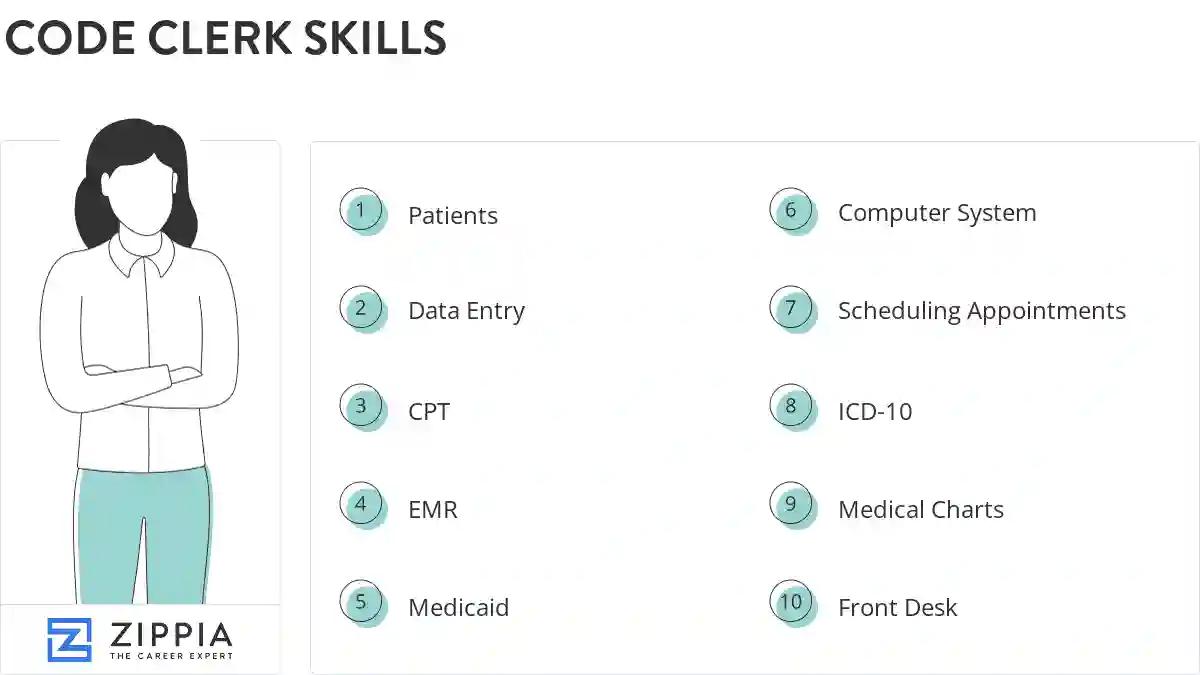
The most important skills for a code clerk resume and required skills for a code clerk to have include:
- Patients
- Data Entry
- CPT
- EMR
- Medicaid
- Computer System
- Scheduling Appointments
- ICD-10
- Medical Charts
- Front Desk
- EOB
- Insurance Policies
- Diagnosis Codes
- HIPAA
- Patient Accounts
- Insurance Claims
- Patient Data
- Procedure Codes
- Insurance Payments
- Hippa
- ICD-9-CM
- Patient Charts
- Insurance Coverage
- Insurance Verification
- Unpaid Claims
- Medical Billing
- Word Processing
- Medical Data
- Telephone Calls
Updated January 8, 2025
