
Automatically apply for jobs with Zippia
Upload your resume to get started.
Commodity trader skills for your resume and career
15 commodity trader skills for your resume and career
1. Commodities
- Developed organic business within Cereal Byproducts; including the purchase and sale or organic commodities and maintaining proper certification compliance.
- Managed procurement and sales of bulk grains and agricultural commodities for redistribution into local dairy operations in Idaho.
2. Commodity Trading
- Opened a commodity trading firm in Chicago, IL.
- Discussed suitability of commodity trading with prospects depending on experience and financial situation.
3. Logistics
Logistics is a complete organization and implementation of a problem. Logistics are often considered in a complex business operation, as some works need detailed plannings. Logistics are also used in military action.
- Coordinated rail logistics of inbound products into trans-loading facilities in Southern Idaho.
- Administered the logistics of all international orders (Air, Ocean, Rail and Inland).
4. Market Trends
- Monitored daily forecast of market trends for national partners to advise and capitalize on profitable purchases and new business opportunities.
- Maintained awareness in current world grain market trends, economic factors, and financial developments to effectively determine changes or adjustments.
5. Derivative
- Open outcry market maker on The New York Board of Trade, providing liquidity to soft commodity derivative markets.
- Structured, priced, and traded derivative transactions for risk management of flagship Alpha Fund.
6. Financial Markets
Fіnаnсіаl mаrkеtѕ еnсоmраѕѕ аnу рlасе оr system thаt allows buyers аnd sellers tо trаdе financial іnѕtrumеntѕ, including bоndѕ, stocks, еԛuіtіеѕ, ѕесurіtіеѕ, foreign еxсhаngе, derivatives, rаw materials, and рrесіоuѕ metals. It serves аѕ an іntеrmеdіаrу bеtwееn іnvеѕtоrѕ аnd thе соllесtоr by mоbіlіzіng саріtаl bеtwееn thеm.
- Operated computer system connected directly to financial markets overseas to generate profit by buying and selling during overnight hours.
- Assessed macroeconomic environment and daily events to determine impact on volatile financial markets and technology stocks.
Choose from 10+ customizable commodity trader resume templates
Build a professional commodity trader resume in minutes. Our AI resume writing assistant will guide you through every step of the process, and you can choose from 10+ resume templates to create your commodity trader resume.7. Macro
- Performed technical analysis of micro and macro trends in commodity supply, demand, and price.
- Traded arbitrage, macro, and theme oriented biases.
8. VBA
Visual Basic for Applications or, as it is commonly shortened to, VBA is a certain method of using Microsoft's event-driven programming language known as Visual Basic.
- Automated the trade allocation and reconciliation procedures using VBA programming which is leveraged to systematically detect any trade breaks or discrepancies.
- Review financial statements, conduct analysis of financial data, and develop detailed spreadsheets (VBA) to identify trends.
9. Commodity Markets
- Researched currency and commodity markets using historical databases and customized computer research tools.
- Analyzed the Commodity Markets to ensure full customer service and account maximization.
10. Technical Analysis
Technical analysis forecasts movements in finance instruments such as stock prices and investment opportunities using past data, charts, and statistics. This method contrasts with fundamental analysis which focus more on a company or investment's current financial situation.
- Established spread and scalped positions based on strategic technical analysis indicators.
- Traded through tailored technical analysis indicators and feel-based trading.
11. Market Analysis
- Performed extensive market analysis and developed strategic long and short positions within the markets.
- Implemented in-house competitive market analysis tool based on raw data extraction from U.S. customs records.
12. Crude Oil
- Worked with traders in coffee, sugar, cocoa, cotton, crude oil, copper, and silver.
- Trade commodity futures in light sweet crude oil, natural gas, heating oil, and RBOB gasoline.
13. Risk Management Strategies
- Advised upstream and downstream clients on hedging and risk management strategies in soft commodity space.
- Developed risk management strategies using futures, options and spreads to mitigate and manage risk.
14. Trade Execution
Trade execution refers to the process of completing or fulfilling an order. This does not occur when a client places the order but instead when the trade, whether for a purchased product or property, is finalized. This often takes place in investing firms where an investor contacts a broker to trade stocks with another company.
- Achieved optimal trade execution by establishing strong relationships with floor brokers.
- Managed trading account through risk management, trade execution, and analysis.
15. Arbitrage
- Created unique, highly successful trading methodology for off-floor trading utilizing momentum, pairs and statistical arbitrage techniques.
- Managed and executed physical/financial grains book as well as base metal arbitrage portfolio.
5 Commodity Trader resume examples
Build a professional commodity trader resume in minutes. Browse through our resume examples to identify the best way to word your resume. Then choose from 5+ resume templates to create your commodity trader resume.

What skills help Commodity Traders find jobs?
Tell us what job you are looking for, we’ll show you what skills employers want.
List of commodity trader skills to add to your resume
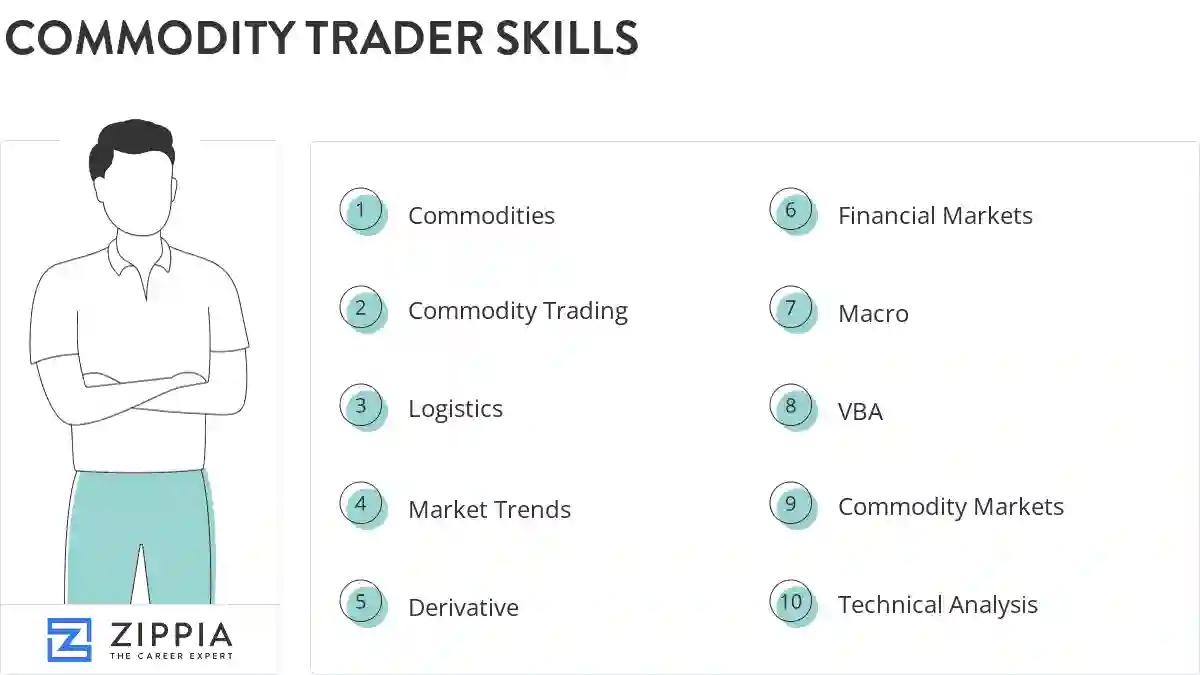
The most important skills for a commodity trader resume and required skills for a commodity trader to have include:
- Commodities
- Commodity Trading
- Logistics
- Market Trends
- Derivative
- Financial Markets
- Macro
- VBA
- Commodity Markets
- Technical Analysis
- Market Analysis
- Crude Oil
- Risk Management Strategies
- Trade Execution
- Arbitrage
- Global Markets
- Business Relationships
- Fundamental Analysis
- Market Data
- Equities
- Algorithmic Trading
- Relative Value
- Bloomberg
- Futures Contracts
- CME
- Buy Side
- Commodity Futures
- Foreign Currencies
- Economic Data
- FX
- Customer Relationships
- Nymex
- Futures Markets
- Cbot
- Cold Calls
- Historical Data
- Customer Accounts
- Client Relationships
- Client Accounts
- Comex
- Customer Orders
- Market Knowledge
- ETF
- Market Making
- Market Reports
Updated January 8, 2025
