
Automatically apply for jobs with Zippia
Upload your resume to get started.
Communicator skills for your resume and career
15 communicator skills for your resume and career
1. Customer Service
Customer service is the process of offering assistance to all the current and potential customers -- answering questions, fixing problems, and providing excellent service. The main goal of customer service is to build a strong relationship with the customers so that they keep coming back for more business.
- Deliver High Quality Customer Service.
- Answered calls for customer service and assisted with information such as flight times, restaurant and store locations throughout the airport.
2. Outbound Calls
An outbound call is made by the call center representative to the customers on behalf of the company. Such calls help increase sales and generate revenue for the organization.
- Handled inbound cable calls Learned and executed outbound calls Weekly meetings with supervisors about job procedures Made customers installation dates
- Expedited outbound calls to previous and prospective volunteers for various non-profit organizations.
3. Healthcare Professionals
- Provided over the counter product and prescription information for consumers, healthcare professionals and retailers.
- Respond to medical information inquires from healthcare professionals and the public on various products.
4. Telephone Calls
Telephone calls are a communication means through which a caller is connected to the called party. The call is done through a telecommunications device called a telephone. The caller can use a landline, mobile phone, or satellite phone to make the call.
- Answered telephone calls to satisfy the needs of the customers related to the acquisition of merchandise and setting of medical appointments.
- Maintained a record of messages when answering telephone calls, and served walk- ins.
5. Inbound Calls
- Received inbound calls from donors requesting informational pamphlets, ordering materials or contact information.
- Take inbound calls for different Ministries/Charities for donations or to purchase products for the Ministries.
6. CPR
Cardiopulmonary resuscitation or CPR is a medical procedure that involves chest compression to help a patient breathe. This artificial ventilation helps in keeping the brain function in place and regulates blood throughout the body. CPR is a lifesaving procedure that is used in emergencies.
- Give first-aid instructions to emergency callers.Accomplishmentsi received my CPR and First Aide certification.
- Verbalized instructions to citizens on how to perform CPR and other life saving techniques.
Choose from 10+ customizable communicator resume templates
Build a professional communicator resume in minutes. Our AI resume writing assistant will guide you through every step of the process, and you can choose from 10+ resume templates to create your communicator resume.7. EMS
Emergency Medical Services, also known as EMS, is an emergency medical response system that provides stabilization and urgent preclinical and on-site treatment for serious illness and injury, as well as the transportation of patients who are unable to transport themselves to a definite health care center. The main objective of EMS is to provide emergency medical treatment to those who need urgent medical attention and to properly treat the patient's condition and transport them to a suitable health center or medical facility.
- Job Description is dispatching Police, EMS, and Fire units to emergency calls.
- Provide communications from EMS in the field to Medical Command Physicians and receiving facilities.
8. Computer Aided Dispatch
- Operated computer aided dispatch system.
- Take information over the phone from callers and input it into the computer aided dispatch program to begin the dispatch process.
9. CAD
- Log and document calls and complaints into radio log database as well as the CAD system.
- Operate a CAD console equipped with multiple computer terminals, including a mapping program.
10. Non-Emergency Calls
Non-emergency calls are calls that do not require immediate attention or intervention. They are simply a request for police, fire or rescue service that does not present a life or death situation. In this case, the local non-emergency number should be used if immediate dispatch of the police is not required.
- Dispatched appropriate public safety personnel and equipment to emergency and non-emergency calls.
- Receive and process 9-1-1 emergency and non-emergency calls from the public using a specialized telephone system.
11. Non-Profit Organization
A non-profit organization (NPO) is a business that has been granted tax-exempt status by the Internal Revenue Service (IRS) because it serves a social cause and provides a benefit to the public. The organization must serve a social cause whether it is through services, goods, or both.
- Recruited volunteers for non-profit organizations to participate in mailing envelopes to their neighbors for donations.
- Assisted clients with determining whether to renew their volunteering for non-profit organizations.
12. NCIC
- Performed searches for warrants on the local database (TCIC) as well as National database (NCIC).
- Learned how to run information for requesting officers through different programs such as NCIC.
13. Emergency Situations
- Utilized medical training received to provide the proper instruction to callers in emergency situations.
- Notified shift supervisor of emergency situations and kept supervisor notified of major field problems.
14. Data Entry
Data entry means entering data into a company's system with the help of a keyboard. A person responsible for entering data may also be asked to verify the authenticity of the data being entered. A person doing data entry must pay great attention to tiny details.
- Educated potential donors on the benefits of the non-profit, data entry of donor contact information, processing of donor payment.
- Assisted with data entry, running reports and other administrative duties with Loan Analyst and Mortgage Bankers.
15. Law Enforcement
Law enforcement is the task of certain members of the community who work together to uphold the law by identifying, preventing, rehabilitating, or prosecuting others who break society's laws and norms. The phrase refers to the police, the judiciary, and the correctional system.
- Use of local law enforcement and civilian databases to obtain and run background information of citizens.
- Queried and entered information into various law enforcement databases.
5 Communicator resume examples
Build a professional communicator resume in minutes. Browse through our resume examples to identify the best way to word your resume. Then choose from 5+ resume templates to create your communicator resume.

What skills help Communicators find jobs?
Tell us what job you are looking for, we’ll show you what skills employers want.
List of communicator skills to add to your resume
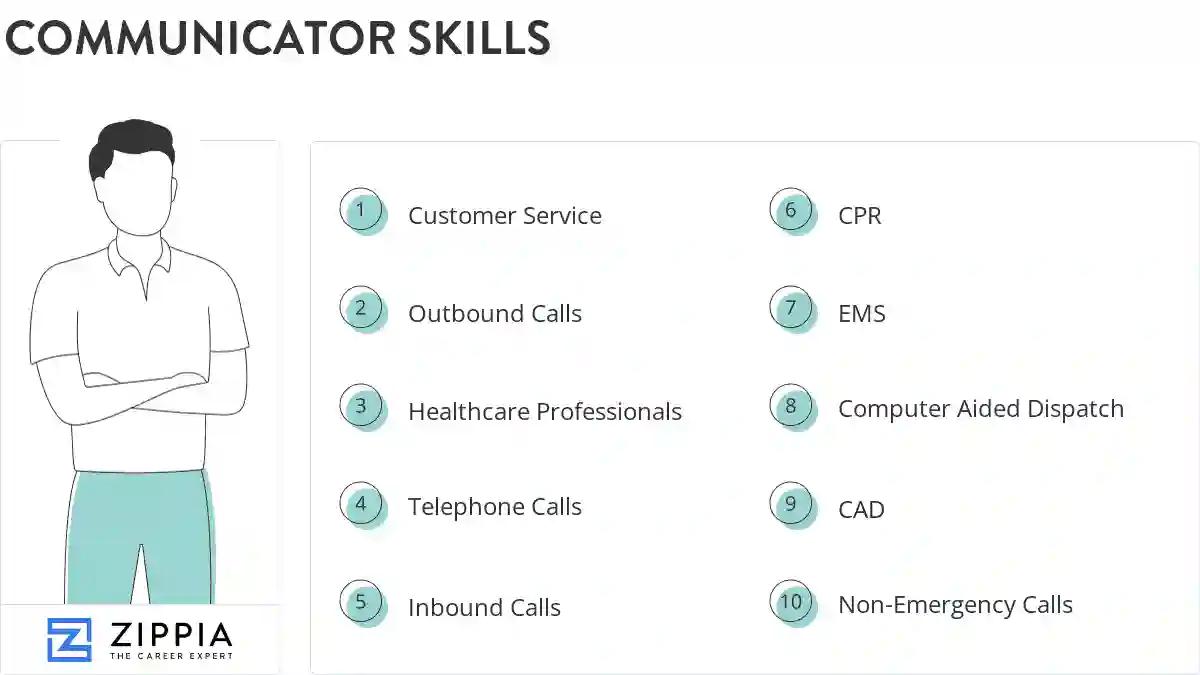
The most important skills for a communicator resume and required skills for a communicator to have include:
- Customer Service
- Outbound Calls
- Healthcare Professionals
- Telephone Calls
- Inbound Calls
- CPR
- EMS
- Computer Aided Dispatch
- CAD
- Non-Emergency Calls
- Non-Profit Organization
- NCIC
- Emergency Situations
- Data Entry
- Law Enforcement
- Product Quality Complaints
- Demographic Data
- NRA
- Alumni
- Outbound Sales
- Sales
- Windows
- Customer Accounts
- Computer Programs
- Cold Calls
- Fund Raising
- Diabetes
- Computer System
- Ambulances
- Problem Solver
- Customer Complaints
- Customer Inquiries
- Fame
- Payment Method
- PowerPoint
- Customer Calls
- Describe Products
- Private Individuals
- Sales Talks
- Customer Issues
Updated January 8, 2025
