
Automatically apply for jobs with Zippia
Upload your resume to get started.
Compensator worker skills for your resume and career
15 compensator worker skills for your resume and career
1. Litigation
- Prepared client files for litigation with discovery, interrogatory findings and reviewed medical records.
- Implement appropriate action plans for medical and indemnity management, and litigation management.
2. Patients
- Issued medical billing for workers compensation patients which required selection and delivery of the required documents.
- Assist patients with reporting/filing/verifying claims with worker's compensation insurance to help expedite approvals and payments.
3. Legal Research
- Perform legal research, including cite-check of judicial filings and computerized legal research.
- Performed legal research and document production.
4. Management System
A management system is a set of policies, processes, and procedures taken by an organization or a business to ensure it can fulfill its tasks and achieve its objectives. A management system makes sure that the company excels financially and improves the user experience. The management system also takes care of the worker's and employees' needs and manages their workload and oversees their performance. Apart from interior matters of the company, a management system also deals with exterior matters like legislations, tax matters, and law issues.
- Coordinated maintenance of online claims management system and interfaced computer systems through Ascension IS department.
- Utilized AIM paperless agency management system.
5. Appeals
- Drafted settlement documentation and Medicare appeals for lien reduction process.
- Reviewed and processed appeals for denied payments
6. Compensation Benefits
- Obtain workers compensation benefits for clients who are not being paid out by insurance companies.
- Receive and respond to liens or other reductions in time-loss compensation benefits by statue.
Choose from 10+ customizable compensator worker resume templates
Build a professional compensator worker resume in minutes. Our AI resume writing assistant will guide you through every step of the process, and you can choose from 10+ resume templates to create your compensator worker resume.7. Workers Compensation Claims
- Calculated and provided wage information for both Unemployment/Workers Compensation claims.
- Investigated and settled workers compensation claims for Chrysler Corporation.
8. Insurance Carriers
- Contacted workers compensation insurance carriers and private insurance companies to obtain authorization for surgery and diagnostic testing.
- Coordinated and communicated with insurance carriers and third party administrators to ensure accurate status of claims.
9. Subpoenas
Subpoenas are formal and legal documents issued mostly by a court or some other government agency that demands the presence of the person the document is addressed to, to show up at court. Subpoenas are issued to individuals whom the court wants to appear either as a witness in a particular case in order to testify or to provide any evidence such as an object or a document.
- Drafted and filed pleadings, handled discovery demands, drafted subpoenas, requested state and federal workers' compensation hearings.
- Directed and coordinated law office activity, including but not limited to the delivery of subpoenas.
10. Medical Treatment
- Monitored all medical treatment for appropriateness; authorized treatment within guidelines of the accepted diagnosis.
- Facilitated medical treatment for Clients, requested and reviewed medical records.
11. Medical Care
- Directed medical management, facilitated RTW through alternative work duties until return to work full duty and/or discharge from medical care.
- Coordinated and arranged medical care for employees injured on the job.
12. Compensation Insurance
- Worked directly with various insurance agents to obtain accurate information to provide a quote and policy for workers compensation insurance.
- Scheduled patient appointments under workers' compensation insurance department.
13. Party Administrators
- Called Insurers and Third-Party Administrators to collect medical payments.
- Completed injury reports, submitted to third party administrators for acceptance or denial of claims and maintained OSHA logs.
14. Trial Preparation
Trial preparation is the practice of gathering sufficient raw material for a court case. This preparation is done to make the bases of a case stronger by bringing the facts to light in a way that will give the concerned law bodies a better comprehension of the entire scenario. The method for preparing for a case may differ depending upon its nature.
- Document preparation bates stamp, and trial preparation.
- Maintained files, trial preparation, data entry, record keeping; coordinated meetings, depositions, arbitrations
15. Compensation Programs
Compensation programs are the complete packages that detail an organization's employees' salaries, wages, benefits, and terms of payments. Compensation plans may also detail increases for years of service and scheduled raises.
- Full responsibility for the administration of the self-insured workers' compensation program.
- Supported the Office of Workers' Compensation Programs (OWCP) Central Bill Processing Office at the Department of Labor.
5 Compensator Worker resume examples
Build a professional compensator worker resume in minutes. Browse through our resume examples to identify the best way to word your resume. Then choose from 5+ resume templates to create your compensator worker resume.

What skills help Compensator Workers find jobs?
Tell us what job you are looking for, we’ll show you what skills employers want.
List of compensator worker skills to add to your resume
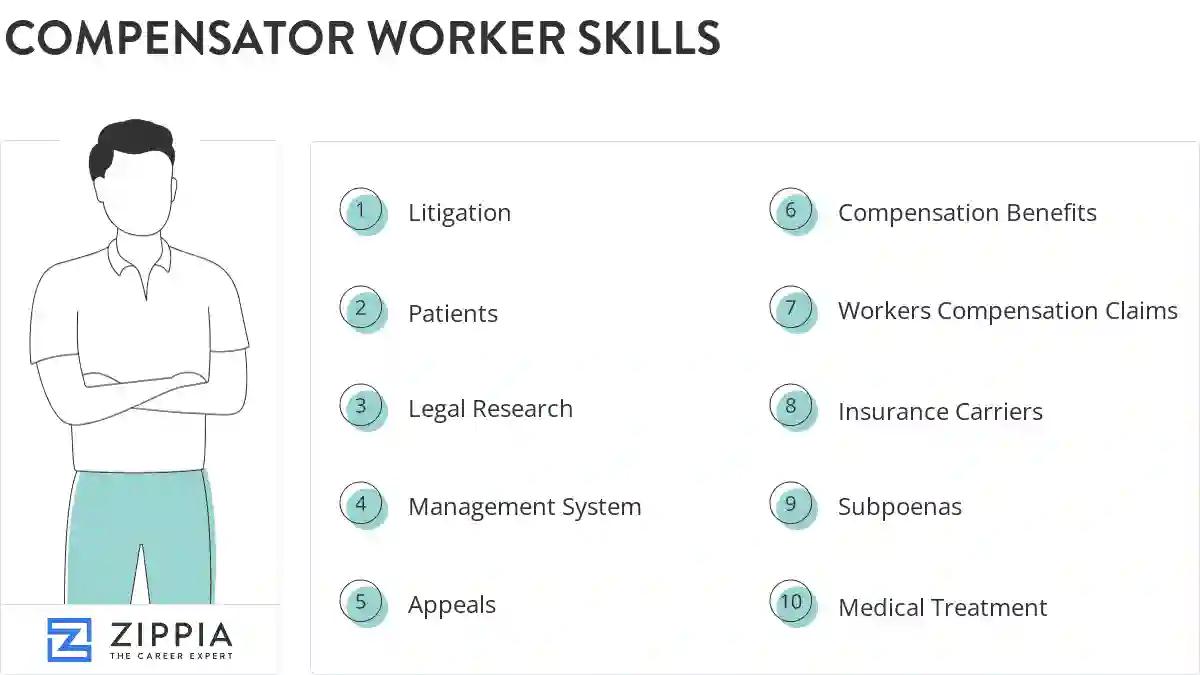
The most important skills for a compensator worker resume and required skills for a compensator worker to have include:
- Litigation
- Patients
- Legal Research
- Management System
- Appeals
- Compensation Benefits
- Workers Compensation Claims
- Insurance Carriers
- Subpoenas
- Medical Treatment
- Medical Care
- Compensation Insurance
- Party Administrators
- Trial Preparation
- Compensation Programs
- Renewal Business
- TPA
- Medical Bills
- Interrogatories
- Insurance Adjusters
- Compensation Board
- CPT
- FMLA
- Medical Reports
- Compensation Cases
- Physical Therapy
- Claims Adjusters
- Eams
- Ncci
- IME
- HR
- DME
- Medical Appointments
- Defense Attorneys
- Claims Handling
- EOB
- Wcab
- A/R
- Settlement Agreements
- Medical Facilities
- Fee Schedules
- Compensation Policies
- Telephone Calls
- Court Dates
- Compensation Commission
- Medicaid
- Legal Correspondence
Updated January 8, 2025
