
Automatically apply for jobs with Zippia
Upload your resume to get started.
Computational linguist skills for your resume and career
15 computational linguist skills for your resume and career
1. Python
Python is a widely-known programming language. It is an object-oriented and all-purpose, coding language that can be used for software development as well as web development.
- Programmed a basic software in Python language that parse a limited sample of tweets and categorize them under different topics.
- Performed unit testing using Python and PyDAQ to measure TTL signal strength being outputted from the Data Acquisition Device.
2. NLP
NLP is an acronym for Neuron-linguistic programming which is the act of using language to change a person's thought pattern and behavioral tendencies towards achieving a goal. It's also an acronym for Natural Language Processing which is the process of making a computer understand human languages whether spoken or written.
- Managed and designed evaluations for various NLP software applications for Machine Translation, Machine Learning and Automated Language Tutoring programs.
- Research and development on distributional semantics, multi-word expression, NLP systems design and implementation, machine learning, and more.
3. Java
Java is a widely-known programming language that was invented in 1995 and is owned by Oracle. It is a server-side language that was created to let app developers "write once, run anywhere". It is easy and simple to learn and use and is powerful, fast, and secure. This object-oriented programming language lets the code be reused that automatically lowers the development cost. Java is specially used for android apps, web and application servers, games, database connections, etc. This programming language is closely related to C++ making it easier for the users to switch between the two.
- Designed object-oriented, pattern-driven Java tools to flexibly manage scientific data archived to an SQL database.
- Designed and implemented a user-friendly graphical Java application for editing response/susceptibility matrices stored in XML format.
4. Extraction
- Worked as a computational linguist on ISC's natural language processing team, contributing to information extraction (IE) efforts.
- Act as technical liaison to medical equipment manufacturers on issues of system configuration, data management and data extraction.
5. Perl
A Practical Extraction and Report Language, or simply PERL, is a programming language used for a script intended for syntax. You can see this when a particular web programmer or a junior developer creates a script for servers. It is used to manipulate text and utilize tasks such as web development, programming, and system administration.
- Developed public web pages using HTML and Perl.
- Help script some of the in-house tools created using Perl & Bash.
6. Data Analysis
- Developed a new data analysis technique which added a new dimension to data interpretation.
- Perform data analysis in collaboration with senior team members.
7. Linux
Linux is a Unix-like operating system. Just like Windows, Mac OS, and IOS, Linux is an operating system used by millions across the globe. Android itself is powered by the Linux operating system. Linux manages all the hardware resources that are associated with your computer. The software is famous because of the protection it grants from viruses, malware, and crashes. The Linux operating system is entirely free and is an open-source software meaning it can be altered by those equipped with the knowledge to code.
- Administered a Linux system utilized by staff for data formatting and manipulation.
- Ported the entire core product from BeOS to Linux as BeOS had become an unsupported operating system.
8. Entity Recognition
- Named Entity Recognition - Developed rules for finding legal citations in proprietary legal corpus.
9. SQL
- Developed data visualization dashboard and wrote SQL scripts to track vendor metrics.
- Managed developers and collaborated with developers in the Richardson, TX office to maintain and support CAD data using SQL RDBMS.
10. Foreign Language
A foreign language is a language that is not the official language spoken in a given state or country. It's a language that is native to another country but can be studied in addition to one's native language as a means of fostering international relationships among countries.
- Worked on the human factors and ergonomic issues in using the standard English keyboard for foreign languages.
- Transcribed foreign language accents for a project in the Artificial Intelligence Department
11. API
- Created modules for medication NER, including ontology creation using RxNorm web services and baseline comparison using the NCBO annotator API.
- Developed web API for simulating protein interactions.
12. Visualization
- Designed and developed data mining and information visualization techniques for visually analyzing students' discussion activities data.
- Developed interactive visualization components for a chemistry tutoring system in HTML/CSS.
13. Unix
UNIX is a computer operating system that was first created in the 1960s and has been constantly updated since then. The operating system refers to the set of programs that enable a machine to function. It is a multi-user, multi-tasking device that works on computers, laptops, and servers. UNIX systems also have a graphical user interface (GUI), similar to Microsoft Windows, that makes it simple to use.
- Configured and tested AUTOCAD under Digital Unix; created a UNIX daemon to recycle program log files and users log files.
- Assist EDP team in developing and maintaining several applications under UNIX, C, and Unify 4.0.
14. Debugging
- Provided support (testing and debugging) for the operating system written for the communications project.
- Provided support (design, testing and debugging) for DSD designed assembler communications software.
15. Regression
- Designed and implemented modular software system in C++ for general classification and regression analysis.
- Program development of multiple linear regression models of current and wind data in the New York Bight.

What skills help Computational Linguists find jobs?
Tell us what job you are looking for, we’ll show you what skills employers want.
What skills stand out on computational linguist resumes?
Jennifer Cramer
Associate Professor and Chair, University of Kentucky
What soft skills should all computational linguists possess?
Jennifer Cramer
Associate Professor and Chair, University of Kentucky
What hard/technical skills are most important for computational linguists?
Jennifer Cramer
Associate Professor and Chair, University of Kentucky
List of computational linguist skills to add to your resume
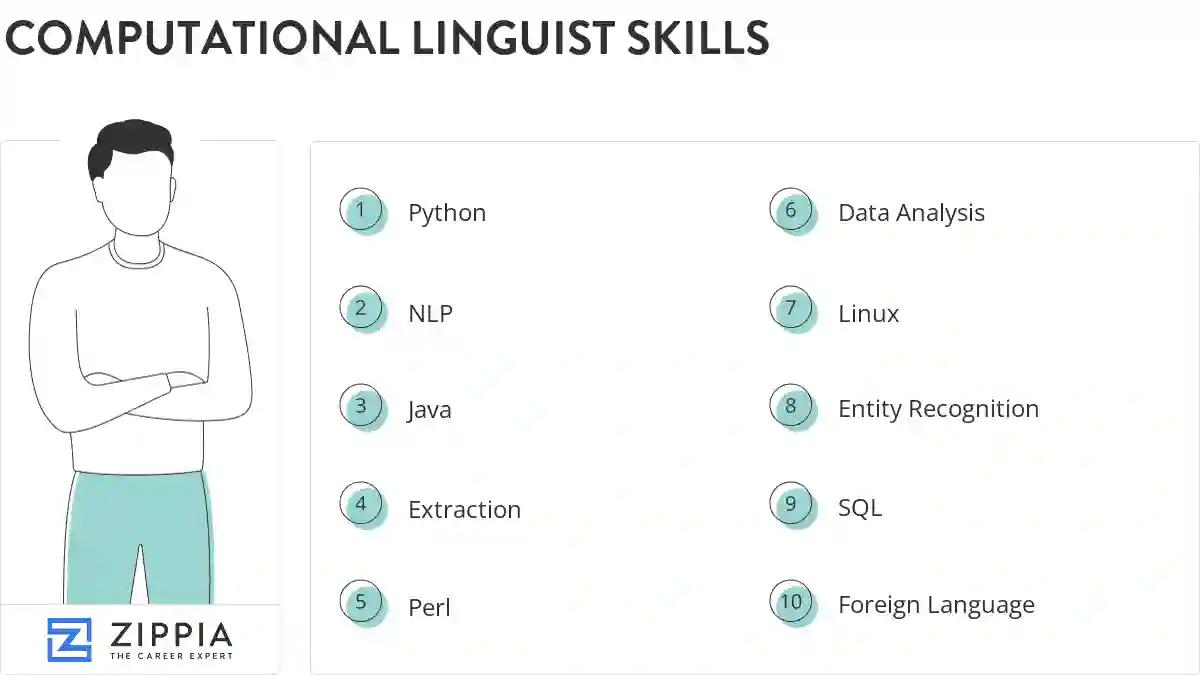
The most important skills for a computational linguist resume and required skills for a computational linguist to have include:
- Python
- NLP
- Java
- Extraction
- Perl
- Data Analysis
- Linux
- Entity Recognition
- SQL
- Foreign Language
- API
- Visualization
- Unix
- Debugging
- Regression
- R
- Machine Learning
Updated January 8, 2025
